Beth Alvarez - Author of Epic Fantasy
  • Exploring Influences: The Elder Scrolls IV: Oblivion

    Oh boy, where to even begin with this one?

    Oblivion and I have an interesting history. I mentioned previously that I didn’t have much interest in the game. It never looked like something I’d enjoy, but a large part of that is because the game’s coverage really only showed it in first-person.

    Me and first-person games don’t get along. It might be something to do with my depth perception, or maybe just that I like the disconnect of being someone else when I’m playing a game, and the Elder Scrolls games didn’t seem to do that. That, of course, was a mistaken impression on my part. Once my husband told me there was a third-person view, I was willing to give it a shot.

    The world presented to us in Oblivion, which is the fourth installment of the Elder Scrolls series, is huge. The game takes place in Cyrodiil, a country divided into several smaller provinces. Each province has its own stories, its own citizens, its own problems. And the world is developed so well that it’s easy to get lost in the lore.

    The game offers a grand number of ruins, caverns and castles to explore, some tied to the numerous storylines that pepper the world, others nothing more than… well, a cave. But each character you encounter can teach you a little more about the world you’re playing in, and if you’re really lucky, you might stumble across a book.

    Books, in a game. Real books! Books about the world’s history, books about armoring, multi-volume encyclopedias of the world’s flora and fauna. Not only that, but there’s a wide variety of fiction to choose from, as well. I couldn’t tell you how many hours I spent in that game, reading books that later found a permanent home on a bookshelf in my virtual house.

    The Elder Scrolls games are well written and well developed, so that the visuals are matched by the grand storytelling that happens throughout. The world is vibrant, it feels like it could exist without you. And that’s an amazing thing. You aren’t in control of the situation, not really; You’re along for a very interesting ride, and that’s a wonderful example of what storytelling should be like.

    In all honesty, Oblivion quickly became one of my favorite games of all time. Much of the world created by Bethesda shows me a reflection of the worlds I’ve created, but best of all, it gives me a great example of how to create a world right.

    Whenever my fantasy novels are complete, I can only hope they live up to the kind of vision Oblivion has helped develop in my head.

    Last week: The Legend of Zelda
    Next week: Legend of Mana

    Save

  • Anime Blues

    In 2011, my husband and I had the good fortune of visiting Anime Blues Con in its debut year. Neither one of us had been to a con before, meaning we didn’t know what to expect. We were warned by friends and acquaintances not to get our hopes up, because cons aren’t very good in their first few years.

    Fortunately for us, ABC ended up being a rare exception. Its first year was phenomenal, and while we weren’t able to return for its second year, we were able to attend ABC3 over the weekend this year.

    There’s something special about conventions. So many happy people, so many instant friendships forming as you walk the halls and ask people in costume (known as cosplayers, for those unfamiliar with the hobby) for pictures. It’s a warm environment with a sense of camaraderie. And for good reason, since conventions present a unique opportunity for people with unusual interests to simply be themselves.

    Regardless of how popular things like super heroes and video games have become in recent years, there’s still a lingering social stigma against those society deems to be nerds and geeks. Conventions throw those stigmas out the window, the one time of year it’s not only okay, but actually encouraged for people to wear their favorite video game T-shirt, or go out in full medieval garb. They’re among like-minded people, people who won’t judge or laugh, people who will praise their efforts to recreate a favorite character’s completely impractical outfit.

    And that’s a beautiful thing.

    Have you ever had the opportunity to attend a convention? Which one?

  • Friday Photo Break, vol. 20

    Purple toadflax. What an unfortunate name for a pretty wildflower.

  • To the con!

    As some of you may know, I’ll be busy attending a convention this weekend. As a result, there won’t be any updates to my series of posts on sources of inspiration today.
    The feature will return next Thursday, and be sure to check in after that to hear all about the convention!

  • I Don’t Like Doctor Who

    There. I said it. Now you can judge me, point and laugh, try to tell me that I’m wrong and that I have to change my mind. I’m sorry, but it’s not going to change.

    I wanted to like the series. I really did. I listen to all my friends gushing about it and how wonderful it is. But I don’t like it.

    I don’t get what all the fuss is about. Maybe I don’t ‘get’ British television. Well, no, that can’t be it – I’ve always liked Monty Python, so what gives? I’ve tried watching my friends’ favorite episodes, but I can’t get into it. I don’t hate the program, mind you, I just don’t see the point.  All I see is lousy acting, mediocre writing, and special effects that look like something my younger siblings put together for the comedy tape they used to work on filming.

    And I’m okay with campy acting and bad effects. Really! Army of Darkness is one of my favorite movies. But Army of Darkness is only an hour and a half of camp. Not 750+ episodes spanning the course of fifty years.

    Right now, this is a difficult phase for me because Doctor Who is insanely popular. It’s everywhere and everyone loves it, except for me. It’s a bit like standing outside in the rain. I’d love to go inside, but inside doesn’t interest me, and where else is there to go? I know it will eventually stop raining, but for now, wet jeans are very uncomfortable.

  • Friday Photo Break, vol. 19

    A purple iris in the woods at Shelby Farms.

  • Exploring Influences: The Legend of Zelda

    This week, we begin the transition away from books and delve into something else near and dear to my heart: Video games.

    I grew up with an NES in the house, and with that, the gold cartridge that any gamer worth their salt knows all about.

    There’s something special about Zelda games, see – Not just that the first wave of cartridges (and then later, CDs) released come in gold. Zelda was my first foray into a massive, immersive and interactive world.

    With the exception of the latest release (I’m sorry, Skyward Sword, I just can’t love you) I’ve spent countless hours enjoying being drawn into the world of Hyrule again and again. The story itself is straightforward, but each game approaches the same story from a slightly different angle. Time, too, is of an extreme importance to the series. All of the later games feature puzzles where time itself must be manipulated to solve them.

    There is, of course, the small problem of the major time paradox created in Ocarina of Time, but it can be forgiven, since the game was otherwise just so darn good.

    You see, Zelda does something I love, but you never see in books: Every game features the same cast of characters. There’s always Link, who always has to rescue Zelda. There’s a persistent bad guy, Ganon, who comes back time after time to try the same scheme. And yet, for all that the same characters are used, the story plays out differently in each setting.

    And why can’t authors re-use beloved characters? Why is it so unheard of in literature? Among roleplayers, it’s not uncommon at all to take a favorite character and re-outfit them to fit into another world, another story, another version of themselves. Comic books delve into this, as well – We call it an Alternate Universe storyline. This particular type of story is almost unheard of in books, but for what reason?

    I’d love to try it, someday. Take one of my characters from one story and give them a cameo in another, in a completely different setting. I don’t think I could write them as the main character, but wouldn’t that be something?
    Of course, it won’t be happening any time soon. I have too many other stories to write, first.

    Last week: My Neighbor Totoro
    Next week: The Elder Scrolls IV: Oblivion

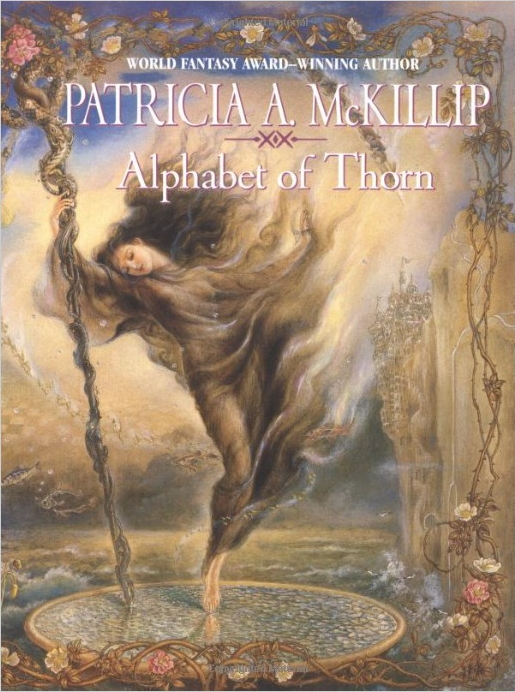
  • Book Review: Alphabet Of Thorn

    Several years ago, I moved from Illinois out to the very edge of North Carolina to settle into what would be me and my husband’s first home together. It was a cozy little apartment with ridiculously high rent, but it came with a few special benefits that weren’t the joy of living with the man of my dreams.

    It was hard to get much more convenient than that little place. There was a K-Mart beside the apartment complex and a bead shop next door to the post office, which was about a mile and a half away, easily within walking distance. But the best feature of the property, hands down, was that the library was only a few blocks away.

    I must admit that I did a terrible thing when I found this book in the library. I picked it up and took it home not because it sounded interesting, not because it had been recommended, but solely because it was pretty.

    All of this author’s books were pretty, in fact. Stunning artwork decorating a tiny hand-sized hardcover book. It was dainty. It was cute. I had a hard time choosing, probably because I didn’t read the story descriptions, but this was the one I took home.

    And what a choice it was. My only complaint is that the story is just so short, but what can you expect from a tiny book? Patricia A. McKillip’s Alphabet of Thorn is a remarkably well-crafted novella that takes place in two timelines. One where a young translator becomes caught up in revealing the history of the legendary conqueror Axis and his sorcerer companion, Kane – And the other, following Kane through trials that happened centuries in the past.

    The two timelines are connected through a twist that occurs perhaps a bit predictably, but the concept of time and its manipulation are portrayed in a manner that is top notch.

    I didn’t get a chance to read this author’s other works before we left that cozy little apartment, but if presented to me, I wouldn’t hesitate to pick up another one of this author’s books – Which are beautiful inside and out.

  • Friday Photo Break, vol. 18

    Wild buttercups in the back yard.

  • Exploring Influences: My Neighbor Totoro

    This week, we’re taking a look at one of my favorite movies: My Neighbor Totoro.

    Hayao Miyazaki’s movies often receive a lot of praise, and not without good reason. They’re excellent films that appeal to a broad audience. With Disney’s updated releases of a number of them, the fanbase only continues to grow.

    Of course, when I first saw Totoro, it was back when VHS tapes were a thing. The movie was enchanting and endearing, presenting a sweet tale of the way children cope with troubling times.

    It’s a film that blurs the lines of fantasy and reality, something I’ve always enjoyed doing, but it does it while keeping the message easy to understand and child-friendly for those who watch as a family.

    It’s hard to say whether the Totoros, soot sprites or cat bus are real or just the imagination of two lonely girls, but the subtle hints that all of them might exist is what really creates a lot of the charm. Growing up, my mother always gave us reason to believe in gnomes and fairies, so seeing the same sort of whimsy presented with Asian flair is sure to do nothing but delight.

    Last week: Dragonriders of Pern
    Next week: The Legend of Zelda