Beth Alvarez - Author of Epic Fantasy
  • The End

    The other day, a friend asked me a very specific question about writing, and I’ve been turning it over in my head since then.
    How do you stop writing?
    How do you keep your story from dragging on and on?

    The ending is a vital part to any story, and really, this is one of the reasons I went from just writing to writing with an outline. Very short stories don’t necessarily require an outline, but that’s because short stories are usually no more than a few pages long. It’s much easier to write without oulined goals when you’re only jotting down a few thousand words.

    But it doesn’t work that way for novels. Losing sight of your ending can mean losing sight of your story, and both of those things can mean losing the attention of your readers. If this is something you have a problem with, you may not like my advice, but it’s something you may want to consider.
    If you have a story in mind, you shouldn’t begin writing it at all until you know how to end it.

    It may sound harsh, but do you really want to have written 70 chapters of aimless meandering about the story, only to get stuck when you can’t figure out how to pull everything together and finish it? Or would you rather have 25 chapters of action and riveting, focused storytelling that effectively builds up to the big finale?
    I’m not saying you have to have every minute detail of the ending worked out before you start writing, but your path to that goal, and a notion of the final goal itself, needs to be clear before you begin. Otherwise, your meaning – And all the power behind your words – will get lost.

    If you’re intimidated by the idea of an outline, don’t be. It’s far from a rigid guideline, and it’s definitely not set in stone. You really only need to flesh out the major points you need to touch on, putting them in order before the time to write them actually comes. And it doesn’t have to be detailed. If your story is an epic fantasy and the villain must be vanquished at the end, that’s all you need to write down. If your story is based on personal growth of your characters, you just have to establish a point where all the trials they’ve overcome are able to come together and show them how they’ve grown.  These are very vague ideas, but they are important, nonetheless! You usually don’t start a road trip without a goal of where you want to be in mind, so treat your story the same way – Give yourself a map and directions before you start, and you’ll find it much harder to get lost.

  • Influence Map, Part 2

    Influence Map, Part 2

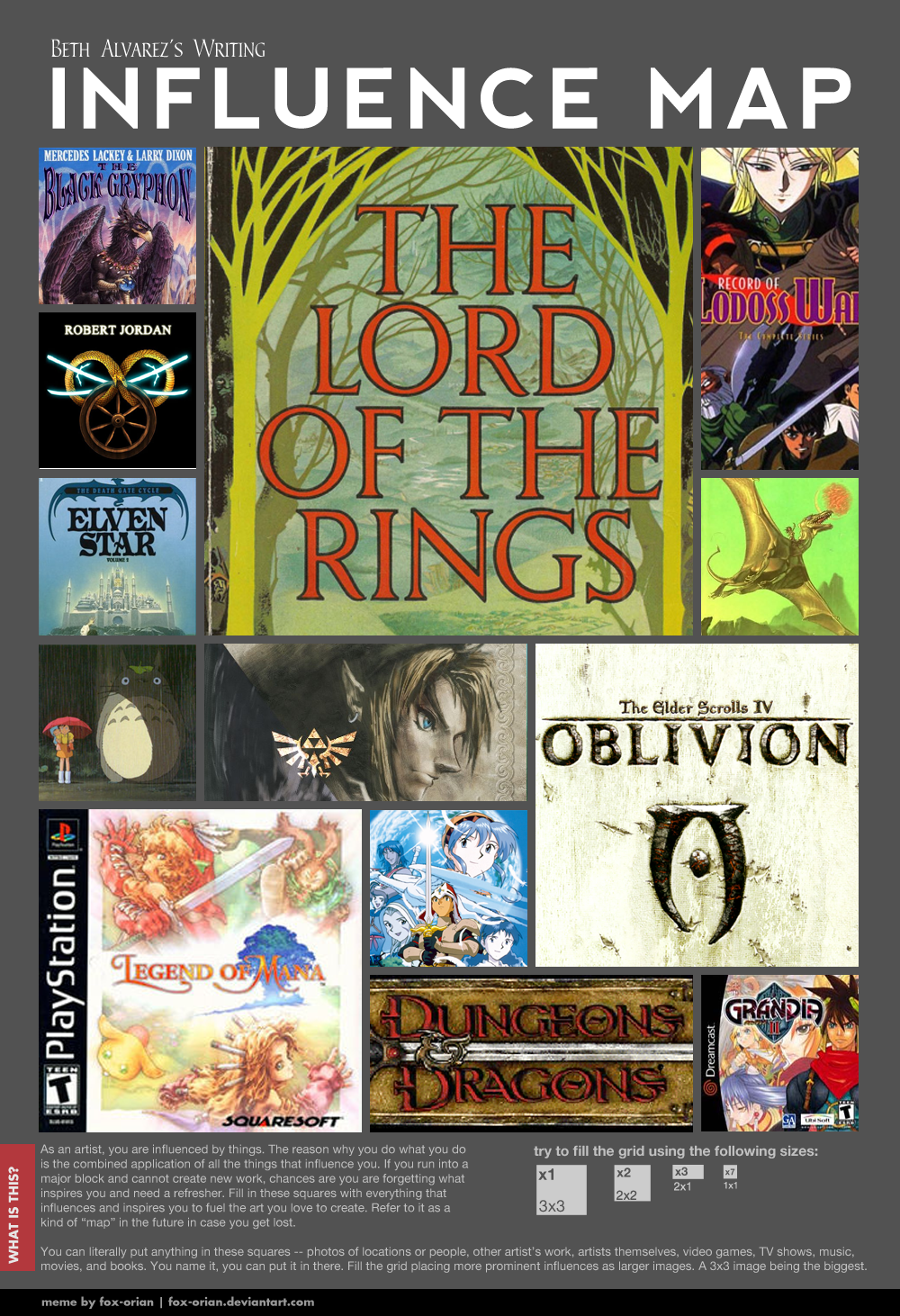
    I meant to finish this a lot sooner, but some things came up and for a little while, blogging was the last thing on my mind. Don’t worry, though – I’m not leaving you hanging. For anyone who was waiting, here’s the rest of the commentary on my influence map. Just in case you missed it, you can read the first part on my blog. For sake of ease, I’ll even include the image again! Just remember, we’re starting halfway down this time.

    Left, Row 4 – My Neighbor Totoro

    I’m a big fan of Hayao Miyazaki’s work, but My Neighbor Totoro will likely always be my favorite. His films all share a number of qualities, ranging from artistic style to the colorful whimsy portrayed in them. But My Neighbor Totoro was the first of Miyazaki’s films I saw, and it’s stuck with me ever since. As a writer, there’s something very compelling about a story where it becomes impossible to distinguish between what the girls are imagining and what’s really happening. That immersive draw is what I strive for in my writing, and thinking of people being sucked in as they read… well, that just really tickles my fancy.

    Middle, Row 4 – The Legend of Zelda
    The NES version of The Legend of Zelda and I were born in the same year. I don’t remember when I first picked up the controller to give the game a try. I’ve been a gamer for essentially my entire life, and Zelda was one of my earliest video game loves. The world built in each game is innovative and immersive, and I always find myself coming back for more with each addition to the series. Until A Link to the Past was released, there wasn’t much to the storyline, but the vibrant feeling of the world was enough. Once the storytelling started to catch up with the enjoyable gameplay, I was more hooked than ever! Meeting a new version of the same hero over and over again seems like it might get stale after a while, but Zelda manages to pull off recurring characters in its storylines in a way that I, as a writer, can only refer to as artful.

    Right, Row 4  and 5 – The Elder Scrolls IV: Oblivion
    I’ll be honest. I didn’t think I was going to like Oblivion. I’d never played any of the Elder Scrolls games, and since all the screenshots I’d ever seen depicted first-person perspective (Which I’m TERRIBLE at playing in) I wasn’t interested in even giving it a try. My husband insisted that I ought, he ordered the game despite my protests and urged me just to give it a chance. Now, I’m glad that I did.
    I’m not interested” quickly became “I can’t believe I just played for nine hours straight!” once I stepped into the vivid world of Tamriel. I’d never encountered a game like this before – The places seemed like something straight out of my own head, the stories complicated and well-written. For heaven’s sake, there’s even books to be read inside the game. Not just any books, but mythology books! Fiction books! Multi-volume fantasy books! Books detailing the history of a rich and well-designed world that reminds me so much of my own creations that it’s almost eerie. I got swallowed up by all the creativity that went into that game, and I’m not sure I’ll ever come back out.

    Left, Row 5 and 6 – Legend of Mana
    The painted world of Legend of Mana is unique in that the player shapes it as they play. By completing bite-sized quests and stories, they gain artifacts that become cities, landscape or dungeons when placed on the world map. The order of the storyline can be altered by what artifacts the player chooses to place when, but it never contradicts itself, and never tells a piece of story that can’t be understood on its own. While some story aspects are simple, some are quite deep and ornate, and the ability to take a single piece of a story and make it able to stand alone is quite remarkable. This game illustrates that you don’t have to have something giant to tell a good story… and sometimes simpler is better.

    Middle, Row 5 – Lunar: Silver Star Story
    Dragons.
    If there was nothing else that could’ve gotten me hooked on Lunar, it had dragons.
    Lunar is interesting in that it takes a bunch of pop cultural references, mixes them with a bunch of cliches, and somehow gets an interesting and original story out of it. I’ve never figured out how it works, but playing through the game taught me something unusual: Sometimes it’s okay for your writing to be cliche. It’s okay to take an element of a story that’s old and worn out, and add something fresh. It’s okay for main characters to be orphans, or sons of legendary warriors. These things are often frowned upon, mostly because they’re used a lot. But they’re used a lot because they’re an old standby, something known to simply work. So go right ahead and let your hero be the chosen one! Let them fulfill an ancient prophecy! Let them actually a dragon, though they didn’t exactly know it! A good writer can take any cliche and make something interesting out of it… as long as they’re willing to try.

    Middle, Bottom Row – Dungeons & Dragons
    Roleplaying was a very large part of my life while I was growing up. To those aware of that, this comes as no surprise. What does tend to surprise people is that, while I’m very familiar with the lore, the monsters, the worlds and the races, I’ve never actually played D&D.; The closest I’ve come is a few mini-campaigns put together with some friends that we ended up never finishing. Half the time, we abandoned our stat sheets and dice within ten minutes, and just decided to wing it.
    But many of the roleplaying games I participated in online were based on D&D.; They were freeform, which meant there were no stat sheets, no dice, and half the time, there were barely any rules. The games focused primarily on character interaction, and since it was all text-based online, it was based entirely on writing. I found my first game accidentally, but I was hooked in an instant. It was in these forums and chats that I started learning how to properly write, so even though I’ve never played, D&D; has definitely done a lot to shape my craft.

    Right, Bottom Row – Grandia II
    I have no idea what made me want this game, but I’ve never regretted the $15 I spent on it. Grandia II isn’t quite my usual fantasy fare – It’s blended with technology and sci-fi elements, but the way it’s done makes me still consider it wholly a fantasy game. There’s not a lot to say without spoiling the entire story, and the story is quite long – So all I’ll say is that Grandia II was an interesting look at the roles that heroes and villains usually play, and the way those roles can be twisted and skewed can make for some very interesting stories.

    And with that, we are done!
    My entire influence map has been spoken on. There’s other things that influence me, sure – But we’ll save those to talk about another time.

  • Influence Map

    Influence Map

    For a while, influence maps were a popular trend among artists on deviantART. It spread outward and I saw them on other art sites, from time to time, but I never made one. Sure, I draw – I’m not terrible at it, either, though I’m far from being great. But my real art is my writing, so when I finally made my influence map, I decided to base it off that. So, here’s my map. See how many things you recognize at a glance, then I’ll talk about each of my influences for just a second.
    You can click it for a much larger version.

    Oh boy, you can really tell where my interests lie, can’t you?  We’ll start with the 3 smaller influences in the top left… Then we’ll tackle my largest influence up there in the middle.

    Left, Row 1 – The Black Gryphon
    When I was in my early teens, reading anything by Mercedes Lackey was a delight. After revisiting her works as an adult, I’ve changed my mind, but I won’t deny that this one trilogy in particular had a definite influence on me during my formative years. It was the first series I encountered that gave a glimpse of the kind of world I wanted to build. The Black Gryphon was the first of Lackey’s books that I read. Seeing something close to the concepts of fantasy I already had in my head was thrilling. I was probably 13 or 14 when I first read the trilogy, but some things – Magic and monsters in particular – have never left the back of my head.

    Left, Row 2 – The Wheel of Time
    This series is the most recent addition to my list of influences. As my taste in literature grew up along with me, I found that, as an adult, it’s very difficult for me to find books that measure up to my literary standards. I’d had friends urging me to read the Wheel of Time books since I was 15, but I never bothered – Even though I had a copy of the first book! It was largely frustration at lack of quality reading material that drove me to finally pick it up, but once I did, I was hooked. I’ve not finished the series yet, it can be very slow to advance, which means I like to take breaks at random to read other things. But through the 6 books I have read, Jordan manages to keep from contradicting himself or losing track of any of the many, many characters, and that’s a pretty impressive thing for an author to achieve.

    Left, Row 3 – The Death Gate Cycle
    I chose Elven Star to represent the series because it’s my favorite thus far – I’ve read all but the last book, which has always proven hard to find. I really need to just order it off Amazon.
    There’s not a lot to say about why I love these books, I think they speak for themselves. They’re well-written and easy to follow, bear plots that are far from transparent, and have an excellent cast of characters to go with fantastic world building.

    Top Center – The Lord of the Rings
    My biggest influence, and how could it not be? The Hobbit introduced me to fantasy and Tolkien’s work at the age of 8, but when I read The Lord of the Rings after, I got lost in those pages, and I think a part of me will never come back out of them. All the greatest fantasy I’ve read since shows the influence of Tolkien’s writing. He was a true pioneer into what we know as modern fantasy genre, and few series can now touch on things as mainstream as orcs and elves without giving a nod to his formative works.

    Right, Row 1 and 2 – Record of Lodoss War
    Record of Lodoss War was my first anime series. Sure, I’d watched a few episodes of things here and there, but Lodoss War was the first I completed. Once I completed it, I bought it on VHS, in a time when movies were something I simply didn’t do. The VCR is buried somewhere in the attic, but Lodoss War still has a place of honor in the living room.  In an era where visual effects meant fantasy movies were often campy and ridiculous to watch, cartoons simply did it better. Epic battles, compelling story, and Tolkien-esque goblins and elves – All were portrayed well in a medium that gave it the credibility such a great fantasy series deserved.

    Right, Row 3 – Dragonriders of Pern
    I was introduced to the series by my childhood librarian, a wonderful lady named Wanda. She knew exactly the sort of thing to recommend when I told her I wanted something based in fantasy, and she handed me the first book in the Harper Hall trilogy, which I still think are some of the greatest Pern books. It’s not really a secret that I don’t like science fiction, but Pern distanced itself enough from its sci-fi basis to give the first 6 books I read a definite fantasy lean. And come on, dragons. It’s not like it needed much more than that to ensnare me. I’d always loved them, but after the Pern series, dragons have always been a mainstay of my idea of fantasy.

    Whew… this post has grown far beyond what I originally planned, so I’m actually going to stop here – You can view part two elsewhere on my blog, and see me speak about the rest of my influences and why they’ve remained a part of my life.

  • The Revision Process

    Editing is the most important step of finishing a book. Anyone who disagrees is fooling themselves. Even the best books have an editor, whether or not they’re listed in the credits page. Very few authors are able to edit their own work successfully, and it makes sense that we wouldn’t. After all, we’ve put months into the work at hand, and to say we’re looking at it through rose-tinted glasses might not be strong enough to explain the colored vision of our work we have.

    Some of the biggest problems indie authors have is lack of editing, lack of skilled editing, or lack of resources to hire their own editor. But since editing is something that will ultimately make or break your career as a writer, it should never be neglected. If you’re uncertain about your editing skills, don’t be afraid to seek help from Google or more common household resources – A dictionary can easily become your best friend.

    I’ve read a lot of books about editing, but in the end, there’s only one I remember as being helpful. That one is Be Your Own Editor by Sigrid Macdonald. It may not be of any assistance to the more experienced writer, but it’s a great refresher course if you’re feeling rusty, and the current 99 cent ebook price can’t be beat.

    That said, you’re here to read about my revision process, so that’s what we’ll talk about. I definitely can’t afford a real editor, but the thorough editing of Death of the Sun is something that consistently receives praise, so who knows! Maybe I do okay without. First up…

    Step 1 – The Break

     It may seem counterproductive, but the first thing you need to do once completing a manuscript is to put it away. After months or even years of working on a story, you’ve grown so close to your words that when it comes time to edit that it’s difficult to see the errors. As soon as that last chapter is done, the very best thing you can do to aid the editing process is to put everything away.
    The amount of time you need to distance yourself from the project is different for everyone, and different for each project as well. Just take some time off, don’t worry about it, and have a few weeks to enjoy movies and other pastimes while your brain comes out of writing mode and settles into the right mindset for editing.

    Step 2 – The First Read

    After some time to let the project settle, the first task is reading what you’ve written. Some people are able to do all their reading at the computer, but I can’t. Extended reading of all-text documents on a computer screen hurts my eyes, and gives me a killer headache. So for me, the first portion of this step is spent printing a paper copy of my manuscript. This makes editing easier for me, as well. Once printed, I keep the manuscript in a 3-ring binder and write the name of the book on the spine so I won’t lose it on my shelf.

    Whether you do your reading on the computer or on paper, it’s important to be done. You read it just as anyone else would, from start to finish. I keep a red pen with me and mark any glaring errors as I come across them, making note of any problem areas that need to be rewritten. It’s a straightforward process, and you’ll be surprised at how many errors you find. I pride myself on being a fast and accurate typist, but the number of typos in the first draft always shock me!

    Once I’ve read through the book the first time, I start the revision process immediately, fixing the problems I marked while reading through. For Death of the Sun, the entire process of the first read and rewrite took about a week. Then it was on to step 3.

    Step 3 – Readers and Feedback

    I was fortunate to have two volunteers ready to read my book the moment the first round of editing was done. I handed each of them a copy, and not too long afterward I received great feedback in response. One reader was a wonderful friend, Michelle, who found a great number of mistakes I’d missed and offered tons of valuable feedback on how to improve certain places in the story. In my head, she’s my editor, and I credit her as such in the book. Her help was invaluable, and having an outside perspective was fantastic.

    The other reader was my husband. His read-through offered help that was a little more unique. Not only was he not at all interested in the genre, which made him more able to tell me if the book was actually interesting or not, his first language isn’t English. His English is fluent, but I still tease him sometimes for phrasing or grammar that makes little sense. His perspective was great because it helped point out sentences that were more difficult to get through than they should have been. It also meant he had a keener eye for typos and missed punctuation, since he seems to process reading material a little differently as a result of it being in his second language.

    After about two weeks, both of them had finished reading and compiled tidy lists of suggestions for me to go through. As soon as I had their commentaries, it was time to begin the process over again.

    Step 4 – The Second Read

    The second read-through was a lot faster. The first round of edits helped readability greatly, letting me focus on problem areas highlighted by the commentary my two readers gave me. The ultimate decision of what to keep in the final draft of the book is usually left up to the author, regardless of what the editors would prefer. Still, I tried to be very considerate and appreciative of the time and effort these two put into their criticism, and I forced myself to look at every suggested change under a hard light. Did the change make sense? Did it make it easier to read? Was I able to preserve the story or feelings I was trying to convey if I changed it? If so, the change was made. If not, I tried to reach a compromise, if I could see where the advice was coming from.

    A few scenes were altered or edited, a few were removed completely. One sprang out of nowhere and was written from scratch, with just that scene being sent back to my readers to make sure it flowed well from point A to point B. When all the editing was done at the end of the read, there was only one thing left to do before it’d be ready. I put the book away for one more break.

    Step 5 – The Final Read

    One more time, I had to have a clear head to do what needed to be done. After a week off, I read through the book one more time, just to be sure it was ready.
    Fortunately for me, my original manuscript was pretty clean, which made the editing process fast and smooth. After the months I spent writing the book, it was polished in just under one more. The only changes left to be made were finicky adjustment of comma locations, changing sentence punctuation for emphasis, or rearranging a word or two to make a sentence just a little bit smoother. The reading only took a day, and when I put it down and was satisfied by the story I’d just read, I knew it was time.

    I cleaned up the document and used a number of helpful online tools and downloadable programs to create neatly formatted e-book files. I’d seen what automated formatting tools like what Smashwords offers had to offer, and I was unimpressed. The only way to get a good looking e-book file is to format it by hand – So that’s exactly what I did.

    It took months of effort from beginning to end, but every moment was worth it, if only to show myself I really could do it. There was nothing so thrilling or terrifying as hitting the submit button that added my book to the scores already available on Amazon and Barnes and Noble, but I did it.

    My next trick? Well, I guess that’ll be doing it again.

  • Sample chapters finally available

    Nothing major to update with today. I’ve had a few days off work, so I’ve been a busy little bee, catching up on the million-and-one things waiting for me to do them.  One such thing was making the first 3 chapters of Death of the Sun available for free reading online.

    You can find them on my personal website:
    http://ithilear.com/

    I’ll be back on Monday with a blog post about my editing and revision process, as promised. Happy Friday!

  • The Writing Process

    Not that long ago, I asked a great friend about her writing process. I have always loved reading about how other people work. There’s no guarantee the same method will work for everyone, of course, but hearing how other people do it has helped motivate me in the past. Besides, I love trying new methods on for size.

    Despite me asking about her method, it didn’t cross my mind until last week that I could share my own writing process, as well. There’s a lot to talk about, so much like my friend Megan did, I’ll be splitting the explanation of my writing process into two posts. So, without further ado, here’s the first glimpse at how I get things done.

    Step 1 – The Notebook

    An idea is obviously the starting point for a story, you can’t really write one without an idea in mind. I carry a notebook with me at all times. Right now it’s either the tiny Hello Kitty notebook in my purse, or the spiral-bound journal with cherry blossoms on it that my husband gave me as an anniversary gift. Any time I have an idea for a story, I take a moment to stop what I’m doing and write it down on a page in the notebook. It’s usually a brief summary, maybe a page length in my cherry blossom journal.

    Once the idea is written down, I label it with the date I wrote it down and the story’s name. I don’t always think of a name right away, I find naming a story to be one of the hardest parts. But giving it a working title, which can be anything and doesn’t even have to make sense, helps me assign an identity to the story. Later on, that makes it easier to recall the idea from memory.

    The notebook is also useful for writing out ideas for particular scenes in stories I’m currently working on, or tiny biographies for characters I’d like to fit into stories at some point later on. And if I’m in the middle of a project and inspiration happens to strike when I’m out away from home, I’ll open my notebook and write out the scene that’s come to mind while it’s still fresh.
    All in all, the notebook becomes a tidy little library of information to roll into my stories when it comes time to write.

    Step 2 – The Journal

    Don’t let me fool you, the journals I keep on hand are completely different from the notebooks step 1 revolves around!
    For each story that I write, I keep a separate journal. I love the feeling of real books, and having nice journals to keep each project in is something I find very enjoyable. Whenever I start a story, I find a journal to fit. For Serpent’s Tears, the story I’m working on now, I write in a red embossed journal I was given for Christmas. For its sequel, which I’m already taking notes for, I write in a brown embossed journal with gilded pages.

    The journal serves two important purposes. One, I use the journal to write my outline for the story. This means I have a hard copy on hand at all times, which makes it easy to reference my outline at a glance when I’m actually writing. Two, when I’m working on one specific project, I’ll carry its journal instead of my regular notebook. That way, when I’m feeling inspired and I’m not near my computer, I can open it up and write a scene or two in the pages of the journal. This keeps all my work for each story neatly organized, and since each is in its own journal, I can tell at a glance which one I’m picking up.

    Step 3 – The Outline

    Once I’ve got the idea in the notebook and a journal picked out, outlining is the next step I take.
    Before writing Death of the Sun, I wasn’t much of a believer in outlines. I felt like they were too constricting, and why bother writing an outline when I could be writing the story? Like it or not, though, my refusal to adhere to what’s been a staple for writers through the ages is why it took me until Death of the Sun to actually complete a novel. Without guidelines, it’s easy for a story to wander. Without the clear tracks laid down by outlining, it’s easy for the entire point of a story to be derailed.

    My outlining process isn’t too complicated. The story is already outlined in the idea page kept in my notebook, so my outline starts with the first chapter and ends with the end of the book, though I usually start writing once I’ve outlined about a third of the story. I label the top of each journal page with the chapter’s number, and it takes off on its own from there. A chapter outline is just the summary of events that need to happen in each chapter. Sometimes I spare a page for new characters introduced in a chapter, adding a short biography to help keep who’s who straight and make sure I have descriptions of them matching consistently.

    The outline is often revised as I write, making notes in the margins. As I encounter things in the outline that don’t work where I’d originally placed them, I make notes in the margins to move events from one chapter to another, rearranging the order things happen in, or striking things out completely. An outline helps keep me goal-oriented, but it’s not the stifling, narrow thing I always thought it was. It’s just a path through the garden to guide me from one end to the other – Having it there doesn’t mean I can’t wander among the flowers on my way.

    Step 4 – Actually Writing

    After all those paragraphs, this is where we really get down to the heart of it. Spending time actually writing is what seems like the easiest part, but sometimes, it’s rather like pulling teeth. Slow, excruciating, and it’ll leave you hurting for days on end. Writing is hard work, and while I enjoy it, I don’t know if I would honestly call it fun.

    Writing the meat and potatoes of the story is no small feat. It can take months to years of a person’s life, even working at it every day. Some days are more successful than others. Overall, I’m proud to have been able to write Death of the Sun in a matter of months. If you’d asked me at the beginning of the project when I thought I’d be done, I don’t know what I would’ve told you. Probably something like “Next year, I think. Maybe.”

    It’s hard to be productive. Especially in an age where digital distractions are everywhere. For me, the only way to really get anything done is to cut myself off from the outside world.
    Whenever I write, I make sure I have a snack or especially tasty drink on hand. Starbucks bottled frappuccinos are ideal for me, but a bit on the expensive side, so I usually settle for fake-uccinos made in my own little kitchen. Having refreshments close by helps quash the urge to get up and go get something after I’ve started my work for the night.  I always write best at night, by the way – Everyone works differently, but I simply cannot get fiction writing done during the day.

    Once I’ve got my goodies for the night, my notebook, and my journal with the story outline in hand, I unplug my laptop from all the contraptions it’s tethered to at my desk and I retreat to the bedroom. I pile the pillows up to make a backrest, click the little glowy button that turns my wi-fi off, and put some mood music on. The music I listen to changes depending on the mood of the scene I’m writing, but for general inspiration, I usually start with E.S. Posthumus or Karsh Kale.

    And then I write. All the fuss and preparation leads into this. I do set a word goal for myself, and I check my progress regularly. Depending on how much time I have to write, I aim for either 500 or 1,000 words. Usually, once I’m settled in and disconnected from the world outside, I breeze past the goal pretty easily.
    This is the process that I rinse and repeat, over and over again, until the oh-so-satisfying moment I type the words that bring it all to an end.

    Seems like that’s it, right? Well, no. If I said I was done after writing an entire book, I couldn’t be farther from the truth. There’s still a lot more left to do, but we’ll save that for the next entry, which will be all about my mortal enemy… Revision.
  • Q&A, volume 2

    It’s been a bit since I posted my last, so here’s a few more questions I’ve been asked.

    Q: How you keep writing?
    A: As much as I’d like to say there’s some kind of secret to keeping me going, there’s not. How do I keep writing? Honestly, I don’t. When it stops coming easily, I stop. There’s no point in forcing it, I’ll just be unhappy with it if I do. Muscling past writer’s block has never worked for me. The thing that works best for me is to keep a notebook with me. I fill it with thoughts and ideas for various stories, or jot down a scene here or there as it pops into my head. What really keeps me going is never letting the stories die in my head. As long as I’m thinking about them, about the chapters I haven’t written yet and the scenes I can’t wait to get to, I know I’ll get back to the project when the time is right.

    Q: What motivates you to write?
    A: This is something that’s actually hard to put a finger on. I find motivation in everything, really, ideas come to me and encourage me when I’m doing even the most mundane things, like washing dishes or driving to work. One thing that motivates me more than anything, though, is reading a well-written book.

    Q: What inspired you to begin writing?
    A: Honestly, I couldn’t tell you. I wanted to write from the time I was a very small child. I don’t even really remember the beginning of it! I was only a handful of years old when I learned how to use Lotus Works on Dad’s very first computer, and let me tell you, I bet it was odd seeing a tiny kid using DOS prompts to open a word processor instead of games!  I guess what really inspired me to start was that I was always a voracious reader, and my mom always had a fantastic selection of books in the house. The room with the first computer, down in the basement, was also the library. One wall was completely lined with books. Even when I was very young, I used to stand there looking at spines of books – Especially big, fat ones like Mom’s copies of Thoreau or The Portable Walt Whitman – and dream about what it would be like to have my name on that shelf, too. Just being in the same room as them when the word processor was open was enough reason to get started.

    Q: What inspires you the most?

    A: Much like what motivates me, this is something that’s really hard to quantify. I guess overall, I draw the most inspiration from being exposed to a good story. It can be anything from a movie to a book, but once I’ve heard a great story, I’m usually brimming with inspiration to work on mine. There’s plenty of other things I draw inspiration from, though – One of my favorite things to do when I need a dose of inspiration is to go outside with my iPod and just sit. Or even better, find a swing set and spend a good hour or so on a swing. The simple things in life are sometimes the greatest to help us keep going.

    Q: The story you’re currently working on, how long has that been a WIP?
    A: Oh, that one’s actually kind of embarrassing! The story I’m currently writing was my first idea for a novel. It’s my Holy Grail, the one story I want to finish if I never finish writing anything else in my life. But because I have such love for the story, I never feel like my writing really does it justice.  I started writing it when I was sixteen, but I’ve edited, redone, scrapped and restarted it at least half a dozen times. After nine years of working on it, I’m reasonably content with this incarnation so far, but I’m only halfway through the story, so we’ll see how long that lasts.

    Q: What advice would you give aspiring authors?
    A: Finish a book. It seems like a no-brainer, but actually completing a story is a huge feat. It’s filled with pitfalls and perils and you’ll probably hate the process, you’ll probably want to give up a million times. The moment you look back at all of your progress and realize you hate everything you’ve written so far is the point you know you’ve got something special on your hands. It’ll take a lot of time to finish and even more time to polish, but finish it first… And then edit, edit, and edit again. You can never edit enough.

    Q: What did you want to do before deciding to become a writer?
    A: I went through a few phases of things I wanted to do with my life, but I think writing was always my ultimate goal. When I was a kid, I had a collection of stories written by James Herriot that made me want to become a veterinarian for farm animals. That want evolved into a desire to own a pet store, and somewhere along the line I decided I should give up on animals and become a jewelry designer and own my own jewelry boutique. Since websites like Etsy made that one an actuality, I moved on to my real goal of writing. Of course, I had two other dreams when I was a teenager. I either wanted to own a candy store that was something like Willy Wonka’s factory inside, or I wanted to own a coffee shop. The latter may happen someday, because after all, coffee shops and writers seem to go hand in hand, don’t they?

    Have a question for me? Leave a comment here or on Facebook and I’ll address it in the next Q&A; volume!

  • A trend I just can’t follow

    Before I say anything, let me state that I’m not criticizing this particular style of writing. I’ve read a few books in it that I’ve liked perfectly well, but overall, there’s one thing about myself I’ve really noticed lately:  I do not like reading books that are written in first-person perspective.
    It’s not just reading them, I guess – I can’t write in first-person perspective, either. Or rather, I can, I just don’t enjoy it.

    Books in first-person perspective seem to be a rapidly growing trend. I remember a time when finding a novel in first-person was not unheard of, but was pretty unusual. Now, picking up books off the tables at Barnes and Noble, you’re hard pressed to find a recent release that isn’t written in first-person. And every time I picked one up, I found myself a little more irritated by it. What bothered me most of all, though, was why? Why do I have such an aversion to first-person perspective? Why does it make me grit my teeth and pull sour faces whenever I see it used?

    Then, this week, I finally figured it out. As I sat on the couch, curled up in the corner with my Nook and a copy of The Hunger Games, it finally hit me – I hate books that are written in first-person perspective because all too often, they lack depth.

    A good writer can overcome this. Some do, but all too often, what we really get is just a shell of what the story could have been. There’s a rule for writing that I hear over and over again, everywhere I go, and that rule is show, not tell. This is what makes a story strong. The vivid descriptions of everything around the characters, the deep portrayal of emotion we see in characters through action and expression, rather than being privy to their innermost thoughts.
    First-person books, as they have a narrator, don’t have any show. Everything in them is tell. Everything you get to experience is spoon-fed to you from the narrator’s perspective. The narrator tells you what to think of other characters, coloring your opinion of them because you’re forced to look at them through the narrator’s tinted glasses.

    And I can’t help but think of the missed opportunities. There’s a million places in most first-person books where the story could have been so much stronger if it’d been written in another perspective. Imagine the narrator seeing their own eulogy and wondering how their family is taking it, thinking that they’ve died. Then imagine how much deeper the impact would be if the scene had, instead, been the family seeing the eulogy. Thinking their loved one is gone, being crushed by the loss.  And then the very next chapter, we meet up with the character thought dead. They’ve seen their eulogy, we see how concerned they are for their family, how desperately they wish they could get to them and let them know they’re all right. In the span of a few paragraphs, you can move a reader from grief over the loss of a character they loved, to hope, realizing they’re still alive – and finishing with anxiety of not knowing how they’re going to make it through and reunite with their loved ones.

    First-person perspective robs you of all this emotion, because everything you see is one-sided.

    It’s not that I think nobody should write in first-person perspective, it can be done quite well. But with the increase in its popularity and the overall drop in literary standards over the past few years, I can’t help but think that many authors use it as a crutch, letting it cover up their own shortcomings by using an easier method of storytelling.
    At the end of the day, though, I think the easiest way to explain it is this:
    Would you rather watch a movie, yourself, or have a friend describe the entire thing to you?

  • Ants

    I don’t like bugs very much.

    For the most part, bugs and I have a mutual understanding. If they leave me alone, and stay out of my house, I’ll leave them alone. There’s a few exceptions, of course, such as unspoken rule that they’re not allowed to eat the flowers, veggies or herbs growing in the flower pots out back… or that wasps aren’t allowed to build nests anywhere I may need to go, since I’m a little bit allergic to them.

    I wasn’t always so nice to lesser life forms. Shocking, I know. I was never the kid with a magnifying glass, but I was the one that found it interesting to see what happened if I poured a bucket of water on top of an ant hill. How fast could they rebuild it, anyway?

    As the weather has gotten warmer, I’ve found myself watching ants again for the first time in almost 20 years. They surprised me when I saw them first, a thin black ribbon threading across the concrete slab that forms our back porch. I don’t spend a lot of time outdoors any more, but instead of rushing the dog in and out this time, I found myself sitting on the concrete beside the line of ants, watching.

    I’m sort of a small person. Standing at 5’9″, I’m taller than most women I’ve met, but I’ll likely be the shortest of my brothers and sisters. Only my two youngest sisters are still shorter than me, but they’re catching up fast. Aside from my height, I’m pretty slight of figure, and I’m not a very loud or outspoken person. It made for a strange experience, really. Sitting next to all those ants, for the first time in a long time, I just felt so big.

    I could have crushed them at any time. I could have hosed them off the patio or doused them with bug spray. But when I looked down, I happened to see one solitary ant, off on her lonesome away from the line. In that moment, as meaningless as ants would normally seem, I felt a wave of sympathy for that poor, simplest of creatures.

    She walked in circles, footsteps halting and hesitant. She’d gotten off track, somehow, and try as she might, she couldn’t find the flow of her sisters that would lead her back home. I saw her drop the crumb she was carrying several times. Each time, she’d stop and pick it up, right herself and start looking for the group again. Something about that sheer, mindless determination was humbling. There’s so many times I’ve felt like just one lonely ant – Separated from the group I belong with, lost and trying to find my way on my own. I understood the uncertainty, and I was embarrassed by the way a tiny little ant could face the trial with more courage than I.

    With that strange new kinship with a creature a fraction of my size in mind, I plucked a blade of grass and laid it in the ant’s path. She seemed confused, at first, but edged along it until she reached the end – An end I’d laid right beside the long, milling line of her sisters. The moment she reached the group, those halting, hesitant movements shifted seamlessly into a smooth and confident stride. Crumb held proudly overhead, my little ant-friend made her way down the line to the anthill bubbling up from a crack in the concrete. I watched her the whole way, and when she disappeared from sight, I felt a simple sort of satisfaction.

    Sometimes we’re all a little bit like ants, and sometimes, we just need a little push.

  • My new life as a tiger

    I don’t put a lot of stock in things like the zodiac, but it’s something so mainstream that it’s hard to not know where you fall on the charts. When I was a teenager, I had a passing interest in it. I was curious as to how one simple sign could represent countless people who really only had one thing in common: the time of year they were born.  Of course, I learned that there was a lot more to it than that. There’s your sign, your rising sign, how the planets were aligned when you were born, and a dozen other possibilities. Overall, what I learned was that my signs didn’t really describe me. The one that seemed closest was my Chinese zodiac sign, which is the hare. Or, I always thought it was the hare. As it turns out, I’m terribly, terribly wrong.

    My whole life, I’d figured my Chinese sign by what was printed on my place mat at Chinese restaurants. That was probably my first mistake. Everyone knows that Chinese restaurants don’t serve real Chinese food, so what made me think they’d tell me my real Chinese sign? The wool was pulled over my eyes, and like a fool, I ate up the lies they served me with my side of crab rangoon! I swallowed the falsehoods whole and then moved on to get my fortune told by a cookie – A cookie actually designed by a Japanese man who lived in California. But no more. Today, I have finally learned the truth.

    The truth is, I was born in the Year of the Tiger.
    I could have been born in the Year of the Hare, had the doctors not insisted that I had baked long enough. I was born on January 26th, only three days before the Chinese New Year, ringing in the Year of the Hare on the 29th. It was a close call, but as they say, close only counts in horseshoes and hand grenades. I was never very good at horseshoes, anyway.

    I don’t know a lot about tigers. Just a few facts, really. Like that there’s six subspecies of tiger still alive, or that all white tigers are actually inbred. I also know that tigers love water, unlike most cats. And that the Tasmanian tiger isn’t actually a tiger at all. But that point is the end of my tiger knowledge, and if I’m going to be a tiger now, I guess I’d better educate myself.

    I figured I would start by looking up what Wikipedia had to say about my new-found identity. What are tigers like, according to the Chinese zodiac? Apparently, this is me:

    Tiger () (Yang, 3rd Trine, Fixed Element Wood): Unpredictable, rebellious, colorful, powerful, passionate, daring, impulsive, vigorous, stimulating, sincere, affectionate, humanitarian, and generous. Can be restless, reckless, impatient, quick-tempered, obstinate, selfish, aggressive, and moody.

    Daring? Impulsive? Powerful? Well, if I read it on the internet, it must be true. I mean, I always thought I was meek and shy and quiet like the rabbit, but who am I to know what I’m like? Of course, I’m sure the elements and my other signs play a part as well. So what does it mean when you’re a Water-Bearer Fire Tiger with a fixed element of Wood and Libra rising? I’ll tell you what it means: it means I’m really confused.

    But it can’t all be wrong. My husband will tell you that when I’m arguing something, I’m definitely passionate. I’d like to think I’m sincere, affectionate, and generous. And of course I know I can be restless and impatient, but everyone can be, right?
    All in all, I guess it doesn’t really make a difference, but who knows. Maybe there’s a little tiger in me, after all.

    What’s your sign?