Beth Alvarez - Author of Epic Fantasy
  • Concept Art

    One thing that can get me excited about a book like nothing else is artwork. A picture is worth a thousand words, after all. Any time I find a book that’s got illustrations or other artwork in it, I find it boosts my interest in the text considerably. It’s interesting to see a visualization of the characters and places they may be visiting. It helps intensify the mental images the book gives me, helps immerse me in the world the author has created.

    Maps count for a lot too, as I’ve mentioned before, but nothing compares to portraits of the characters you’re reading about.
    For a long time, I’ve planned to have drawings of various characters appear in my fantasy novels, but I’m not sure who will be drawing them. I’m a little bit artistic, myself, and I’ll share some of my drawings here in the future, but my husband is even more talented than I and there’s always the possibility of keeping him on tap for doing character illustrations to go with my work.

    Sometimes, his drawings even end up being a bit help when it comes to fleshing out characters I haven’t devoted a lot of time or attention to yet. It’s really interesting to see how he can take a description given by me and help it grow into a more solid idea. There have been a couple characters I’ve had him sketch when he’s asking for ideas to help him warm up, and I’ve been delighted with the results each time. One of them is the quick concept art he put together for Sera, a character from a story still going through outline development.

    Though she’s been in my head as a character for some time, I had never taken the time to work much of her appearance out in my head. Now that there’s art existing, though, it’s easier for me to picture her actions, reactions and personality.

    I’m not sure if he or I will be doing the final artwork for the book, or if we might collaborate on it together, but I definitely plan for complete pieces to appear in the book Sera is a part of.

    Do any of your favorite books include illustrations?

  • Friday Photo Break, vol. 24

    The morning the roses out front bloom fully, the outermost petals are pale pink, while the inside is creamy yellow-white. Throughout the day, though, the flowers go through the most curious change.

  • Exploring Influences: Dungeons & Dragons

    Let’s be real, here. I write fantasy. How could I not have D&D; on my list of influences?

    Long regarded as a game for nerds, quite a few people overlook the fact that books set in the worlds created for D&D; often present fantastic stories and memorable characters. Dungeons and Dragons has been the proud parent of good books and the victim of terrible Hollywood ventures, but it’ll never stop being a staple of fantasy.

    D&D; is a great starting point for introducing people to the stereotypes in fantasy. But really, it’s sort of funny how everything goes full circle. Many things that have become staples in  D&D; started with Tolkien and The Lord of the Rings. The difference resides in that D&D; takes the time to expand and elaborate on a number of ideas introduced to us in much older fiction, giving new aspects to old ideas that we, as fantasy writers, can continue to develop and grow on. Sadly, I wish this was something I’d realized a long time ago.

    Years and years ago, I was actually offered the chance to co-author a Forgotten Realms book. I fired a few email messages back and forth with a representative from Wizards of the Coast and the other author I’d be working with. But the more they told me about what they wanted, the less I felt like I could do it. They had a specific storyline in mind, they just wanted me to write the long form. A lot of character concepts had already been put together, and I didn’t feel like the opportunity was going to give me the creative liberty I hungered for in writing fiction.

    I can’t really say I regret the choice to pass on the offer, it wasn’t right for me at the time. But there’s still a small part of me that wonders what things would be like if I’d realized then how much liberty the D&D; setting really offered me. But then I remember that the more time I spend writing in other people’s worlds, the less time I spend writing in my own, and I feel that I did make the right choice.

    Last week: Lunar: Silver Star Story
    Next week: Grandia II

  • Friday Photo Break, vol. 23

    There’s an old rose planted in the garden in front of my house. It came with the house, so I don’t know how old it is, but it undergoes the most beautiful transformation every time one of the pink buds blooms. They promise to be a bright, hot pink blossom, but when the petals begin to unfurl, a creamy ivory color is revealed inside.

  • Exploring Influences: Lunar: Silver Star Story

    I have a very deep fondness for retro games. That includes newer titles that pay homage to games of old, though the classics will always hold a special place in my little gamer heart.

    One of my favorite games that’s not quite old enough to be retro, but carrying a retro vibe, is Lunar: Silver Star Story.

    In a time where most companies were pushing to create games with more realistic visuals, Lunar went the opposite direction, opting for a wholly sprite-based look. Here’s a little secret… I absolutely love sprite-based graphics.

    The graphics were the reason I started playing the game, but they certainly aren’t the only part of the game I love. The story and characters are, of course, the other reason. And let me tell you what, the whole story of Lunar is pure, absolute, delicious cheese.

    The great part about the title is that it doesn’t take itself too seriously. It’s deliberately cheesy and cliché, and that’s what makes it even better! The story is predictable, the characters are all comical jabs at stereotypical roles and personifications present in oldschool Japanese RPGs, and it’s all done with a sly sense of humor and a boatload of pop-cultural references.

    I love the way the series repeats an old and tired storyline, doing it all with tongue in cheek. Lunar makes no bones about being a rehash of a dozen other games, they don’t even bother trying to veil it. The characters themselves often remark on predictable or cliché circumstances, the sarcasm and wit of the writers making it easy to laugh your way through the game.

    Nonetheless, the writers add just enough fresh twists on overused ideas to make it enjoyable, giving a quirky take on an old tale that leaves you feeling plenty satisfied at the very end.

    Last week: Legend of Mana
    Next week: Dungeons & Dragons

  • Friday Photo Break, vol. 22

    To children, there’s something magical about dandelions. Something to do with their transformation, something to do with the way the seeds carry on the breeze. Recently I discovered that wishing on a dandelion is something that doesn’t carry to every culture, though it’s as ingrained in me as anything else I was raised with. The neighbor children leaned over the fence, asking my husband to pick one of our “wishing flowers” for them, and he didn’t know what they meant. I taught him about wishing on dandelions that afternoon. It will be fun to pass that tradition on to our daughter.

  • Exploring Influences: Legend of Mana

    This week’s entry is about another video game, one I first played twelve years ago. For a game as old as it is, Legend of Mana has aged gracefully, unlike many games from that time period. One reason for it is that the visuals in the game are created from watercolor paintings, giving it a unique look and feel and creating some dazzling scenery while it’s at it.

    Everything about the game is an interesting way to put things together. When the game begins, you create the world by selecting a portion of a large map to use as the gameplay area, then it lets you start building.

    By building, I mean exactly that – Once you choose a location for your character’s home, you’re given a set of building blocks to place on the map. The building blocks are just one of many items used to create your play world. You can put an artifact anywhere you please, as long as it sits adjacent to an artifact that has already been placed. Everyone receives the same building blocks, giving them the same locations and stories as everyone else who plays the game, but everyone’s worlds end up entirely different depending on the order they do things in.

    While the game does have one large overall storyline, it also hosts well over one hundred mini-stories. Many of the mini-stories tie into the main storyline, but are not necessary to complete it, and most can be completed independently of each other. The way you handle the choices presented in each mini-story can affect which mini-stories come next, or whether you get to see others at all.
    In that respect, the game and its stories are just a little bit different for each game started – Including if someone plays through it a second time.

    A story doesn’t have to be complicated to be interesting, nor does it have to be long. Many of Legend of Mana’s mini-stories are just as riveting as the overall storyline of the game, introducing you to characters that are lovable and easy to relate to in only a handful of minutes. This, of course, is excellent storytelling, and teaches how important it is to keep from letting too many details bog our stories down. There’s no wasted characters, no wasted world space, and no wasted words.
    Sometimes short can be very sweet.

    Last week: The Elder Scrolls IV: Oblivion
    Next week: Lunar: Silver Star Story

  • Bark at the moon

    While I’ve spoken before of my fondness of the stars, we shouldn’t overlook my fondness of other celestial bodies.

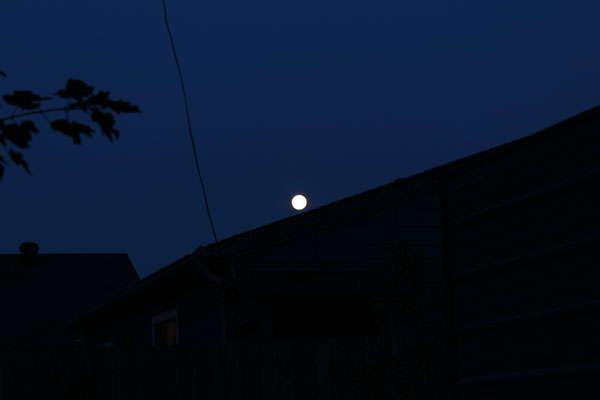
    There was a lot of hullabaloo on the internet last month over the “Super moon” that rose on the 23rd, 14% larger than the average appearance of the moon or something like that. It wasn’t as big as a heavy October harvest moon, but it certainly was bright and beautiful. The summer humidity gave it a warm glow, and while I don’t really have the camera equipment to do it justice, it was the first clear and warm full moon we’ve had since I got my new camera back in February.

    My first few tries weren’t very impressive. I did get some great pictures of the neighbor’s garage, and some stunning shots of telephone wires, but the moon managed to elude me no matter what I did.

    I’m pretty proud of my new camera, you see, even if it’s a little outdated. I treated myself to a Canon T3i as a combination birthday present to myself and business investment. But I only have one lens, the 18-55mm kit lens it came with. It’s a good enough general purpose lens, and since I share a lot of the “for fun” pictures I take with it here during my Friday Photo Breaks, I’d like to think you’d agree that some great shots can come from it.

    But the kit lens just wasn’t enough to capture what I needed. I needed something bigger, something better, something that could zoom in. If only I had a telescoping lens, I lamented to myself.
    And then it hit me.
    Telescoping.

    At one of the last jobs my husband worked, he was given the gift of a small tabletop telescope. I mean, that’s basically just a camera lens that you can’t actually attach to your camera, right? I was worried about trying to rig it up to my camera body, so I decided to take the safer route and just hold the end of my lens to the end of the telescope. It couldn’t hurt anything, after all. As long as I was careful, it wouldn’t even scratch the lens. I set the telescope up, focused on the moon, and then something magical happened.

    Yes!
    I don’t know if I’ve ever been so excited about taking a picture. I snapped a dozen different shots with a dozen different camera settings, feeling a wash of inspiration. Not all of them turned out well, but I did get a few dazzling glimpses of the moon’s face.

    Best of all, I snagged a few photos that were just what I had in mind for the cover of one of my next books. I have mentioned Born of the Moon, haven’t I?  No? Well, don’t worry – I’ll be speaking of that one soon enough.

  • Friday Photo Break, vol. 21

    My neighbor has the most gorgeous azalea bush. Really, she does. For a few days every spring, it erupts into the most amazing display of color.

  • Exploring Influences: The Elder Scrolls IV: Oblivion

    Oh boy, where to even begin with this one?

    Oblivion and I have an interesting history. I mentioned previously that I didn’t have much interest in the game. It never looked like something I’d enjoy, but a large part of that is because the game’s coverage really only showed it in first-person.

    Me and first-person games don’t get along. It might be something to do with my depth perception, or maybe just that I like the disconnect of being someone else when I’m playing a game, and the Elder Scrolls games didn’t seem to do that. That, of course, was a mistaken impression on my part. Once my husband told me there was a third-person view, I was willing to give it a shot.

    The world presented to us in Oblivion, which is the fourth installment of the Elder Scrolls series, is huge. The game takes place in Cyrodiil, a country divided into several smaller provinces. Each province has its own stories, its own citizens, its own problems. And the world is developed so well that it’s easy to get lost in the lore.

    The game offers a grand number of ruins, caverns and castles to explore, some tied to the numerous storylines that pepper the world, others nothing more than… well, a cave. But each character you encounter can teach you a little more about the world you’re playing in, and if you’re really lucky, you might stumble across a book.

    Books, in a game. Real books! Books about the world’s history, books about armoring, multi-volume encyclopedias of the world’s flora and fauna. Not only that, but there’s a wide variety of fiction to choose from, as well. I couldn’t tell you how many hours I spent in that game, reading books that later found a permanent home on a bookshelf in my virtual house.

    The Elder Scrolls games are well written and well developed, so that the visuals are matched by the grand storytelling that happens throughout. The world is vibrant, it feels like it could exist without you. And that’s an amazing thing. You aren’t in control of the situation, not really; You’re along for a very interesting ride, and that’s a wonderful example of what storytelling should be like.

    In all honesty, Oblivion quickly became one of my favorite games of all time. Much of the world created by Bethesda shows me a reflection of the worlds I’ve created, but best of all, it gives me a great example of how to create a world right.

    Whenever my fantasy novels are complete, I can only hope they live up to the kind of vision Oblivion has helped develop in my head.

    Last week: The Legend of Zelda
    Next week: Legend of Mana

    Save