Beth Alvarez - Author of Epic Fantasy
  • Exploring Influences: The Lord of the Rings by J.R.R. Tolkien

    Continuing on the topic of influences, this week we’re looking at The Lord of the Rings by J.R.R. Tolkien.

    If I had to say there was any one thing that made me want to write, it must be that I had access to these books. At an early age, I found myself with my mother’s dog-eared volumes. Like many, Tolkien’s work was my first foray into the fantasy genre. He was a pioneer in the field, giving rise to the versions of elves and dwarves and orcs the genre is known for today.

    Orcs, in fact, are something we owe Tolkien for completely, as the barbaric green or gray-skinned creatures we’re familiar with today came first from his series. Likewise, prior to Tolkien, elves were regarded as mischievous and sometimes wicked spirits, rather than the pointy-eared and graceful humanoid beings seen in modern media.

    In that respect, the development of these fantasy hallmark species in The Lord of the Rings has permeated the writing of virtually every addition to the fantasy genre. There’s still the occasional series that hearkens back to the traditional roots of various myths and legends, but it’s impossible to refute that the 1950s classic has impacted every fantasy writer, by simple nature of the fact that the books altered culture and classic folklore.

    Last week: The Death Gate Cycle
    Next week: Record of Lodoss War

  • Caturday no. 5

    Because Noodle is a particularly naughty cat, we can’t trust her to stay out on her own at night. It’s not the jumping on desks or knocking things over that concerns me, really, but her penchant for chewing on wires. We’re technophiles, there’s wires everywhere. She’s good about not doing it where we can see her, but if we leave the room, it’s not uncommon to come back to discover her chowing down on a phone charger. We tried a number of things to discourage her from it, but ultimately what worked best was kennel training the cat.
    She’s perfectly content to sleep in her kennel, and often goes there for her afternoon naps, as well.

  • Friday Photo Break, vol. 12

    When I was a kid, I never cared for autumn. I didn’t like the colors or the weather, didn’t like the onset of winter. I still can’t say I like the onset of winter, but my feelings about the colors that come with fall have changed.
    Naturally, this Japanese maple presented an interesting juxtaposition between two opposing seasons. The colors are distinctively autumnal, vivid reds and oranges. But this photograph was snapped in April, when the trees were blooming in the first warm days of spring. It creates an odd contrast, the flowers inspiring thoughts of fresh air and new life, the colors of the leaves suggesting cool winds and an impending end.
    The contrast between the two has always made this one of my favorite photos.

  • Exploring Influences: The Death Gate Cycle by Margaret Weis & Tracy Hickman

    Continuing to explore influences, this week we’re looking at The Death Gate Cycle by Margaret Weis and Tracy Hickman.

    I started reading the series not because I discovered it myself, but because I found the first book in my older brother’s room. He was never very vocal about literary interests, and given the things he seemed to like, I was surprised to find a fantasy book in his things. I borrowed it to read, and it wasn’t hard to see why it had drawn his interest.

    Haplo was not my first antihero, but he is still my favorite. The series does a remarkable job of molding that cliché into something satisfying, without seeming overwrought. Unlike most, he’s not really the reluctant hero – Instead, he fluctuates between seeming to fill the roles of hero and villain throughout the course of the series.

    Generally speaking, very few series are written in a way where they follow the antagonist. While Haplo doesn’t play that part all the time, it does an interesting job of showing how sometimes the difference between hero and villain is only a difference of opinion.

    That unique method of character development has taught me a lot about character growth, and showed me that sometimes, changing perspective – If only briefly – can make a world of difference in a story’s depth.

    Last week: The Wheel of Time
    Next week: The Lord of the Rings

  • A Fighting Edge

    I like swords.
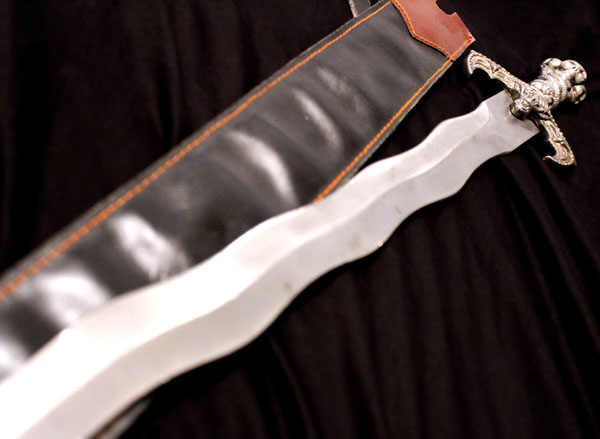
    Being all into the fantasy scene, I guess that comes as no real surprise, but despite my admiration of them, I only have one sword. It’s a simple red and black wakizashi that my Dad bought for me when I was a teenager. It hangs above the doorway into the kitchen, but it’s kept company by my husband’s much larger collection.

    Agnes, my husband’s first sword

    He’s got a nice assortment. A jian, some longswords, couple katanas, a wakizashi or two, a claymore, a flamberge, and I don’t even know what else. Either way, his swords are peppered throughout the house as part of the decor, with a few of them put away in a closet until we figure out where to put them.

    I never knew much about swords until my husband started educating me. It wasn’t until then that I realized that, as a fantasy writer, knowing this and that about bladed weapons was kind of an important thing. You get a little leeway in worlds you’ve created, but it’s still easy to stumble into a weaponry faux pas (Is that a broadsword or a longsword?) that could have people who know their stuff snickering at your amateur mistake.

    It’s important to make sure your characters have a sword that fits with the story you’re crafting, instead of just giving them a katana because Japanese swords are cooler. To that effect, it’s also important to remember that some types of sword receive their names because of the region they’re developed in, so if your story isn’t happening in an Earth-setting, you may need to rename them. Zweihänders should probably just be called great swords, or you can think up a special niche for the weapon and give it its own shiny new name – The heron-mark sword Rand wields in The Wheel of Time is really just a katana, after all. (Because katanas are just better, right?)

    The more I’ve learned about swords, the easier it’s become to determine when a writer doesn’t know a whole lot about them. All in all, it’s just another reason that research is always important.

  • Caturday no. 4

    Like most cats, Noodle is fond of blankets. Unfortunately for her, the dog is also fond of blankets… in a different way. Xochitl thinks blankets are delicious, so there are no longer any blankets kept on the furniture for Noodle to curl up in.

  • Friday Photo Break, vol. 11

    One of the most unique places I’ve been in my life is the Cathedral Basilica of St. Louis. Its interior is home to the largest mosaic surface in the world, though the exterior is amazing enough! I wasn’t able to get any good pictures inside, as we were told not to use flash, and no flash pretty much kills any point-and-shoot camera.
    As my husband was raised Catholic, I’d like to take him there to see it someday – And this time, I’ll be armed with a better camera, so I can get good pictures… even without flash.

  • Exploring Influences: The Wheel of Time by Robert Jordan

    Continuing on the topic of influences, this week we’re looking at The Wheel of Time, which was completed by the release of the final book not that long ago.

    While I haven’t finished the series and it may take me a few years to do so, The Wheel of Time is a series makes an interesting addition to my influence map as it’s the youngest fantasy series I’ve stuck with.

    The writing style is more in tune with what I tend to write like, making it easier for me to follow than a lot of books. The series also doesn’t shy away from having a large cast of important characters, something I can be quite guilty of doing. On that point, it provides me with a great example of how to balance a large cast, making sure each character is given the right amount of attention and growth.

    There are a lot of elements in Robert Jordan’s world that have also made appearances in my own, which is always interesting to see. I greatly enjoy comparing and contrasting his elements and mine, as it helps me better describe the differences between my version of common themes (such as magic) and everyone else’s. This aids me in making my stories more unique, while reminding me to keep things grounded enough to make sense.

    Despite all the reading material the series provides me with, I find that the first book is still my favorite, if only because I love that new sense of wonder that comes from being introduced to an unfamiliar world.

    Last week: The Black Gryphon
    Next week: The Death Gate Cycle

  • Maybe I’m a Lion

    Like most little girls, I had a deep love of animals. A few in particular rose above the rest, however. My mother gently told me that unicorns were extinct, which prompted me to decide that my favorite animals should probably rank among the living. And possibly the existing, which meant gryphons and dragons were ruled out, too. Naturally, since I was a little girl and most of us are the same, my favorites were horses… and cats.
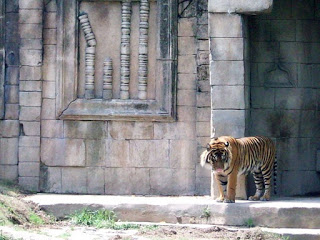
    Narayan, a Bengal tiger at the Memphis Zoo

    Not just house cats, though, no. I was in love with the big cats. I fantasized about petting a tiger and spent quite a few months of my childhood pining after the giant stuffed white tiger at the store. I never did get that tiger, but that’s okay. I still have most of my stuffed animals, and I’m not sure where a giant stuffed tiger would fit.

    My mother kept me active in children’s events at the local library, which exposed me not only to books, but to a number of interesting things. One such thing was a traveling petting zoo. Much to my delight, the two stars of the petting zoo were cats. Big cats. Okay, they were baby big cats. But still, how many people get to grow up and tell people that they once stroked the fur of a sleeping lion, or that they were clawed by a cheetah? Schemer didn’t mean to scratch me, of course, he can’t help that his claws lack the retractable nature that other cats have.

    Conveniently in line with my love of big cats is that the lion is sort of my husband’s totem animal. His only tattoo is that of a stylized lion’s head (which is actually an emblem from a video game, the game this post’s title comes from, but we can talk about that another time) and “Lion” has long been a name he uses online.

    Lions represent a lot of things. Strength, courage, pride. Running even deeper, for him, is that the lion is often associated with the sun, and my husband’s name is associated with Aztec sun gods. Lions are also viewed as guardians and protectors. The animal suits him, my husband is definitely a lion, though perhaps a tame one now.

    But what about me? Well, lionesses are viewed just a little differently. Where the lion is associated with the sun, the lioness is associated with the moon. The lion represents power and dignity in daily life, the lioness represents power in subconscious thought and dreaming. Together, the lion and lioness represent balance.

    It’s a little funny, since I’ve always been a night person, and someone known to be often lost in thought and dreaming vividly at night. Throughout the day I look to him for leadership, and as we’re married, I find his strength slowly rubbing off on me.
    So, maybe I’m a lion, too – A lioness, that is.

    What animal best represents you?
  • Caturday no. 3

    The funny thing about Noodle is that she’s always up to no good.
    You can tell because she’ll peek around the corner, casual as can be, but the moment you look at her, she lays her ears back and runs away with a noisy skittering of claws.