Beth Alvarez - Author of Epic Fantasy
  • Q&A, volume 1

    Since I started doing this whole writing thing seriously, I’ve had a lot of people ask questions about it. Mostly they’re spur-of-the-moment type conversations that might come up while I’m out running errands or while I’m at work. Sometimes they come to me over instant messenger or pop up in my email inbox. Sometimes it’s idle chatter during get-togethers and parties.
    The questions are usually along the same lines, though sometimes I get a few that surprise me. For sake of documentation, I’ve decided to try to take a few minutes each week to answer a handful of questions that get sent my way. So here’s a handful of questions I was asked today!

    Q: How long have you been writing?
    A: I’m not actually sure how to answer this, because I don’t know. Writing wasn’t something I just started doing, it’s something that’s always sort of been a part of me. I have a folder in my craft room full of old drawings and stories. The oldest story I’m aware of is from 18 years ago, I would have been 7 years old at the time. But I know that wasn’t the beginning. By that point, my spelling was decent, my punctuation was decent, and my typing was pretty good too, since it’s one I wrote in LotusWorks on my Dad’s old DOS-based computer.
    If the question is more along the lines of when did I start writing seriously, I’m a little better equipped to answer that. I started my first real novel when I was 16, which was 9 years ago. It’s been started and restarted several times since then, but I think its current incarnation is the most solid it will ever be.

    Q: Where you get your ideas and character development from?
    A: Story ideas are everywhere around me. I rarely have ideas that come to me in bits and pieces, usually it all comes in one big chunk. Most of my story ideas come from dreams I have, as I tend to be a very vivid dreamer. Other things that inspire me can be difficult to keep track of, as the concepts usually just spring to mind fully-formed. The most recent example is an outline for a story that I have written down in one of the notebooks I carry with me everywhere. The idea jumped into mind, fully developed, after passing emergency vehicles stopped around an accident on the interstate. (Fortunately, nobody appeared to be badly hurt. Just a few scrapes and bruises.) My husband was driving, so I had my hands free to get hold of my notebook and write it all down.
    As for character development… to be honest, I don’t get it anywhere! One of my favorite parts of writing is giving a chance to let characters bring themselves to life. I usually start with an unrefined notion of what they are, but I never know what they’re going to become. My writing method is very organic, I tend just let them become what they will as I write. Not all characters end up interesting to read about, not all of them end up being likable. But then, aren’t there some people who are like that, too?

    Q: Do you schedule a time to sit down and write or do you just sit down and write whenever?
    A: I’m most creative at night, so I try to keep a little time free in the evenings to write something. I hope for the chance to write every day. It usually doesn’t happen, so I try not to get too stressed if it doesn’t pan out the way I plan. My goal this year is to get 1,000 words written every day. I’m a little behind due to house remodeling projects, but I should be caught up in a week or two.

    Q: What do you find most helpful when you’re having trouble working out details of what you’re working on?
    A: To stop writing. This is actually one of the hardest things for me to deal with! If something isn’t working out or coming out the way I want, it can be pretty frustrating. But since I try to let the story flow as naturally as possible when writing, I figure if I hit a roadblock, I’m doing something wrong. I used to try to muscle my way past it, but my teacher in college taught me something about art that applies to writing as well: If it isn’t working, give it time. Take a break, clear your head, come back to it later and you’ll see exactly what’s wrong.
    So if the details or workings of something just aren’t flowing onto paper, I call it a night, eat some candy and do something else! Usually if I give it a day or two instead of trying to force past it, the problem becomes glaringly obvious. Sometimes it means going back and changing a lot to let a new idea fit, sometimes it’s just minor edits or tweaks to reroute the story.
    Of course, I’m also of the opinion that eating some candy is always the solution.

    Have a question you’d like to ask? Feel free to leave me a comment!

  • Websites and things

    I like websites. I always have.
    My older brother is a very skilled web designer. Even his MySpace profile was gorgeous! I’ve always been pretty envious of his skill, but I like making websites, even if they don’t look as good as his.

    All in all, I think my biggest problem has always been that I don’t like the cold and austere look of professional sites. I always find myself trying to squeeze in a few more graphics or just a little more color. Something to give it just a little more life, a little more energy.
    The result, as you would imagine, is usually horrendous.

    But a professional author has to have a professional webpage. Several years ago, I bought my own .com and hosting. I’ve used it for various things and it’s had at least half a dozen designs in the span of time I’ve had it, but the one I gave it this morning is the most professional it’s ever looked.

    You can view it here, of course: https://www.ithilear.com/

    It could look cleaner. It could look sharper. But all in all, I’m not sure it could look more me. As a writer, I’m obviously the creative sort. As an artist, I find myself drawn to things with visual interest. Sure, I could’ve had plain white backgrounds or sleek glassy looking Photoshopped buttons. But I wanted something a little more frilly, a little more varied, with a little more color and texture than that.

    I’m sure I’ll probably change it again in the future, but for now, I think this will do nicely.

    In other news, I’ve finally done it. After years of resisting, I finally started a Twitter account. I’m not sure how often I’ll update it, or even remember that it’s there, but if you’ve always wanted to tweet me, now you can!

  • Welcome

    Whether you were directed to our world by chance or by choice, we welcome you to Ithilear with open arms.

    Ithilear.com is the homepage of budding author Beth Alvarez, whose first complete work, Death of the Sun, is currently available on both Amazon.com and Barnes and Noble.

    Specializing in fantasy fiction but not opposed to exploring other genres, Alvarez is currently working to complete her second novel and first foray into the fantasy fiction genre, Serpent’s Tears.

    The first of three books in the series, Serpent’s Tears aspires to be an immersive and enjoyable tale, and marks the beginning of a long line of novels to be set in the world of Ithilear.

  • The importance of nice cars

    The importance of nice cars

    At some point in our lives, each of us comes to learn of one luxury that we feel is vital to our way of life. Obviously, I think the internet is my most important luxury. Video games are probably in there somewhere, too.
    But after that, it’s nice cars.

    I’m no expert on cars, but I enjoy them. I’m always eager to drive something new, though the opportunity doesn’t come along all that often. My list of things I’ve driven is relatively short – Short enough that I can recount it right here.
    As far as manuals go, I’ve driven a Chevy S-10, a Toyota Corolla, and a Dodge Neon.
    For automatics, I’ve driven a Mazda Protegé, a Mazda 3, a Chevy HHR, an Oldsmobile Intrigue, a Dodge Caliber, a Ford Focus, a Ford Windstar, a Chevy Cavalier, a Chevy Malibu Maxx, and two different Ford Mustangs.

    I don’t know what it was about the Mustangs that drew me to them, but I love those cars. Hot Wheels versions, still in the packages, hang above my sewing machine. A book about them sits on my shelf, there’s pictures of them on the calendar in the kitchen, a sticker of one on the back of my phone. That one serves an important purpose, at least; my husband and I have the same kind of phone, so a sticker means I can tell at a glance which one is mine.
    There is also, of course, the Mustang that sits in my driveway. Her name is Rosie II.

    But what does all this have to do with writing? It seems like a stretch, I know.
    Writing Death of the Sun was an interesting experience for me, largely because it’s a genre I don’t even really read. I’m just not that interested in fiction set in modern times, I’d rather re-read The Chronicles of Narnia. Writing a book that was set in the real world presented a unique set of challenges. I had to bend the rules of the world around me to make something supernatural fit in.

    I’ve always heard people say that it’s best to write what you know. I did a lot of research, but in the end, the things that make the fictional additions to the world seem believable are the ties they’re given to real places.
    I spent some time thinking before I decided to set the story in St. Louis. It’s no secret that I grew up in that area, and I feel like adding a little fantasy flair to places I knew was what would really make it seem real. I’ve had several readers from the St. Louis area mention that they love the local references.

    But as an extension of writing what you know, I decided to explore one of the facts of life that I learned when I was a teenager, and that’s where cars come in.

    I suppose I was about sixteen or so at the time. A dear friend of the family came to spend a few nights with us, and his dad was the one who came to get him when it was time to go home. I’m sure I will never forget seeing him roll up the driveway in a brand new black Trans Am.
    He’s always seemed like a quiet and mellow kind of guy. Serving in the Air Force, he had just returned from a tour in Iraq. He didn’t really want to talk about the war, I couldn’t blame him for that. Just speaking of coming home seemed to make his voice shaky. My mother asked him about the new car, and he just sort of laughed. “Well,” he’d said, looking the Trans Am over with an appreciative eye. “Life is too short to go without nice cars.”

    I wrote a lot of life lessons into Death of the Sun. They often don’t show clearly, but that one line was something that had always stuck with me. Blaine, of course, speaks of the same wisdom. He may repeat it with some sense of irony, but since I ended up writing him with an awfully nice car, it’s easy to see that it’s some tie to humanity, some simple wisdom that can apply to anyone.

    I’m not in love with Blaine’s car. It’s nice, don’t get me wrong – But it’s not my dream. I gave him his car, a 2002 Pontiac Firebird, in homage of that car being my husband’s dream. He may never get it, but that’s no reason to forget.

    But the idea that life is too short to live without nice cars… that’s why I made the push to get a Mustang as my first car, because it was what I really loved. Once I had that, and I got to experience driving the winding paths that Route 66 cut into the southern Illinois countryside, I understood a little better.  There’s a real freedom in having a car. And if you’re going to give yourself that freedom, why not go all the way? Our time here on Earth is so brief. We might as well ride it out in style.

    Everyone’s got a life luxury like that. What’s yours?

  • Judging a book by its cover

    Judging a book by its cover

    Let’s just admit it.
    Despite everything our mothers taught us, all of us have judged a book by what we see on the outside, at one point or another. This is something I try not to do, being a writer. I’ve read some great books with bad covers, and some bad books with great covers. But at the same time, I’ve also read some great books with great covers.

    I have to admit, my feeling on book covers is best summarized with one of Shannyn Sossamon’s lines from the movie A Knight’s Tale: A flower is only as good as its petals.
    So as an independent writer who decided to go the self-publishing route, the book’s cover was, in fact, a big deal to me. I thought about it a lot, and often. I started thinking about it before I was even done writing the first chapter. We’ve all seen them, haven’t we? Those e-books that might be great stories, maybe they even have good reviews, but the covers look like something that belong on Photoshop Disasters.

    I knew I wanted a simple cover, and I knew I wanted something Aztec-inspired. But beyond that, I hadn’t a clue. I looked around at a lot of services offered by artists who I’m sure could have done a lovely job with it, but at the end of the day, I was just another penniless writer, looking for my outlet for all good things in life – Truth, Beauty, Freedom, and above all things, Love.

    Well. That settled that. If I wanted a book cover, I was just going to have to make it myself.

    Over the course of several weeks, I looked everywhere for an Aztec calendar stone. Not a full-sized one, I’d never have anywhere to put that! But a small one, maybe an Aztec wristwatch stone, would be perfect. I don’t know how I became fixated on it, but it turned into a months-long search for the perfect picture of an Aztec calendar stone. I looked and I wrote, and I wrote and I looked. But the writing was going better than the looking, and before I knew it, I had completed the novel and was on to the task of editing, still with no cover.

    What was I going to do? I was going to end up with one of those horrible Photoshop Disasters-style covers, I just knew it! I spent more time looking, and looked harder. The answer to the problem came one day, through no remarkable means. All that time, all I had to do was open my jewelry box.

    Now, I make jewelry. I make a lot of it, mostly to sell on Etsy. Despite how much I make, I actually wear very little. I have a few bracelets I like best, and I wear those almost every day. My wedding ring and engagement ring rarely come off, obviously. Other than that, though, I only have a few necklaces and a few pairs of earrings that I wear, and I don’t wear them all the time. I was surprised that I’d forgotten it, but as soon as I made the rediscovery, I knew that I had found my cover.

    My husband and I got married on a sweltering August day in Illinois. Because the Midwestern heat wasn’t enough, we then flew to Acapulco, Mexico for our honeymoon. The city was amazing, and I would love nothing more than to go back someday, but one of the most interesting things we did there was explore the local market.

    It was amazing to see all the tents and tarps, run together to create some massive outdoors shopping center. It reminded me of all the fantasy stories I read, and I ran from stall to stall without ever really taking in what there was to be seen in each. Eventually, one stall caught my eye, selling silver jewelry brought in from Taxco. The gentleman running the stall handed me a basket and told me to pick up anything I liked. I found quite a few pieces, some for myself, some as gifts for my family. But the one piece I really fell in love with, the only piece I ended up asking my husband to buy for me, was a pendant in the shape of the Aztec calendar stone.

    Pentax Optio WPiI don’t have a great camera. Actually, we’re not even sure where it came from. My husband served in Okinawa, Japan before we married, and most of his possessions were shipped back to the States when it came time to change duty stations. When we unpacked one of the boxes, we found a small Pentax camera that had seen better days. There were gouges out of the front, an ironic crack across the ‘waterproof’ emblem, and I couldn’t even make out how many megapixels it said it was supposed to be. It took a good hour on Google to find out what it was.

    We still don’t really know where it came from, but it’s my favorite camera of any I’ve ever used. I snapped a few shots of my necklace on the coffee table, and cleaned them up in Photoshop. Honestly, it took a lot less work than I expected, and this was it! This was perfect. It may not be the most eye-catching cover in the world, but it has meaning to me.

    Publishing Death of the Sun marked a new beginning in my life, the part where I decide to throw caution to the wind and just take a chance with my writing, see if anyone else likes it as much as my friends say they do. It only seemed fitting that it bear an image of something that represented another new beginning, now several years behind me. My Aztec pendant was the first gift my husband gave to me after we were married. That was the first step in my life transforming into what I always dreamed it would be, so it’s only fitting that it be included in the second step, as well.

    Will that become a trend? Hmm… I don’t know.
    After all, I don’t really know how my dream car would figure in.

  • At last

    At last

    It’s been a while since I posted. The holidays have come and gone, and the new year has started. My birthday is right around the corner, and a new chapter of my life began just a few days ago.

    Last time I blogged, it was about the trial that was editing my first novel. Well, editing came and went, and then came again. In all, the book was edited four times. It was a long process, and one of the most difficult I’ve experienced, but at the end of it all I’m glad that it happened. One thing I’ve always said I would do has actually happened, and I think that’s something to be proud of! It was cutting it close, but I’ve managed to sell my work before turning 25.

    So how does this happen? Well, for me, I decided to do it on my own.

    My first novel, Death of the Sun, is now available on Amazon.com for the Kindle and paperback, and also on Barnes & Noble as a paperback.

    The decision to self-publish the story as an e-book was a difficult one, but it was one made after much research and consideration. Ultimately, I’m pleased with the choice. I’ve only heard back from the first few readers, but so far, the only negative comment I’ve received is that they wished it had been longer.

    Length was actually a major factor in the decision to make it an e-book. The final word count was a decent bit over 73,000 words, so it’s nothing to sneeze at! But it still falls short of what most publishers want for length. The story was complete in my eyes, so it would have felt wrong to try to pad it out and meet a word requirement. It would have seemed forced. After all, there’s nothing wrong with a short story as long as the entire story is told.

    It’s been a beautiful learning experience. From figuring out how to format things myself to learning how a story should be structured, I gained an incredible amount of knowledge. On top of that, it was an interesting challenge. Death of the Sun is a romance novel, and a vampire story on top of that. I’ve always been smitten with vampires in classic literature, ever since I was a girl. But romances? I’ve never read a single one! For that reason, it’s possible that Death of the Sun is an oddity in the genre.

    The story follows Angela, a young professional that’s become so wrapped up in her career that she’s never even decorated her apartment. She struggles with the desire to do something different with her life, and the desire to make her father (who just so happens to be her boss) happy. These are things that end up absorbing her, and everything else in her life falls by the wayside. It’s not until she meets Blaine, a vampire that no longer finds his condition all that it’s cracked up to be, that she realizes how off-track she’s gotten.

    In that respect, it’s a story that chronicles the growth of the characters as people. Sometimes they’re enriching each other’s lives, sometimes they’re unintentionally making things worse, but all things considered, there’s the underlying feeling that everyone can be stronger when they have someone to lean on. In that respect, even if romance isn’t really your thing, I think there’s something in the story of people’s lives that all of us can relate to.

    Save

  • Last Sunday

    Last Sunday

    It’s not that I’ve already run out of things to talk about. It’s more that this past week has been very busy – Last Sunday was one of the biggest, most important days of my adult life. Well, since getting married, at least.  Last Sunday was the day I completed my first book.

    It’s hard for me to believe it’s taken this long, really. I’ve been writing forever, but I’m such a perfectionist that it’s hard for me to finish anything. I go back and edit a million times over as I’m writing, and that ends with me not getting anything written at all. That, and my attention span isn’t always the greatest, so I tend to jump between stories quite frequently. I have over a dozen books started on my hard drive, but until now, I’d never actually completed one. It was a huge step forward, a cause for great celebration, and the beginning of what I’m discovering to be the actual hard part.

    This feels like a terrible thing to confess, but I’ve never actually gone back and edited anything. Even when I was in college, I never edited my papers. I wrote them out in one shot, ran spell check, and went from there. Part of this is good, because it goes to show you that my typing, spelling, and grammar skills are decent enough that I can skate by without having to check my work. But on the flip side, it’s quite bad, because it means I don’t have experience editing anything.

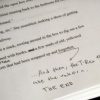
    What do I keep? What do I cut? Am I doing this right? Am I doing it wrong? Can it be done wrong? I don’t even own a red pen! These are new problems I face every time I sit down to edit. I quickly learned that I can’t stand to read my work in the OpenOffice document it’s written in, I had to print out a hard copy and edit it the old fashioned way, flipping pages, proofreading three or four times over, marking things out and scribbling out notes between lines and around the margins of the page. But again on the plus side, at least it’s not a bad first draft. I have some odd habits that have stuck in my writing since the days I did chat room roleplaying, but overall, there’s usually only two or three things on a page that I decide to remove or change.

    It’s been a huge undertaking, but it’s one I’m  happy to finally be doing. Once I’m done, I’ll read it again, but I’ll probably let my alpha readers review it to help find mistakes before I begin the second round of editing. When that will be, I’m not entirely sure. I’ve heard that the editing process usually takes about a week per session, but is that for full time writers, or people like me? People working retail and doing editing in the break room, coming home and doing housework and laundry, trying to squeeze in enough time to do a few more pages before bed?  I hope to have it done before the end of the year, but as my work schedule gets busier and the holidays get closer, I’m not always sure that I’ll make it.

    But I’m going to keep my chin up. Every day of this is an adventure. And besides, I have my husband to help me with editing… apparently.

  • Magic

    It’s no wonder that truth is stranger than fiction. Fiction has to make sense.

    -Mark Twain

    I’ve seen this quote being shared by a lot of my friends lately, and every time I see it, it reminds me of a conversation I keep having with my husband. Both of us are particularly creative individuals, but our creativity goes in different directions. Whereas my primary goal with my writing is to be an accomplished author with many books, his goal is to write and illustrate comics.

    Mark Twain’s view on truth versus fiction is something that comes up between us now and then. We go back and forth for a bit, until we finally settle on the idea that we just don’t understand the other’s viewpoint. See, we both like fantasy fiction, but we have very different ways of approaching it. Good comparisons can be found in main characters of stories we’ve both been writing, so those are the characters I’ll explain with.

    His character has wings. Pretty standard fare in comics and fantasy, but this has ended up being a major stall in why he hasn’t begun drawing his comic. His problem lies in that his character is also a general, and armor and clothing don’t always mesh well with wings. No problem, he’s already established that her race can hide their wings at will. In my opinion, that should be enough to get started. But instead, the how and the why of it is all he can think about.

    Because he refuses to go the Warren Worthington route and just have the wings conveniently vanish whenever the character dons a trench coat, cape, or other coverage, he’s instead spent the past few years trying to determine just how the species is able to hide their wings. Folding them up close because of extra joints in the wing structure? No, too bulky. And besides, the long primary feathers could end up being bent or broken. Do they retract into the body? No, that couldn’t work! There’s too much length in the wing bones, they just wouldn’t fit. And how do they move those wings, anyway? They already have arms, so they’d need a second set of pectoral muscles to control their wings. Then their wingspan would have to be increased, to account for the extra weight of the new muscles…
    He puzzles over this, sometimes for quite a long time. And whenever he asks my opinion, he always gets the same response from me. How do they do it? Magic!

    Now look at the issues my character has. The people around him never age, why is that? Magic! He’s a weird looking lizard creature. How is that supposed to be explained? Magic! Is it as simple as that? Well, when your story involves wizards or mages, sometimes, it is.

    Magic has always been a fallback in fantasy fiction. It’s that extra something that makes the unbelievable into something believable, by adding that one extra element that isn’t defined by science. Magic doesn’t exist in our real world, except maybe as parlor tricks and phone psychics, who I’m pretty sure are just Googling your name when you call anyway. This means that without the rules of science to bind it, magic is the perfect something to add sense to something that otherwise couldn’t be explained.

    It’s a fantastic element added into some of the most incredible stories. The Lord of the Rings has Gandalf, The Wheel of Time has the Aes Sedai, and most things ever written by authors like Mercedes Lackey, Margaret Weis, Tracy Hickman, and R.A. Salvatore include a fallback onto the mystical, unexplainable force that is magic in fiction.

    And there’s nothing wrong with that. Even when creating your own worlds for fantasy fiction, you can’t abandon things like physics. Even if you tried, it would be so completely off the wall that it would be nigh impossible to explain it properly in your story. The human mind sort of operates on the idea that even in parallel worlds, there’s some things that will always exist. Light, for example. Elements like water, fire, earth. Liquids and solids. These things cannot be avoided, and are all written the same way. But magic is something the writer defines. How it can be tapped, who can use it, what its limits are, if any. For that reason, magic will likely always be a staple of the fantasy author’s work.

    Will my husband ever figure out the science for his character having wings?
    I don’t know, but at some point, I think he may just come out and say magic.

  • The Groove

    Don’t get me wrong, I like my job. I’m probably one of few people working in retail that can say that comfortably. I like the people I work with, I like the products I handle on a daily basis, and for the most part, I even like the clientele. But if there’s one thing I have to choose about my job that I don’t like, it’s got to be that work is the one thing that is best at throwing off my groove.

    I’ve always been more of a nocturnal person. I love sunshine and fresh air, but my inspiration is always strongest late at night. When I was a teenager, it wasn’t such a big deal. I was homeschooled, so it was never a problem for me to sleep a little late if I’d been up late writing the night before. I wouldn’t say my parents encouraged such behavior, but as long as I had my schoolwork done by the end of the day, they didn’t seem to mind. Even in the project I’ve been working on the past few months, I’ve found the parts that turned out best are the ones that I wrote later at night. This has led me to the conclusion that I have a late-night groove, and unfortunately for me, working mostly mornings brings about a problem.

    Sure, I rarely work full shifts. Most of the time I only work 4 or 5 hours a day. I’m extremely blessed to have a very traditional husband, he only expects me to pay for my car and the insurance on it. Had we gotten a different car, he’d probably pay for that too, but when my Oldsmobile Intrigue’s transmission went out at the end of September, I insisted on getting the car I really wanted. So I only work a few hours a day, just enough to pay for my Mustang. The rest of my time is spent doing a whole lot of nothing, a task I’ve come to refer to as “getting into the groove”.

    And the groove is a wonderful, incredible, fantastic thing. When I get into the groove, I can turn out a whole chapter in an evening. When I get into the groove, I can proofread and edit ten thousand words in a few hours. But as of late, whenever I’m in the groove, I’m nestled in bed, and might possibly be snoring. I’ve been trying for a few months to create a new writing habit, in hope it would change where in the day my groove falls, because working mornings after staying up until 2 or 3 AM writing just doesn’t really work! But it’s amazing how hard it can be to change one’s habits.

    There’s a popular claim that a habit only takes 21 days to form. I know from experience that with my writing, that’s not the case. Of course, different tasks take different amounts of time to turn into a habit. Drinking a glass of water when you get home from work, for example… 21 days is plenty of time to turn that into a habit. I’ve written every day for a month, but that still didn’t put me into my groove.

    No problem, research has shown the average median for habit forming is 66 days! Except I’ve tried that, too, and it doesn’t work. Okay, that’s the average median. Up toward the top of the scale, things that are hardest to turn into a habit, those can take up to a whopping 254 days to turn into a habit.

    Ouch.

    Well, with that in mind, to get me to stick to forming a writing habit, I’ve come to a fairly simple conclusion. All I have to do is establish a ritual of things to do when I get home from work, and go from there. I can work writing into it, and as more simple things (Such as getting a drink immediately after getting home) become habits, hopefully I’ll connect those habits to writing. Then writing, in turn, will become its own habit, and move my groove forward into the day! It seems pretty foolproof, but it may not necessarily be me-proof. After all, I’m no fool.

    I’ve already started this project. In fact, I started it when I began writing the story I’ve now nearly completed. I’ve formed one association out of my new habits: I’ve come to associate drinking Starbucks with writing. This is great! This is progress! All I have to do is keep a bag of Starbucks coffee grounds on hand. Every day when I get home from work, I’ll just make myself a cup of coffee, which is really more like a cup of milk and sugar with a splash of coffee for extra flavor, sit down and drink it while I write. It’s worked great for a few days, but today, I encountered a unique problem.

    My remarkably sweet husband brought me a frappuccino while I was at work, because I’d mentioned that I woke up still sleepy. I appreciated it greatly, gave him a big hug and bid him a good day, and happily sipped at my overpriced but delicious goodie while I worked.
    Then something horrible happened.
    I hit my groove.
    At 10:30 in the morning, smack in the middle of my shift, I was overcome by the immense desire to drop everything and write. But there I was, still with hours of work ahead of me, a dozen little tasks to do, and no notepad in sight.

    Oh dear… perhaps trying to move my groove wasn’t such a great idea, after all.

  • The beginning.

    I’m good at procrastinating. In fact, I’m so good at it that I procrastinated on starting this blog for about two months. I’m not always this way, I promise – There’s a few things in life that I always do right away. One is get dressed in the morning, because I’ve always hated pajamas. The other is writing when I feel like writing.

    That right there is why I decided to start the blog in the first place. The problem is, keeping a blog involves writing, and writing involves having something to write about. So why keep a blog until I have something to talk about? That’s what I was waiting for. The more I tell myself that, the less it sounds like I was just putting it off.

    On the other hand, I’ve never been good at speaking as myself. Being a writer doesn’t mean my own voice has to be all that articulate. I’d like to think I handle my words okay, but if I don’t have a story to tell, more often than not, nothing comes out at all. So why is all of this coming out now? That’s because I have a story to tell. A story about stories.

    I began writing my first book when I was sixteen. Yes, I was that kid, shutting myself up in my bedroom on a sunny day so I could jot down everything that popped into my head, without being disturbed. Coming from a large family, there were often disturbances, most of them being named after my younger siblings. There were times my parents would shoo me outside, but it didn’t really make a difference. All that meant was it was a sunny day, and now I was sitting in the tree house or in a swing, thinking up my stories there. For several years, those stories were my life.

    Then something happened. Something wondrous, and something terrible: I grew up.
    All of a sudden, I was responsible. I was out of school and in a job, paying bills and saving money that inevitably was spent on grown-up things like car repairs. The next thing I knew, not only was I grown up, I was married. All of a sudden I didn’t have time for things like daydreaming and writing. I had a house to keep and a husband to look after. For a while, that was all I thought about.

    Until this summer.

    One morning I woke up with a nagging thought in my head. No, it wasn’t a thought… it was a voice. It was half a dozen voices, at least. Characters from stories that I’d begun and forgotten, brushed aside in my pursuit of a “normal” grown-up life. What about us? the voices asked. What about our stories? Don’t you want people to know what happens next? And that was when I realized that in all my effort to lead a grown-up life, I’d left my life behind. My life was writing, my life was my stories, my life was the books I’d begun and set aside.

    Well. If there’s one thing I’ve learned in my years of being a grown-up, it’s that I can do whatever I want, and nobody can stop me. If I want to eat ice cream for breakfast, ha! Mom can’t stop me, she’s four hundred miles away! If I want to sleep until noon on my day off, ha! I can unplug my alarm clock, and no one can chide me for it! So if I want to finish writing a book, who’s going to keep me from it? Okay, okay… to be perfectly honest, my employer might slow me down. But a job won’t stop me. Nothing can!

    I’m two chapters out from completing my first novel, and nothing can stop me.
    So this is the beginning of my real grown-up life. Living up to my goals, picking up those old stories I’d all but forgotten, and eating ice cream for breakfast.
    This is gonna rock.