Beth Alvarez - Author of Epic Fantasy
  • Cover Reveal: Her Midnight Wedding, coming in December!

    Cover Reveal: Her Midnight Wedding, coming in December!

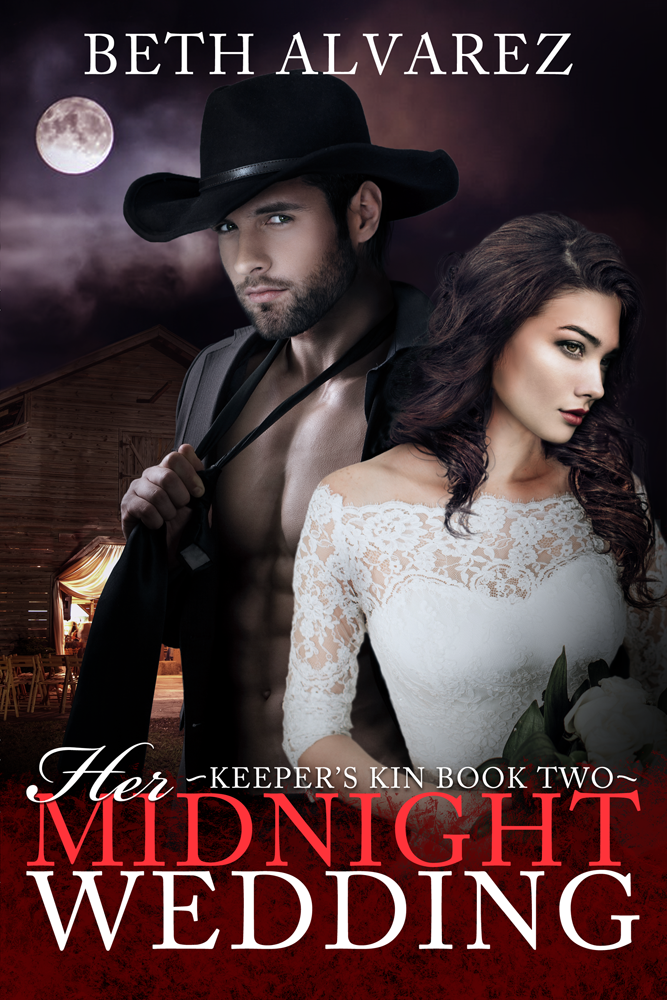
    It seems like I only just shared the beginning of this series, but here we are, already looking at the next installment in the Keeper’s Kin universe. Her Midnight Wedding, the second book in the core trilogy, will hit Amazon and Kindle Unlimited next month. I have more to share about the future of this series and what to expect in coming days, but for now, behold!

    Keep scrolling to see the cover and find out what this book is all about…

    Her Midnight Wedding by Beth Alvarez

    Though Kade Colton swore his hunting days were over, it’s impossible to refuse the call when a werewolf turns up in Holly Hill. With vital steps in the contract missing, the unjustified hunt could spell death for an innocent. Fighting to stop a rival hunter is hard enough, but when a feeding gone wrong puts the sheriff’s son on his heels, Kade must choose between having his secret revealed or defying the enigmatic Keepers—either of which could cost his life.

    Felicity Hammond is determined to marry her cowboy, but happily ever after doesn’t come easy when your intended sports spurs and fangs. Planning a midnight wedding should have been the hard part. Instead, she’s stuck racing the sunrise to save her beloved. If Felicity can’t end the hunt and untangle the sea of red tape that keeps Kade’s hands tied, they can kiss their happy ending goodbye.

    Her Midnight Wedding is the second book in the Keeper’s Kin series and will be released in December.

    The release date isn’t yet set in stone, so I won’t give an exact date, but I’ll be announcing it everywhere as soon as the book is ready to roll.

    More series news coming soon!

  • The powerful properties of vampire blood

    Though I read and enjoy a lot of vampire fiction, one trope that has become common enough to be accepted as fact managed to elude me for several weeks…  and that was vampire blood as having special properties.

    That drinking a vampire’s blood could turn a person into a vampire was grounded in stories at least several hundred years old, but this was something different–the most common trait was that if a human consumed a vampire’s blood, it could transfer power, enhance senses, or heal someone.

    Of all the topics on my list of things to cover, the supernatural properties of vampire blood in media also ended up being the most difficult to research. Part of the difficulty appeared to be that no matter where I looked, there was no clear historical foundation for it.  And yet virtually every vampire book I picked up that was published in the past five years relies on this as a story element. So where did it originate?

    Historically speaking, there is merit for the idea that blood contains power. In ancient times, consuming organs the conquered was believed to allow one to absorb additional strength or traits from the consumed; in some cases, it was thought to apply to animals, as well. The belief eventually spread to include blood, as well, and the practice was long-lived. As recently as the 17th century, English women believed they could increase their fertility by drinking the blood of defeated enemies.

    Yet despite its historical significance, it didn’t overlap vampire lore until much more recently. In fact, it’s the most recent addition to vampire myth I’ve encountered in my research–younger than me, even. The earliest indicator there might be something more to the power of vampire blood that I discovered was in 1988, in Anne Rice’s Queen of the Damned, where Daniel is given a vial of Armand’s blood; if Daniel were to break the vial, other vampires would sense Armand’s power within the blood.

    But that still only applies the additional power to the vampires themselves, giving humans no benefit from it. This now-common trope implies vampire blood is beneficial, offering properties such as healing, which is a little younger still.

    The earliest appearance of this feat belongs to The Vampire Diaries in 1991, and that appears to have been the breaking point. From that moment forward, it became a common theme in vampire media, appearing in a number of bestselling vampire books, both novel and television versions of True Blood, and on and on.

    If it appeared in literature prior to that, it wasn’t enough to make waves. But only ten years after that appearance in The Vampire Diaries, it had become a commonplace addition. Today, it might as well be a vampire staple, as I rarely see books that don’t include a nod to it in some form.

    Alas, I prefer my vampires to be slightly more traditional. Accepting a lot of standards set forth by Dracula and eschewing much of what’s newer, this is one that doesn’t quite permeate my writing. While the vampires in the Keeper’s Kin universe can gain power from consuming the blood of other vampires, that choice was birthed out of the old concept of consuming rivals to receive a portion of their strength.

    Next time, though, we’ll discuss the history of vampire blood as a reagent for creating new vampires–and other methods of turning, as well.

  • Keeper’s Finder and Her Midnight Cowboy are now available!

    Keeper’s Finder and Her Midnight Cowboy are now available!

    Happy release day, everyone!

    After months of hard work, I’ve got several new books to share with you: as of today, Keeper’s Finder and Her Midnight Cowboy are available in both paperback and Kindle editions!

    Keeper’s Finder is a standalone novella of 30,000 words. It tells a whole story on its own, but is set in the same universe as Her Midnight Cowboy, which is the “official” book one in the Keeper’s Kin universe–and 80,000 words long. Either book can be read on its own–they both offer a full story and can be read in any order. Both are available in Kindle Unlimited.

    Just in case you missed the previous blog post, full descriptions of either title can be found on Amazon. Ready to read? Click either cover to head over to Amazon and check them out!

    Keeper's Finder by Beth Alvarez  
    Or, click here to view Keeper’s Finder,

    and click here to view Her Midnight Cowboy.

    But there’s more! I said several books, if you noticed–not two books.

    The First Hunt, a Keeper’s Kin novella of 29,000 words, is also now available!

    The First Hunt by Beth AlvarezBut there is a catch. Since The First Hunt is a prequel to Her Midnight Cowboy, I’d hate for people to stumble upon it and give themselves spoilers. So instead, join my newsletter by following the link in the back of Her Midnight Cowboy‘s eBook, and you’ll receive instructions on how to download your free copy of The First Hunt.

    This book is only available as an eBook edition, but if you read Her Midnight Cowboy as a paperback edition and wanted to give the eBook edition of The First Hunt a try, just join my newsletter by following this link instead, then reply to the welcome message to let me know–I’ll make sure you get a copy.

    The next book in the series is currently scheduled to release in December.

    Happy reading!

  • The Search for Castle Dracula

    The Search for Castle Dracula

    Despite Castle Dracula being a fictional place, the question of which castle inspired Castle Dracula holds a surprising amount of contention.

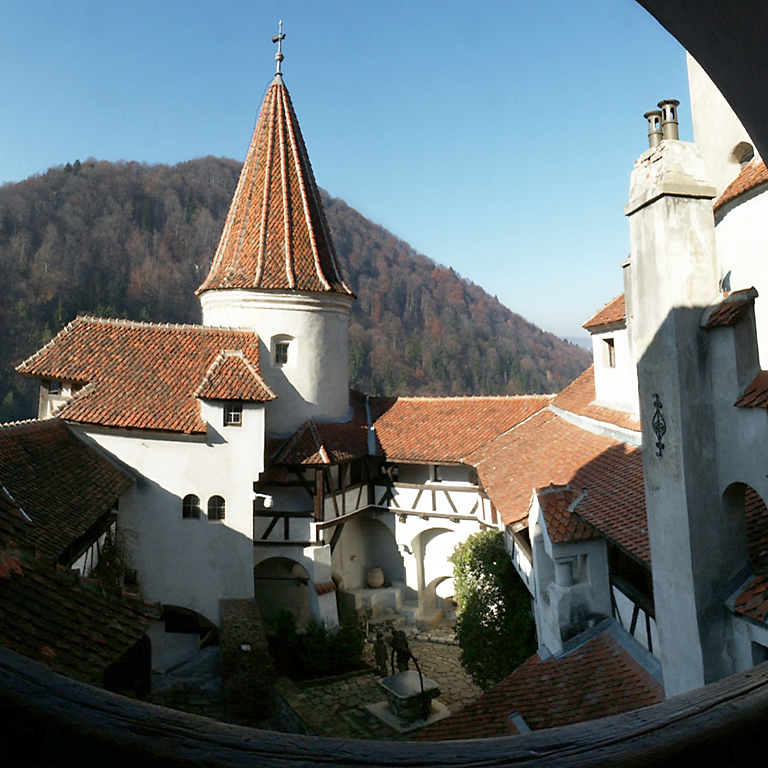
    Bran Castle - Photo by  Daniel Tellman Timisoara
    Bran Castle – Photo by Daniel Tellman Timisoara

    While Bran Castle claims to be the inspiration for the site and markets itself as such, it’s hard to say which castle is the closest contender for the title. Though located within Transylvania–a region inside modern-day Romania–the castle also stands more than 200 miles away from the only real directions offered within Bram Stoker’s novel, meaning that while it may have served visual inspiration, it couldn’t possibly bear anything more.

    Borgo Pass is the clearest clue provided in the actual text of the book. The place refers to Tihuța Pass, located in the Eastern Carpathian mountains. There were two castles in the region, but Bistrita castle was in ruins long before Dracula was a twinkle in Stoker’s eye. Aside from location, there’s little to tie the castle to the Dracula myth; it was built and occupied by John Hunyadi–a contemporary of Vlad the Impaler, who is well known as a source of inspiration for Dracula–but that connection is weak and tangential at best.

    Though Poenari Castle is often held as a contender for the “real” Castle Dracula, it’s even farther from Tihuța Pass than Bran Castle, and its only claim to Dracula fame is that it was home to Vlad III. Weaker still is the claim that Corvin Castle served as the inspiration, latching on to the story of Vlad III’s imprisonment as a way to somehow connect the castle to the Dracula tale.

    And of course, we can’t forget Orava Castle, which isn’t even in Romania, but Slovakia. Regardless of where Castle Dracula was supposed to be, Orava Castle was the site of filming for Nosferatu, creating a visual that sticks with vampires to this day.

    It is possible to delve deeper, however, and discover that Stoker’s own hand-penned research notes indicated the castle was meant to be situated in the Călimani Mountains, on a very particular mountaintop. Considering that Tihuța Pass was mentioned at all indicates that the placement of the castle was what was most important, meaning the best claim to Castle Dracula is simply looking at the peak of Izvorul Calimanului and imagining what could be.

  • The short history of the sleeping dead

    The short history of the sleeping dead

    Though vampires are commonly linked to coffins, that wasn’t always the case.  The association of vampires and coffins is actually a more recent addition to folklore; simply put, it was born out of the fact that vampires are dead, and by the time vampires became a media staple and not just a folk story, most people were buried in coffins.

    Prior to the 18th century, most dead were simply wrapped in burial shrouds, if they were covered at all. Though a casket for burial was in use in Europe as far back as 700 A.D., only the wealthy could afford them, and most were stone–not the wood we typically associate with vampires today. Unsurprisingly, some of the burial practices prior to the common use of coffins likely gave rise to other vampire superstitions, such as killing them with a stake through the heart.

    The biggest change occurred between the late 1600s and early 1700s, when vampire panic famously swept Europe. By this point, the dead were commonly buried in coffins, and it wasn’t unusual for the dead to have their clothing–or even their limbs–nailed to the wooden interiors in order to restrain them, should they rise from the dead.

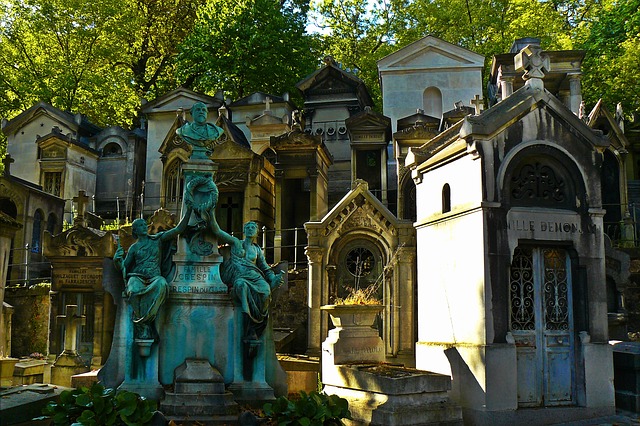
    Tombs in Père Lachaise Cemetery
    Tombs in Père Lachaise Cemetery

    Despite this initial link, early literary vampires did not come with coffins. Geraldine and Lord Ruthven had no casket mentioned; Carmilla lacked a coffin, but was found resting in her crypt. Crypts, tombs, and other methods of interment were mentioned alongside the living dead. Even Dracula and his brides had their resting places described only as tombs, and the importance was placed on a vampire needing to rest on native soil, not a coffin.

    That shift occurred with the advent of Dracula in film. The 1931 rendition of Dracula replaced the concept of plain stone tombs with coffins, and later films merged Dracula’s boxes of native soil with a coffin partially filled with earth. As vampire lore gradually lost the attachment to native soil, the coffin remained alone, providing a dark sanctuary for a vampire to sleep, safely hidden away from sunlight. But, really, any dark place will do.

  • 5 reasons vampires are repelled by garlic

    5 reasons vampires are repelled by garlic

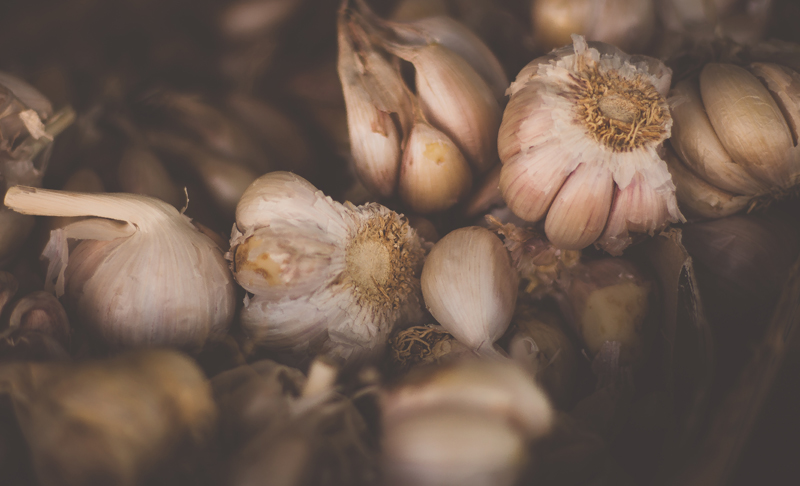
    Though challenged by storytellers in recent years, garlic has long been perceived as a way to ward off vampires. It’s actually been a part of vampire mythology for so long that when you stop to think about it, you might wonder what actually brought the two to be linked in the first place. Though there are more reasons, here are 5 that turned up most frequently in my study of vampire lore.

    In many cultures, garlic is believed to ward off evil.
    This one pops up all over the place. In a number of ancient cultures, a clove of garlic was carried in the pocket for good luck and protection from evil, but more noteworthy are the burials in Europe where the mouth of the deceased was stuffed with garlic for the purpose of protecting them from spirits. Since some cultures believed a vampire was an empty husk that rose from the grave and still others believed vampires were evil spirits that could possess the empty body of the dead, the garlic’s ability to ward off evil was employed to prevent them from rising from the grave.

    Vampires might have just been people with rabies.
    Modern researchers have found a number of connections between the feared behaviors of vampires and the way both people and animals behave when rabid. One noteworthy finding was that rabies can trigger hypersensitivity–causing the afflicted to avoid bright lights and particularly strong smells, such as garlic.

    Many vampire stories are a parallel for blood-sucking insects.
    Mosquitoes are a common annoyance, and they’re one of the only real-life vampires. Not only do they spread disease, as early Europeans feared from their folklore equivalent, but they can be repelled by garlic, too.

    Even now, we recognize garlic as a powerful antibiotic.
    But as recently as a few centuries ago, garlic was considered a panacea–and maybe even magic. While we recognize its medicinal and health benefits with a more educated eye now, it was thought to have power over many things, including illness and disease. Particularly noteworthy, since one of the most famous cases of vampire hysteria in history stemmed from the case of Mercy Brown, who–along with many other members of her family–died of tuberculosis.

    Although reclassified in recent years, garlic was once classified as a lily.
    Lilies have long been a part of religious iconography,  representing purity and associated with holiness. Considering the effect of the crucifix and holy water on the undead, it makes sense that the holy affiliation of the lily would likewise repel vampires.

    Got another reason to share? Leave it in a comment below!

  • Why we use stakes to kill vampires

    The most popular and well-known method of killing a vampire is a stake through the heart, though depending on lore, a stake through the stomach may be enough.

    Although popularized by its use in Sheridan Le Fanu’s Carmilla, the stake’s use as a weapon against the undead originated through burials practiced in Europe prior to widespread use of coffins. In some strains of vampire lore, the stake also only immobilizes, rather than killing; this, too, can be traced to these burial practices.

    In rural regions where coffins could be hard to find or difficult to afford, washing rains could cause the bones of loved ones in shallow graves to work their way to the surface. To prevent this unpleasant discovery, it’s believed that bodies were occasionally staked to the earth in the bottom of graves, holding them where they belonged until the fresh-dug earth settled and the risk of the grave washing out was eliminated.

    Throughout much of early Europe, it was believed that once a soul vacated a body, it could be claimed by malevolent spirits–or become a vampire. The stake prevented them from rising once possessed, discouraging possession and preventing the deceased from rising again. Typically, wooden stakes that would rot away after the earth settled were used, meaning there’s not always a lot of evidence left behind. It’s where metal stakes are used that things become interesting.

    A number of vampire burials have been identified in Europe, but those most easily identified are those where metal implements are used. Prior to common use of coffins, the metal pieces were used to pin the body permanently, ensuring an identified vampire could never return to life. After the use of coffins became more commonplace, the stakes instead were driven into the heart, as common belief held that destruction of the heart would kill an otherwise immortal vampire.

    So why the emphasis on wooden stakes, if metal will do the trick?

    It’s not just wood–it’s the type of wood that counts. Ash, aspen, willow, and juniper are often chosen, though the most common stake of choice is one carved from hawthorn wood. Each type of wood is steeped in folklore that gives it power. In Asia, willow is believed to have power over the dead. Similarly, the ash tree is associated with life, due to its representation of the Norse tree of life, Yggdrasil. Aspen was once believed to be a connection to the other world, making it a choice implement for dispatching a dead creature back to death, while juniper was known as a symbol of protection in medieval England and Scotland.

    Hawthorn, however, was prevalent and revered through much of Europe. Once used as a charm to ward against witchcraft, it’s not hard to see it make the leap to protecting against vampires. After all, the Portuguese Bruxa is believed to be a witch that can take a vampiric form. Yet even more notably, the hawthorn is a revered religious symbol, believed by many to be the branches from which Christ’s crown of thorns was woven. This lends it a holy power, as well, which makes it all the more effective against vampires.

    Unless, of course, you’re Anne Rice. But that’s a topic for another day.

  • Ready to read? Get the first 3 chapters of Her Midnight Cowboy right now.

    Ready to read? Get the first 3 chapters of Her Midnight Cowboy right now.

    Last week, the preorder for the Kindle edition of Her Midnight Cowboy–the first book in my new series, Keeper’s Kin–went live. I can’t wait for people to start reading the story. so I decided it was best not to wait.

    If you’re curious and don’t want to wait until the book is released in September, you can get started with the first 3 chapters of Her Midnight Cowboy right now.

    Click here to download a reading sample for Kindle.

    Click here to download a reading sample for Nook, iBooks, Kobo or Android.

    Or, click here to download a PDF copy of the sample.

    I’m really looking forward to September 19, when this book–along with Keeper’s Finder and The First Hunt–will be available. Until then, I’m plugging along at the next book in the series, so that you won’t have to wait more than a few months for the next peek into the world of the Keepers!

    And of course, don’t forget you can always go ahead and preorder your copy of Her Midnight Cowboy now.

    Happy reading!

  • Keeper’s Kin: New series available September 19!

    Keeper’s Kin: New series available September 19!

    A couple weeks ago, I stealthily upgraded my website’s infrastructure. It was about time to slide into the modern age, providing my site with an updated design that offered a mobile-responsive layout. I kept a lot of things as they were. The colors, for example, which I’m still in love with, and the header graphic didn’t change–though it may soon.

    The other thing that changed was the addition of a new series listed under my paranormal stories. I made the change without mentioning it to anyone, but it’s time to start talking about it. After all, it’s August, and the series will kick off next month.

    Keeper’s Kin is my new paranormal series, named for the vampire guardians of the supernatural you’ll meet within the stories. There will be a variety of stories set in the world, beginning with two books coming out at the same time: Keeper’s Finder, which is a stand-alone novella set within the Keeper’s Kin world, and Her Midnight Cowboy, the first in a trilogy set in the same world. These two books will both be released on September 19, introducing you to the Keepers and their complicated world.

    Ready to learn a bit about these books? Keep reading!

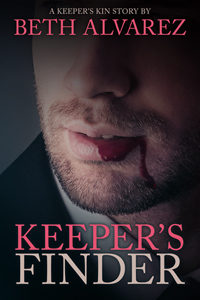
    Keeper’s Finder

    Keeper's Finder by Beth Alvarez

    Death should have been the end.

    The last thing Joshua Rook expected was to wake up after the car crash that claimed his life. Never mind waking to discover he’s part of an underground organization devoted to aiding the undead.

    A second chance to live his life and marry Charlotte, the girl of his dreams, sounds like a miracle, but once Josh swears the Keeper’s Oath, he’ll be cut off from interaction with the mortal world—forever.

    But Josh’s circumstance is special. Robbed of a chance to prepare for death, the period before his swearing in offers one last chance to win Charlotte over.

    There’s just one catch.

    He only has three days.

    Keeper’s Finder is a novella approximately 30,000 words in length. Although part of the Keeper’s Kin series, it can be read alone.

    Click here to get Keeper’s Finder on Amazon.

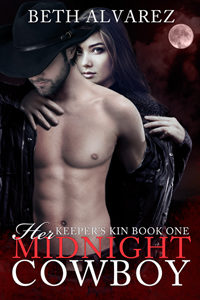
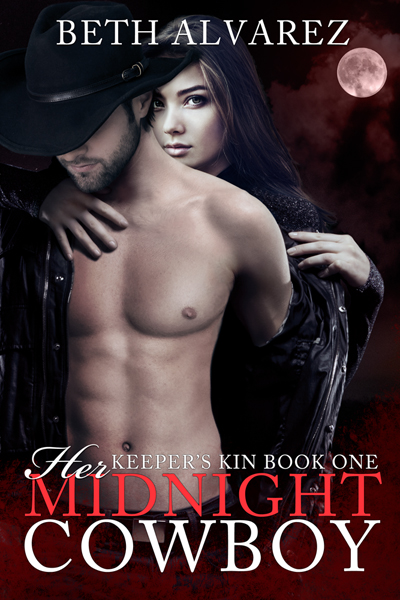
    Her Midnight Cowboy

    Her Midnight Cowboy by Beth Alvarez

    She wants to save the family business.
    He just wants the bounty.

    There’s something odd about Kade Colton, and not just his refusal to taste Felicity Hammond’s famous baking. Sure, he’s the sexiest cowboy she’s ever seen, but working midnights protecting the local ranch doesn’t explain his aversion to daylight. Her father warns her to steer clear, but when a foreclosure notice threatens to close the family business for good, Felicity will try anything to save it—even answering Kade’s scandalous questions.

    Kade lives by two rules: work alone, and don’t get involved. But it’s easier to hunt a jackalope in Yellowstone than get information in Holly Hill without drawing attention. Even if it means breaking his rules, Felicity’s connections are exactly what he needs.

    But letting her in means revealing why he’s really there. With bodies turning up in town, sharing his secret puts his life on the line. It’s not his first go-round with monsters like these, but this one’s big—and he’ll need all the help he can get. And no matter how he tries to ignore it, there’s something about Felicity that’s got him feeling alive for the first time in years…

    Her Midnight Cowboy is the first book in the Keeper’s Kin series.

    Click here to get Keeper’s Finder on Amazon.

    And stay tuned–more info about these books (and the world the Keepers live in) will be coming soon.

    Save

  • Guest post from Megan Cutler – The Island: An introduction

    Just in time for a peak summer read, Megan Cutler is back on the blog tour circuit to share information about her novel Island of Lost Forevers and its journey to print. Once again, I had the pleasure of working with her in creating wraparound covers for the paperback edition of the books, though just the base artwork, this time! One staple inclusion of each cover was the island itself. Keep reading, and Megan will give you a glimpse at the island and what makes it so important…

    Megan:

    One characteristic of epic fantasy is the scale of its setting. Epic tales take place in vast worlds, full of interesting cities, cultures and landmarks. Somehow, the characters become aware of these details throughout their adventure and it becomes clear that the world is active even when the characters aren’t present.

    Building any world, no matter how small, takes a great deal of time and effort. There are a lot of considerations, from the physical makeup of the landscape, to the customs of the people who populate it. James and I were lucky that we only needed to create a chunk of a world, a remnant, and that allowed us to focus our efforts on a small geographic area. The primary landmarks of the island are its tall mountain, its majestic waterfall and its tropical climate. But the heart of the island is the bathhouse, carved out of the slope of the mountain at the base of the waterfall.

    The bathhouse was our first creation and we built the island around it. All together, they form a cosmic five-star resort. It needed breath-taking views, stunning beaches, and a fancy dining room. But we wanted to preserve the soul of the bathhouse concept. We carefully drew attention to the zen-like aspects of the building; the public bathing rooms, the hot springs, and the extensive garden. From there we grew outward, developing the people associated with the bathhouse. Of course the workers had to come from somewhere, and thus was born the village which shares the renown bathhouse’s island.

    Though the island has obvious Asian (and thus Earthly) overtones, we also wanted it to possess an otherworldly feel. While the island ruler and most of his subjects may have easily come from Earth, the bulk of the bathhouse’s guests obviously come from other worlds. One of the most entertaining aspects of writing the book was coming up with fantastic characters to make cameo appearances. And while these encounters are delightfully exciting for our protagonists, they’re mundane occurrences for the people who live and work on our island.

    From the beginning, the island played an important role in our story. Its appearance is the catalyst for our adventure. As our two protagonists search for the secrets the island brought with it, they paint a tapestry of the island’s characteristics. Is it sinister? Is it sentient? As the characters search for the answers to these questions, we were able to take the concept of setting as a character one step further. It’s obvious the island possesses some kind of awareness. It influences the people who inhabit it. As time goes on, it even seems to form opinions about the characters and their actions.

    The way various characters interact with the island becomes central to the plot. At first they want to explore it, but eventually they want to escape it. Overall, it was fun to allow our setting to grow a mind of its own. It added extra emotional and philosophical levels to the plot, all while keeping us on our toes. We tried to give the island a prominent place in the story, to make it clear from the beginning our setting also served the role of character. To that end, we re-wrote the beginning to give the island pride of place. After all, what better way to start an epic adventure than with the appearance of a mysterious island out of nowhere?

    Purchase from Amazon


    Is the island paradise or does a nightmare lurk beneath the surface?

    When a mysterious island appears off the coast of San Francisco, two intrepid academics risk everything to discover its secrets. Catilen Taylor has struggled all her life with the ability to sense others’ emotions. Damian Cooke studies an ancient art he calls ‘magic.’

    The island boasts an idyllic retreat, ruled by the enigmatic Sentomoru, who invites them to share the wonders of his bathhouse. But as the travelers strive to unravel the island’s secrets, Catilen senses danger stalking their steps.

    Neither Catilen nor Damian know how long the island will remain on Earth. If they can’t solve its riddles quickly, they may be trapped wherever it goes when it vanishes.

    a Rafflecopter giveaway

    Megan grew up in a small town in central Pennsylvania where books offered an easy escape from the mundane life of a rural highway town. In 2003 she married the love of her life and moved to Canada. Megan started writing full-time in 2011 and has since published four novels and several short stories, including the Mystical Island Trilogy. Her characters keep her up late and wake her up early, but she loves them anyway. Learn more at megancutler.net, or connect to Megan via Facebook and Twitter.