Beth Alvarez - Author of Epic Fantasy
  • Want pink hair? A review of 4 popular dyes

    It’s been over a year since I decided to dye my hair pink. I’ve been all over–pink streaks, pink dip dye, pink all over, pink ombré–and while I decided I liked the ombré best, experimentation with different dyes kept going.

    Odd colors come in semi-permanents, and of the colors, pink seems to be the most delicate. It’s hard to keep it bright, keep it from turning salmon, and keep it from turning my clothes and skin odd colors. I had a lot of recommendations from a lot of people, but I eventually settled on a handful of colors to try, so here, I’ll share my experiences of sampling those dyes–complete with terrible selfies to show off the color.

    1. Pravana

    Pravana pink and pastel pink ombré on lightly bleached hair
    Pravana pink and pastel pink ombré, undiluted, on bleached hair

    Applied by my excellent stylist whenever I’m in her neighborhood, I’ve tried an assortment of pink Pravana dyes. I’ve had the ChromaSilk in vivids, pastel, vivids locked-in, and they all did pretty much the same thing, though in varying degrees of brightness. Pravana dyes provide gorgeous color. They’re bright and not at all brassy, just exactly the kind of color I want. But when it comes to lasting power, they’re a little lacking. Even with careful care and consideration, using expensive shampoos formulated to baby these hair colors along–or not using any shampoo at all–I can’t seem to get them to last. They’re sound for the first wash, but after the second, the fade is quick. If I lived closer to my stylist, I wouldn’t be concerned, since she could help me re-apply more regularly. But since I live six hours away from her salon, it’s not a good option, even though the color and shine these dyes offer is beautiful.


    2. Manic Panic

    Manic Panic Hot Hot Pink, undiluted, on unbleached hair
    Manic Panic Hot Hot Pink, undiluted, on unbleached hair

    Manic Panic was the first crazy hair dye I heard of, and for good reason. The pink range offers an incredible punch, though my favorite is the Hot Hot Pink. If I want a lighter shade, it’s easy to dilute with white conditioner and get any effect I want. The richest color I’ve had came from Manic Panic. It’s easy to apply at home, and gave me the longest color life, too, a whole month of high-intensity color. Unfortunately, it’s not without its shortcomings. The color shed with Manic Panic is heaviest of all the dyes I’ve tried, and when you’re in a humid climate like mine, this spells doom for any clothing, pillow cases or furniture that aren’t black. I made the mistake of wearing a white leather jacket with my hot pink hair. As stylish as my hot pink leather jacket is, it’s a result I would have preferred to avoid. If you’re in a dry locale, it probably won’t present as much of a problem, but for me, it means lots of extra precautions to go with bright hair. As of right now, I don’t have any photos of Manic Panic used diluted, but it’s essentially the same as the results you’d get with something like Special Effects, which we’ll look at now.


    3. Special Effects

    Special Effects Atomic Pink, extremely diluted, on bleached hair
    Special Effects Atomic Pink, extremely diluted, on bleached hair

    Another vegetable-based dye, Special Effects was touted by a lot of beauty bloggers as superior to Manic Panic. I ordered a bottle of Atomic Pink off Amazon, not sure what to expect, but this dye is super. I’ve only used it diluted, but the color goes on unlike any of the other dyes I’ve used. What you see is what you get, so make sure the color is exactly what you’re looking for. For the color shown above, I used less than a tablespoon of Atomic Pink dye mixed into half a cup of white conditioner. After this initial experiment I’ve started using a tiny drop of Manic Panic Shocking Blue in the mix to cool off the brassiness, and it’s given me a very pretty pink that’s similar in color to the Pravana locked-in dye, though it doesn’t seem as shiny. The lack of shine is my primary complaint with Special Effects; it gives my hair a slightly chalky look, which lasts until it’s completely washed out. It’s also highly prone to turning salmon pink or apricot-colored as it fades, which means re-dyeing every 2-3 weeks or toning it out before it runs its course.


    4. Ion

    Ion Hottie Pink on bleached hair
    Ion Hottie Pink, undiluted, on bleached hair

    Out of all the dyes I tried, Ion came recommended most. All my friends have used it, though all of them used purples, blues and greens. Their colors last beautifully. Pink? Not so much. I applied two colors, Hottie Pink and Rose, hoping for an ombre similar to what my stylist gave me with Pravana dyes. After following the instructions to the letter, I was dismayed when my hot pink dye rinsed straight out of my hair in ice cold water with no shampoo or cleanser added. It left only a light pink stain in my bleached locks, extremely brassy and not at all what I was hoping for. My bathtub, however, turned the most beautiful shade of hot pink I’d hoped to see in my hair, and I’m still working on bleaching that out.

    Of all the dyes I’ve tried so far, Manic Panic and Special Effects are my top picks. Manic Panic would win, hands down, if not for the extreme color shed.
    Have a pink dye you think I should try? Leave me a comment–I’d love to check it out!
  • Tea review: Raspberry Earl Grey black tea from Plum Deluxe

    Tea review: Raspberry Earl Grey black tea from Plum Deluxe

    As I mentioned in my last tea review, one of the unique things Plum Deluxe offers as a tea company is their monthly tea subscription that offers special blends you can’t get otherwise. That makes this month’s tea review special.

    Since I mentioned in our correspondence that I was fond of loose leaf Earl Greys, Andy–the founder of Plum Deluxe, in case you missed it–pulled a sample of one their current subscription-only teas so I could try a cup. The good news is this lets me tell you a bit about what to expect from their specialty teas, which are a surprise from month to month. The bad news is you won’t be able to get it now… and it’s really, really good.

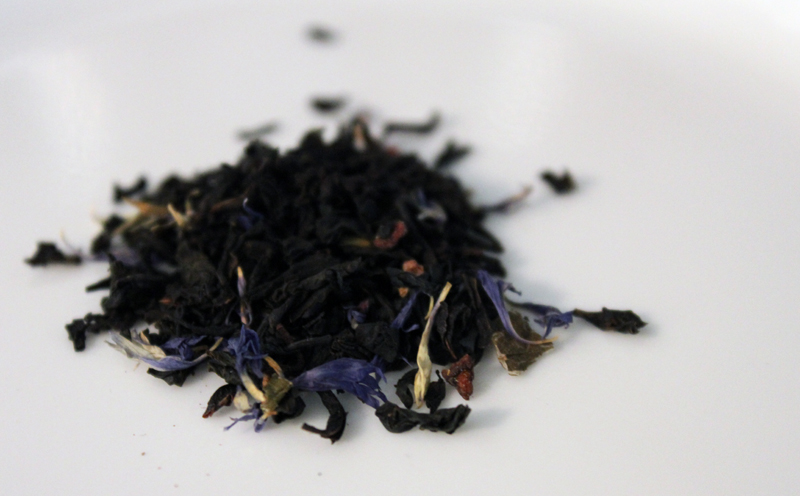
    Plum Deluxe raspberry earl grey

    The flavor of the black tea in this blend is more subdued than that of the standard Plum Deluxe Earl Grey I tried, leaving room for the new flavors to play. There’s just the right amount of raspberry in this mix, which means it takes the lead, but doesn’t drown out the taste of the bergamot.

    I wouldn’t recommend any additives for this blend: it stands beautifully alone. The berry flavor brings just the right amount of sweetness to a straight cup, meaning even a pinch of sugar added detracts from the well-balanced mix of flavors.

    It’s also a pretty blend, including bits of dried berry and orange peel, as well as raspberry leaves to give it a hint of herbal flavor. I’ve always been fond of berry flavored teas, so this one really is the best of both worlds, and I would have loved to have some to add to my collection–but as I said, it’s a subscription exclusive, and the window of opportunity to nab this one is already closed.

    I’m definitely curious about the other special tea blends offered only to members, which I’m sure was the intention. If they’re all as yummy as this raspberry blend, it’d be hard to go wrong. As for this specific tea, though, there’s enough left in my sample bag to give me two more cups, and you’d better believe I’m going to enjoy them.

  • 3 reasons to abandon a writing project

    3 reasons to abandon a writing project

    Late last year I shared a list of story ideas I decided not to use. It wasn’t that they were bad (okay, some of them were) but that they just didn’t work for me. Either they didn’t fit my preferred writing niches, or they didn’t give me enough to work with for the creation of actual books.

    There are a lot of ideas I keep in reserve, but I try not to talk about them until they become a solid part of my writing plan. A lot goes on behind the scenes that I never talk about, but since one of those ideas has recently slipped from the idea folder to the trash can, I thought I’d take a few minutes to talk about this quiet part of my writing process, where only my husband and a few close friends get to see me bouncing around raw ideas.

    Two and a half years ago, I worked on developing an idea for a sort of sci-fi YA novel. It revolved around a girl who was determined to escape the city she’d been assigned to, wanting to find a better life with the other half of her family. The cities rested on an alien planet filled with monstrous creatures. There were two problems: getting past the alien life to make the trek to her father’s home city, and getting out of her city at all. The cities were protected from the alien life by a device called the Adrammelech, named for the ancient Earth Mesopotamian deity. The Adrammelech was powered by the sun, a massive arm of fiery energy that swept around the city’s protective barrier and burned everything in its path to cinders, be it friend or foe. Her chance for escape arrives when an unexpected celestial event causes the Adrammelech to shut down, leaving the city defenseless. It’s the only time she may ever make it past the Adrammelech’s arm, but leaving means abandoning her younger siblings when her survival skills are all that can save them from the encroaching threat of the wildlife.

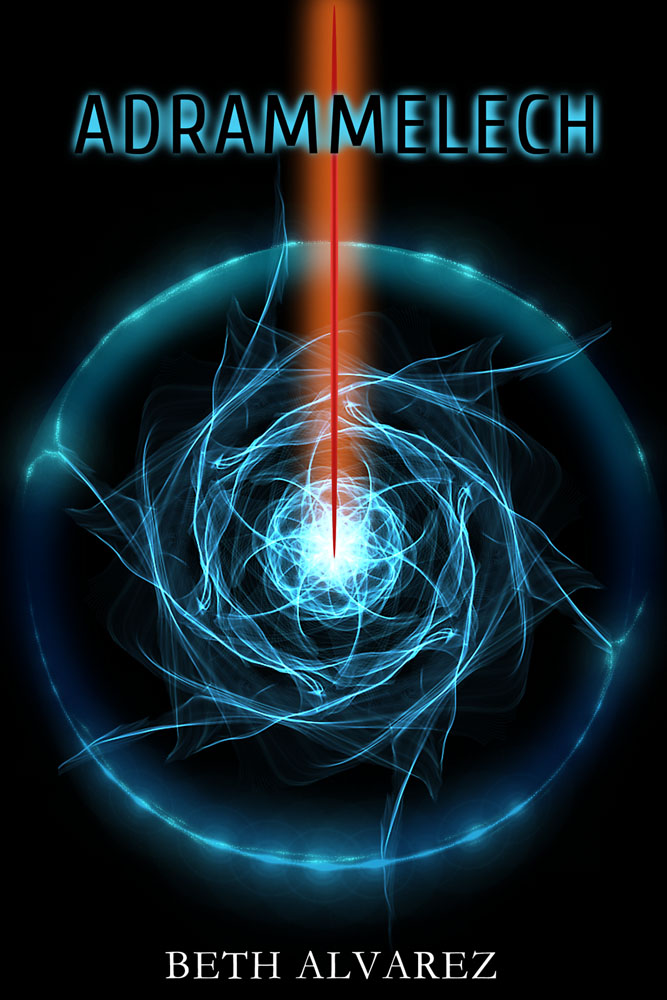
    adrammelechIt was enough of an idea to create a book from and I was excited to add it to my roster of titles to write. I created a preliminary cover for it–something I do for almost all my books, so I can visually sort the project folders–and stockpiled ideas for when I’d eventually get around to writing it. But instead of writing it, eventually I decided the project was a no-go, and I moved my existing work on the idea to the no-man’s land of my Abandoned Projects folder. Here are the biggest reasons why.

    1. It’s outside my comfort zone.

    There’s nothing wrong with pushing boundaries, and you can learn a lot from doing it. But when I’m so early in my writing career, pushing boundaries and expanding into new genres isn’t going to help, especially when it’s one I won’t visit often, if ever again. Writers shouldn’t pigeonhole themselves into just one category of writing, of course, but building my early catalogue should be in something I’m both familiar with and in love with. Branching out into other ideas can happen later, which means there’s no point in keeping this one around now.

    2. The stakes are too small.

    This is a big problem for this particular book. The heroine might not make it out of the city because her family needs her. Ultimately this is such a small issue that when I read back over my story notes, I stop and think “so what?” Not all stories need to be big stories, but they need to have enough impact to resonate with readers. If it’s not resonating with me, something is wrong. Sometimes issues like this can be fixed, but when coupled with the problem of this one not fitting within my preferred genres or the direction I ultimately want my writing to go, there doesn’t seem to be a lot of point in trying to beef the plot up enough to give it real impact.

    3. Sometimes you just lose interest.

    The years that pass between having an idea and having the time to write it are the best thing to separate the wheat from the chaff. It’s pretty normal for writers to jump into a half-baked idea with both feet, only to find it too superficial to complete. If an idea is worth executing, it will stick around for the long haul, drawing you back in over the course of years and years. This is why Emberheart, one of my current WIP stories, is still on the table and scheduled to be tackled next after more than a decade. An idea’s lasting power is almost as important as the willpower to muscle through to a project’s end.

    What are some reasons you’d put aside a project, writing or otherwise?

  • When Good Friends Write Bad Books

    When Good Friends Write Bad Books

    One of the greatest things about being a writer is the chance to connect with other writers. Sometimes they’re in your genre, sometimes they couldn’t be more different, but you’re always able to relate through your shared passion. And since writing is difficult, having support from fellow creatives is very important.

    It also means you’ll never be short on fresh reading material.

    The bad news is sometimes that reading material isn’t so great.

    When Good Friends Write Bad BooksI’m not talking about early drafts. Those are always bad, no matter who’s writing them. If I sign up to read a first draft, I know what to expect: a story containing some typos and grammatical errors, plot holes, filler, and some things that are flat out mistakes. That’s normal, and I’d never judge a writer by an early draft. But sometimes these things slip through to the final work, the piece people are paying for. And when that’s the case, being my friend isn’t going to let you off the hook.
    It’s incredibly awkward to look forward to a friend’s writing, only to find it’s actually sort of terrible. That doesn’t mean I’m going to change how I feel about a writer or a friend, but it does mean that if someone isn’t good at taking constructive criticism, our conversations about the books might be a little awkward. Unfortunately, that’s a problem I’ve encountered a lot.

    Writer types are sensitive, I know, but coddling them isn’t a good idea. If someone asks for an honest opinion, I’ll give it. If they don’t want honest feedback, or they’ve bemoaned honesty before, I probably won’t talk about the book at all. I won’t recommend it to family or friends, either. Silence, sometimes, can say a great deal.

    In the past month, I’ve read three finished, edited books by people I know. Two were disappointments, though for different reasons. And while I haven’t had the time to write reviews of them yet–something I won’t censor, even for people I love–it led me to one important decision. From now on, I won’t read finished work by people I know unless it falls within genres I already prefer. That means if someone comes to me with a completed and published cozy mystery and offers me a copy to read, I’ll probably turn them down. It’s not that I’m not interested in their work, it’s just that it’s not a genre I’m familiar with, so I can’t give constructive feedback on how to improve the next one. Limiting myself to familiar genres doesn’t save me from bad books, but it does let me critique from a standpoint of familiarity, and that’s a plus.

  • How shorter stories can make you a better writer

    How shorter stories can make you a better writer

    I’ve always liked reading people’s writing tips when I have a free moment. With the advent of smartphones, it’s easier than ever to peek at my feeds or pop in to check Pinterest for a few quick and creative ideas. I can research while I eat my breakfast cereal, instead of reading the nutrition facts of Raisin Bran for the 800th time, so that’s pretty cool.

    Since I read a lot of advice from a lot of people, a lot of tips pop up over and over again. One of those is that if you want to be a better writer, you should write short stories. I don’t entirely agree. Should writers try writing short stories? Definitely! But maybe not the kind most people are thinking of.

    How writing shorter stories can make you a better writer - Ithilear.com

    Before I go too far, let me be clear that I don’t necessarily mean short stories in the traditional sense. Science Fiction and Fantasy Writers of America (SFWA) defines a short story as anything 7,500 words or under. This is what most people are talking about when they encourage people to write short stories. Small enough to fit on a few pages, small enough to be printed in a literary journal. I do think the idea has merit, and yes, there’s a lot to be learned from writing short stories. more importantly, I think we should encourage people to write shorter stories, and that’s a different thing.

    See, I tried writing short stories. I wrote a whole bunch of them for writing prompts, and there’s even a section over there on the left devoted to those short stories. I started because everyone told me I should, and I did learn from the experience, but you know what I learned?

    That I hate writing short stories.

    There are only a few things in that section that I actually ended up pleased with. The two short stories I planned to be short stories (Disposable Bodies and Eiri and the Dragon) and a handful of writing prompts, all of which have something in common.

    Three of the four prompts I loved gave me a glimpse into the lives of characters who I can’t touch until I get to their books, all of which are at least a few years away. The fourth featured a character who was to appear in Born of the Moon, but ended up being cut to streamline the story. This is one of the reasons I ultimately decided short stories weren’t for me; the only reason I could make some work was because they were part of a bigger world.

    On the other hand, there’s Gale’s Gift, and a second novelette I’m working on that I won’t talk about just yet. These are too long to be considered short stories, but they’re still shorter than most of what I write. And while I didn’t like doing short stories, I’ve loved working on these.

    They give me enough space to do world building and add a sense of adventure, but they’re one tenth the length of the fantasy epics I’ve been working on the past few years. They’re also short enough that they demand more story be covered faster, cramming as much meaning into every paragraph as possible. And that’s why writing these shorter stories helped me improve; it drives home the need to make every piece of text valuable, probably better than any piece of writing advice I’ve ever read.

    It’s not just something to apply to novellas and novelettes; it should be applied to every book written. Don’t skip writing the story that’s really important to you, just write it shorter, trying to cram it into as little space as possible without losing your meaning. It improves pacing and makes you more conscious of word usage. It also eliminates filler chapters, because you can’t spare a single page for something that isn’t actively moving some part of the story forward.

    In some respects, you can think of it as a more hardcore form of editing, especially since the best way to practice is to take a page or paragraph from your existing story and then rework it, changing phrasing to convey the scene in as few words as possible. If the short paragraphs lack emotional impact, that gives you a clear indicator of where you need to improve, making you mindful of your word choices. It makes you more aware of the words that evoke emotion, drawing attention to the parts where they’re missing.

    So no, writing short stories won’t necessarily make you a better writer. But taking your stories and making them shorter? That definitely will.

  • 5 Quick Tips for Better World Building

    5 Quick Tips for Better World Building

    I have a small group of people I allow to read my early book drafts. They’re the ones who give me solid, truthful feedback, are great at catching typos, and call me out when pieces of my story don’t add up. Last month I popped in to visit one who is currently working through the second book in my work-in-progress fantasy series. We turned the kids loose on a box of LEGOs, plopped on a couch, and the subject immediately turned to books.
    “This book is so much faster,” she said. I agree; mostly because the world is already built.

    As I’ve shared my fantasy books with both friends and strangers in seeking feedback, one consistent statement they make is they enjoy the world building that happens in the novels. Creating worlds is something I enjoy, so I’ve read a lot about doing it, but there are a few key points that I’ve had to learn myself. Everyone develops their own pieces of writing advice, though, so here’s some of mine: The things I wish I’d been told about world building before I started doing it myself.

    5 Quick Tips for Better World Building - Ithilear.com


    1. Blend, Don’t Build.

    When you need a quick start, blending real cultures to create new ones to populate your fictional world is the best and easiest starting point. You can always add on later, fleshing them out however much you want, but taking a few key elements from people and places around the world and mixing them lays the ground work fast. Blurring the lines between the two is where your imagination fills in the blanks, creating new and unique twists to the civilizations you’ve created. Plus, having a real-life basis for your creations lends an air of familiarity, which makes it easier for people to connect to your fictional world.

    There’s one catch, though: You can’t just clip whatever you want and toss it in with no thought. If there’s something you like about a culture, you have to research it first before creating a mash-up with something else. Remember that what you’re building on is the framework that real people have created over thousands of years. Be respectful.


    2. Opposites attract, which makes for interesting worlds.

    This, of course, grows out of the point above. It’s a cliche saying, but it’s true. We like things that conflict, because we want to know what makes it work. The most interesting blends come from mixing cultures that contradict each other.

    One good example is James Gurney’s Dinotopia series, which blends a technologically developed society about on par with Victorian ages with the prehistoric wonder of dinosaurs. That resplendent era clashes with the primitive nature of the beasts that populate the world, creating an intriguing setting. In that setting, dinosaurs have their own developed and refined purpose, which makes their inclusion more believable and adds a unique flavor to the world.


    3. Fill in the empty space.

    Generally speaking, most books don’t contain a ton of globetrotting. Even if you create a vast world for your stories to take place in, you’ll probably only visit a handful of locations in each volume. But these aren’t the only places you should be creating; your world is much bigger than that.

    Open any map and just glance over it. There are hundreds of major roadways and thousands of cities, probably more than you could ever visit. Fictional worlds are like that too, and the people who live in these worlds know it. They might mention a grandmother in a certain township, or a childhood vacation to a city on the coast. If nothing else, when creating a map, take the time to fill all your empty space with a variety of locations. It’s a small step that can lend a lot of flavor to your world, even if these places never come into play.


    4. When you visit a book’s world, you’re a tourist.

    That’s why simple insights into a culture are almost always best. Characters live in this world, but we don’t; they’re already familiar with the ins and outs of traditions and cultural norms. Filtering everything through that lens paints an interesting picture. People feel a sense of awe when they only get peeks into what a world is like. It’s new and exotic and spurs curiosity.

    It also meshes well with the “show, don’t tell” principle, and the practice of sprinkling background information in just a little at a time. Build your world in a way that makes people eager to peek down the next narrow street when your story takes a turn.


    5. Don’t let world building interfere with a first draft.

    This one seems to be a big issue for people, and I admit it was an issue for me, too! It’s easy to get caught up in the idea that you need to have your world fleshed out and developed before you get started, but it’s simply not true.

    Rarely does the story being told depend on more than the most basic information about the world it’s in. More often than not, the world works better if it’s shaped by the actions of the characters within the story, anyway. Just think of it: Our world’s cultures and countries are all the result of people’s actions. They’d develop in fictional worlds the same way and, sometimes, the best way to get a feeling for the world you’re creating is to jump into it with both feet and see where the trip takes you.

    Not only that, but a first draft is always rough. All the fleshing out and refining of the story–and the world–will happen later, so don’t let it bog you down. A well-built world offers a lot of support to a good story, but a bad story can’t save a good world.

    I could talk about world building for pages, but from my experience, those points are the most important to me–and also the points I’ve rarely (if ever) seen anyone talk about.

    Do you have any writing tips you’ve picked up in your experience?

  • Tea review: Mindful Morning black tea from Plum Deluxe

    Tea review: Mindful Morning black tea from Plum Deluxe

    On a gorgeous day last week, I received a surprise email from Andy Hayes, founder of Plum Deluxe, offering me a spot of tea–his treat. Being fresh out of tea to review, it couldn’t have been better for me. I was happy to accept the offer, especially since I’d been on the prowl for new places to try.

    There are a few things that make Plum Deluxe special. For one, there’s the tea of the month club, which is reasonably priced and offers unique blends only available to members. There’s also the fact it’s a small, independently-owned company. Then there was the part of Andy’s message to me that hit hardest; the way his mother’s vibrant life inspired the creation of the company after she succumbed to cancer.

    Tea is a connection to my own mother, and one I wish we could share together more often than our 400 miles of separation allow. She’s always collected teapots, and while I grew up, she always had time for a tea party with her girls, often with a different beautiful teapot for every party.

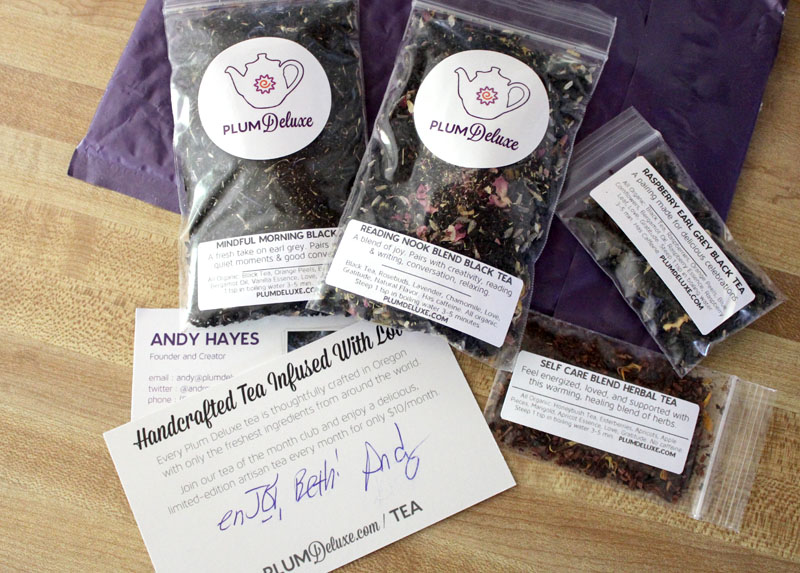
    So my mom was on my mind when I went to the mailbox and discovered the pretty purple envelope of teas waiting for me, several days sooner than I thought it would arrive. Fast shipping is always a plus for online purchases, and even better was the fact the contents were so fresh I could smell them through the envelope.

    IMG_3933

    I received four kinds, but since this post is about the Mindful Morning black tea, I’ll leave the others for later.

    Since developing such fondness for Earl Grey teas, I was thrilled to see this one in the mix. The only thing I don’t like about Earl Grey is that it’s hard to find one with a good balance between robust tea and the soothing bergamot that creates the trademark flavor. I like flavorful tea, so a lot are too mild for my tastes, but nothing about this blend was disappointing.

    IMG_3936I was surprised by the intensity of flavor, since a lot of Earl Greys I’ve tried in the past are a bit lacking on the tea side. This is a bold black tea that brews strong even in small amounts. Unsweetened, the flavor of the tea is what stands out most. Adding a little rock sugar brings out the citrus, creating a tea that’s refreshing and perfect for a morning punch, somewhere other Earl Greys tend to fall short.

    But where this tea really shines is after the addition of just a splash of milk. Milk enhances the subtle vanilla flavor, creating a heavenly blend with just the right balance of full-bodied flavors.

    So how does it compare to Persimmon Tree’s Earl Grey, which was the last type I reviewed?

    They’re very different blends. Mindful Morning is much more robust and balanced, while Persimmon Tree Tea’s blend relies more heavily on vanilla to create a memorable flavor. The dynamic way the Mindful Morning blend’s flavor shifts depending on what you add to it also makes it easy to customize to meet whatever you’re looking for in a tea on any particular day.

    Overall, I’d consider it a tea shelf staple, and I’m delighted to add it to my collection. If you’re looking for a solid Earl Grey blend, definitely give this one a try.

    I have three more teas from Plum Deluxe to review, so I’ll be sharing more soon!

  • A Journey of Days

    A Journey of Days

    Late last summer, in an attempt to increase my productivity, I bought a day planner and created my own customized inserts for it. I’d been making lists for a while, and while they did help me keep on track, I always felt like it was hard to keep the lists themselves organized. It was easy to lose them and hard to compare them, and since keeping them for reference made a lot of paper clutter–something I hate–I just didn’t. I spent a lot of time testing and comparing productivity apps, hoping my phone could help me keep notes and lists and calendars digitally, but nothing did what I wanted. Nothing could beat the good old fashioned paper planner, so that was the route I took.

    CalendarIt wasn’t just about organization, though. It was about being able to keep a visible log of effort, track the time I spent doing different things, learn where to cut corners and determine what efforts produced the best results. I’m big on the idea of work smarter, not harder, so cutting out wasted time to make room for better things and keeping myself on task was important. And more importantly, I wanted to be able to see progress as I crept toward my goals.

    The old saying about how a journey of a thousand miles starts with a single step was heavy on my mind when I purchased my planner. It’s hard to track a journey’s progress when it’s a metaphorical journey and not an actual trip, partly because we never know how long it will take to reach our destination. I know where I’m headed, but there’s no clear path, and everyone who sets out on a quest to publish their work ends up following a different road. I decided to take my own journey; not of a thousand miles, but a thousand days. And not necessarily expecting publication at the end, but to create my own landmarks and see just how far that stretch of time will get me.

    The first of April marked the first quarter of my trip: 250 days since I started tracking my progress in a section of my planner. In that time, I’ve filled two and a half pages with accomplishments. I don’t have a clear rule for what goes in there, just anything that I’m particularly proud of when it’s done, or something that’s been on the to-do list for a while. Early on, as I started making time to draw again, completing a major art piece found its way onto the list. It might seem small, but that achievement is rubbing elbows with lines describing completed major household repairs, completion of a novel and novelette, and learning new skills.

    If you ask me where I’m going, though, I couldn’t really tell you. I’m one third of the way done with my current novel project, but I’ve outlined several upcoming projects and have them ready to tackle when this one is done. I’m not sure if I’ll make progress on my journey toward publication on this trip of a thousand days, but at least now, I can see my progress, and face a reminder every morning that all I have to do is take one day at a time to watch my life change–hopefully for the better.

  • What I cut to make my fantasy series better

    As is typical of beginning authors, when I first started developing my own fantasy world, I packed as much as possible into it. Every fantasy creature under the sun could be found roaming the planet, and usually all in the same area. Most of my stories originally took place in Aldaan, a small region on the northern continent I created, but the original version of Aldaan was known for a few native species: elves, gryphons, and dragons.

    Dragons are one of those creatures that everyone seems to love. I don’t think I’ve ever encountered anyone who disliked dragons. Just those who liked them, and those who really liked them. I have friends who live and breathe for tales with dragons, so I’m sure they’ll be a little bit sad to read this, but Aldaan’s dragons? They didn’t make the cut.

    When I was young, having virtually every type of fantasy creature seemed like a great idea. I loved mythology and spent a lot of time wondering what it would be like to live in a world that had it all, forgetting one very important point of world building. In a world without widespread use of books and long-distance communication, where travel is long and tedious, cultures tend to stay isolated.

    In our world, we can usually connect mythical creatures to particular regions. Greek and Roman mythology gave us harpies and centaurs, while the Irish are responsible for banshees. We know about them because of widespread knowledge and ease of communication in modern times. Pushing all these creatures together eliminates any real cultural definition to the mythology. But more importantly, it just becomes too much.

    A while back I picked up a sample of an e-book that sounded interesting, and the writing was good, but I ended up not reading more than the first chapter because the author had fallen into this trap. In the very first chapter, we had the human main character mingling with elves, orcs, vampires, centaurs, ghosts, dragons–pretty much anything you could think of. As I said, it wasn’t bad, it was just too much. It was overwhelming, robbing the characters we were introduced to of any meaningful or clear identity, since their only identifier seemed to be which mythological creature they were.

    Truthfully, I feel like I only narrowly avoided this pitfall. I had a lot more variety in species in the first book for a long time, but when I sat down to finally finish the first draft–which meant starting at the beginning and fixing all the horrible mistakes–I decided that the best thing I could do for the series was cut anything that wasn’t absolutely necessary to the story I was telling.

    And so the wide assortment of fantasy creatures fell by the wayside. Valuable and interesting, but not the best it could be, nor vital to what I needed. Like peeling layers of scratched and damaged nacre from a pearl to get to the quality gem hidden underneath.

    When I was done paring, I was left with a narrower cast: humans, my own version of elves, and gryphons were the only ones to make it to the final cut.

    But that’s not to say there won’t be others. Our world is a big place, and there’s a lot of the world I’ve created left to explore and develop. But they will have their own clear set of mythological creatures lending depth to their culture, and each of them will only exist as long as they serve a very clear purpose to the story.

    Will there be dragons?

    Maybe, somewhere.

  • Magical transportation

    One of the biggest challenges I’ve encountered in writing my fantasy books is working out magical transportation. I mean, magical gateways are nothing new. Portals have been around for as long as people have believed in magic, but that’s part of the problem: when magic portals have been around forever, it’s hard to use them in an interesting way.

    Every fantasy series I’ve read of late has some sort of portal system, and it’s been a relief that over the past 10 years as I’ve worked out the rules for mine, I haven’t encountered anything that works quite the same way. There will always be similarities; there’s only so much you can do when mage travel is involved. But I knew I didn’t want teleportation to be an option, and gateways needed to be special.

    As with most cases where magic exists, it’s important to establish some ground rules that keep it from making things too easy. Mages range in strength from ineffective to bordering on all-powerful, so the first solution was a simple element: establishing that not every mage can open a Gate.

    In my world, there are two types of mage. Bound mages and free mages have a number of differences between them, but free mages are rare to the point of being mythical. So free mages won, here: they’re the only mages who can open a Gate on their own.

    The second rule I established was an extension of the first. Bound mages have access to Gates, of course, but it takes a number of them to open one, generally half a dozen or more. Since even bound mages aren’t exactly common, that immediately cuts down the opportunity for Gates to be used.

    The third rule was another standard in fantasy travel: a Gate cannot be opened to somewhere you’ve never been. But while other series fail to account for the way time changes locations, I used that to my advantage. If a mage hasn’t been to a place recently, and the location has changed too much from their memory of it, they can’t reach it. A more experienced mage would have a better idea of how to work around this problem, though; opening a Gate using a specific and memorable carving on a tree as the anchor point, rather than a view of a familiar forest, would grant enough leeway to make the Gating attempt more successful. But this introduces its own set of risks, as if that tree has new carvings or lost too much of its crown in a recent storm, it would no longer be viable as a destination. This also allows a facet of danger: Gates are wild and unpredictable, and require a lot of power to control. When a Gate is misdirected, if there aren’t enough mages to stabilize and dissipate the energy that has nowhere to go, it could spell catastrophe for the whole group.

    The fourth rule adds flavor, but also increases the risks that come from chancing a Gate. Gates opened without an anchor point–another mage or a magical artifact expressing power on the other end to open it–are only functional in one direction. You can see where you’re going, but once you’re through, that’s it; if there’s no anchor on the other side, there’s no going back.

    There are more small tidbits about how Gates work in the world I’ve created, but these are the important ones. Magical transportation is a luxury, and robbing it of convenience helps make Ithilear a more interesting world–especially when access to Gates can make or break a country as a world power.