
Beth Alvarez - Author of Epic Fantasy
  • The job of the artist

    The job of the artist

    “The job of the artist doesn’t end with drawings of structure and anatomy.”

    Rolling his eyes, Rhyllyn resisted the urge to sigh. “What does that have to do with—Ow!” He jerked forward, holding his head with both hands. “What was that for?”

    “I saw that.” His brother leveled a claw with his nose, scowling. “Now shush, I’m trying to talk.”

    Rhyllyn lowered his eyes, shifting his guitar on his lap. He wasn’t in the mood for a lecture after hours of fruitless practice, but there wasn’t any avoiding it. There was no one as bullheaded as his elder brother. “But what does that have to do with what I’m doing?”

    “Everything.” Rune dropped to sit on the couch opposite, resting his elbows on his knees and frowning at the low table between them. “Accuracy isn’t even the most important thing, but that’s what you’re stuck on. You’re putting so much effort into having every note perfect that you’re forgetting everything else. But go sit and watch the painters studying at that college of yours, and you’ll see they have the same problem as you. No matter how perfect their form, they’re still missing something. All they’re doing is replicating work done by masters.”

    Snorting, Rhyllyn slid his fingers over the strings, listening to the whisper of sound that echoed in the instrument’s body. “Having every note right should count for something.”

    “If it did, would you be here sulking right now?”

    He didn’t reply, running his hand over the strings again. It was a trick question, anyway. Either he accidentally acknowledged that he was sulking, or he denied it and proved himself sulky.

    “Your problem is that there’s no passion in what you’re doing,” Rune continued. “No feeling. If a piece can’t evoke emotion, then what purpose does it have?”

    “You sound like one of my professors when you talk like that,” Rhyllyn said. “Did you study with them?”

    Rune shook his head. “No, but I had a thorough education.”

    Shrugging, Rhyllyn pretended it didn’t matter. “Anyway, how am I supposed to have any passion for it? This song was assigned to me, I didn’t pick it. I wouldn’t have picked a love ballad, I don’t know anything about love.”

    “Well, maybe you should learn.”

    The suggestion made a chill run right through him. It took everything Rhyllyn had not to shudder. “You know how old I am, right?”

    His brother only raised a brow.

    It was an ambiguous question, anyway; his growth had slowed after his magic stirred, and he’d been stuck in the body of a teenager for longer than he liked. It wasn’t as bad as it could be, since he was surrounded by mages at the college, but he’d always thought he’d be old and grown and married when he was thirty. Not that he would look half his age and feel it, too.

    Of course, in retrospect, maybe magic slowing his aging was a blessing. He couldn’t picture trying to live like an adult. Goodness knew he didn’t feel like one.

    “What would you know, anyway?” Rhyllyn muttered, looking away. “You don’t have any women in your life, either.”

    The corner of Rune’s mouth twitched. Rhyllyn thought he’d struck a nerve until his brother shrugged, pushing himself up from the couch.

    “Maybe you should read on it,” Rune said. “There are plenty of books in the study. Maybe reading some of the old romantic legends would help get you in the spirit of the song before you have to perform it.”

    “Where are you going?” Rhyllyn turned to watch him leave.

    “Upstairs. I’ll see you in the morning. If you don’t keep me up all night with that thing.” Rune gave the instrument a dirty look before slipping out of the parlor.

    Rhyllyn frowned. Perhaps he had struck a nerve after all.

    He didn’t mean to rile his brother; it just couldn’t be avoided, sometimes. The man was foul-tempered and incredibly stubborn, and as Rhyllyn came into his own, he found they clashed more often.

    And yet the bond between them was unwavering. They shared no blood and aside from their claws, scales and unusual eyes, there was no resemblance between them. Rune had adopted him as brother by choice and had always treated him as a sibling might, though his role had been closer to that of father in the early years. He’d related a lot of wisdom in the years they’d been together, Rhyllyn admitted; he just didn’t want to hear any of it right now.

    Instead he sulked, hunching over his guitar, picking at the strings without letting them sing. The way he saw it, he was allowed a little sulking. None of this had been his choice. He’d wanted to learn the lute, but his instructor thought his claws and missing fingers would hinder him on the strings, so he’d been given a guitar instead. He’d wanted to play a war ballad for his performance, but his instructor thought his preferred piece too advanced, so he’d been assigned a traditional love ballad instead. He’d wanted to make his music into his career, but his brother and Alira—the mage being the closest thing to a mother Rhyllyn had—both pushed him to prioritize his magic studies first.

    It wasn’t that he didn’t understand their reasoning. He understood perfectly. The problem was that he just didn’t agree. Regardless of what Rune and Alira said, music was his greatest gift, not his magic. Rune had often told him that there would be time for music after he had the foundations of magic beneath his belt, but he didn’t see why he couldn’t study them in tandem.

    But he had his assignments now, and he couldn’t sulk over them forever. Sulking didn’t excuse him from having to play the piece in public.

    He stretched and sighed, sliding off the couch and padding across the soft carpet. The rest of the house was quiet, as usual; it was just the two of them at the manor, plus Alira, whenever she visited from the Royal City. Most of the oil lamps had been extinguished, but the one in the entryway was still lit, as was the one in the study. Rhyllyn snorted at that, shifting his guitar to his other hand as he moved in that direction. His brother knew him well.

    Books already waited on the desk, all with unfamiliar titles. Unlike his brother, Rhyllyn didn’t read for pleasure. He leaned his guitar against the edge of the desk, settling on the chair before it and reaching for the first book on the pile. Reading wasn’t how he wanted to spend the night, but Rune was right; it was a good way to make himself familiar with the work ahead of him.

    Turning a few pages in, he skimmed the words without real interest. Here and there he found pages with notes on the margins, written in a strange script he couldn’t read. His brow furrowed. The farther into the book he went, the more notes there were, coupled with tiny drawings.

    The next book was filled with the same, empty spaces around the page filled with the same looping script and drawings. The illustrations were odd, little more than fleeting glimpses of something. The shape of an eye, the impression of a woman’s profile, dark hair cascading over a shoulder.

    And then the written text changed. No longer the strange letters that hovered on the edge of familiarity, the notes were scrawled in the letters of the trade tongue. Words he knew, written in a hand he recognized.

    All of a sudden it made him uncomfortable, as if he were viewing something he shouldn’t.

    The meanings of the stories on the pages changed, no longer the frivolous tales he’d assumed. Instead he saw fervor, hurt and longing; a dissonance of emotions that consumed a person who never showed anything but strength.

    Slowly, he turned the pages of all the books before him, finally settling on a page that showed a fine-featured silhouette.

    Passion, his brother had said.

    Rhyllyn hadn’t understood, mistaking passion for romance. It was something else, something more powerful, something that swept someone up and burned within them for the rest of their days.

    His music lacked passion, and yet passion was what had driven him to it in the first place.

    The weight of what sat before him didn’t escape his notice; it was intensely personal, private, and yet had been shared. Squeezing his eyes closed, he exhaled. “Thank you, brother,” he murmured.

    Studying the woman’s silhouette on the page before him, he picked up his guitar.

    ******

    This week’s prompt was a little unusual, directing me to use the first line of the last paragraph of page 51 in the book nearest to me. The book nearest to me was actually a paperback copy of Death of the Sun, and it felt really weird trying to do a prompt off a line I’d written! So I used the second-closest book, instead.

    My line is from Imaginative Realism: How to Paint What Doesn’t Exist by James Gurney: “The job of the artist doesn’t end with drawings of structure and anatomy.”

  • Connections

    Connections

    I’ve been to the local zoo several times in the past year, and each visit has been a very different experience. Some zoos are better than others, both in what they have to offer and how they treat the animals, but our local zoo is often praised for both. Personally speaking, I have mixed feelings on zoo practices; some animals take to it better than others. The wolves here, for instance, always act happy when I see them. Same with the elephants, who have plenty of stimulation and interaction. The jaguars and servals appear less content, always restless and pacing.

    And then there are the gorillas.

    Generally speaking, I don’t like apes or monkeys. I don’t think most of them are cute, and the smell is simply unpleasant. I don’t like movies or TV shows that show chimpanzees baring their teeth in a sign of nervousness that we misinterpret as a smile, and I always feel like my distaste for these creatures is vindicated whenever I hear freakish stories of chimps ripping people apart.

    Because of my dislike, I typically avoid monkey and ape exhibits. But I have a two-year-old now, and like most toddlers, she loves monkeys. So of course, we had to go. And to her delight, one of the apes was close to the side of the enclosure.

    gorilla

    My husband and I discussed how you’re not supposed to look a gorilla in the eyes; it can be seen as an act of aggression. After seeing that viral video of an annoyed silverback cracking the glass of his enclosure earlier this year, the last thing I wanted to do was annoy a gorilla. But the lady on the other side of the glass had other ideas.

    I tried to take a picture for my little one, averting my eyes every time she looked at me. She rocked forward, leaned back, tilted her head, then started pretending not to be interested–only to look at me suddenly, trying to catch my gaze. Eventually, I gave in. She leaned forward again, trying to catch my attention, and I met her eyes.

    I’ve met a lot of animals, some with more personality than others. They were nothing like this. A warm, rich russet, hers were more expressive than the eyes of some people I’ve known. I saw deep thought and emotion enough to wrench my heart. I could have known from her eyes alone, but she touched her face too, expressing in one gesture what some can’t seem to say in a dozen breaths.

    She was sad.

    All of a sudden, it was a terrible thing to be on the other side of that glass. I knew she was unhappy, but I didn’t know why. Was it captivity? Loneliness? Missing her family? She kept looking at my daughter, was she saying she was sad because she didn’t have a baby? I couldn’t understand the why of it, and she had no way to tell me. But it didn’t matter. She was sad, and that, I understood. And then I was sad too.

    I didn’t know why she’d picked me, out of all the people visiting the zoo that day, but she inclined her head, not quite a nod. My face reflected what she felt, and she seemed to take comfort in knowing I understood. Then she looked away, and she didn’t try to catch my eye–or the eye of anyone else–again.

    The whole thing was fast and fleeting, something over in less than a minute. But it was moving, powerful, and reinforced my belief that while breeding programs might be important for species preservation, normal zoos aren’t the sort of place gorillas belong.

  • What she found under the snow

    What she found under the snow

    The fat snowflakes that drifted on the morning wind still seemed foreign, even after all these years.

    Kaia lifted her hand, catching one on her fingertip and watching it melt. She’d grown weary of snow, though she wouldn’t admit it. The landscape in this world was always the same; dark, snowy, gloomy. Even the evergreens appeared dreary after a while, as if they, too, awaited a spring that would never come.

    Few of this world’s natives seemed to notice or care. It was rare for anyone to leave their home world, rarer still for someone to be in her situation, where she no longer had a world to return to. She longed for its sun, the salty tang of ocean air, the feeling of warm sand beneath her feet while the blue seas lapped at her toes. Her sun-kissed skin and raven hair were out of place here, but she was grateful; not everyone forced to flee had found a new home.

    Not everyone forced to flee had survived.

    The stars faded from the sky as rosy pinks filled the horizon. Kaia had been told that other worlds had both day and night, though she found it difficult to imagine. There was no daytime here, just as there had been no nighttime back home. Having both sounded like a fantasy, the sun and moon taking turns traversing the sky, even bringing about a change of seasons. That was how she’d learned about what they called spring, an idea she’d found charming, something she yearned for with every fiber of her being. It heralded summer and the life she’d once known.

    But then there was autumn, a dismal time of year where everything withered and died, the world fading into the bitter depths of winter. Thinking of it made her more aware of the cold and, shivering, she pulled the fur-lined hood of her coat tighter. Then she stood, brushing snow from her knees and turning toward the stone palace that loomed out of the icy cliffside.

    She didn’t want to spend the rest of her life in the kitchens, but at least the kitchens were warm. It was the only place she ever felt comfortable, able to shed her many layers and warm her skin beside the fire. The work was difficult, but it wasn’t all bad. She was free to stir the coals more than necessary, the dancing embers reminding her of fireflies, filling her head with memories of song-filled nights on the beach.

    Already one of her father’s songs stirred in her throat. It was too cold to sing; the frosty air burned enough just breathing to hum, but the melody brought cheer and warmth, things that were sparse here. Kaia started to reach for the door’s latch, pausing when she noticed a fresh heap of snow atop one of the barrels outside. Her friends were few, but they were dear, and they always hid their notes and gifts beneath mounds of snow. The piles were so commonplace that everyone else ignored them, or didn’t notice they existed at all. But to Kaia, the snow was still foreign. She never missed their signs.

    Tugging her glove tight, she stepped to the side of the door, digging into the pile of white to see what had been left for her this time. She blinked in surprise when she saw the splash of color, her dark eyebrows climbing her forehead.

    Flowering quince, the reddish-pink blossoms covered in ice. The closest thing to spring one could find, and a plant only found growing in the queen’s private garden.

    Oh, Gerel, she thought with a sigh, though she couldn’t help smiling. She shook snow from the tiny blossoms, tucking the little twig into her hair as she slipped inside.

    He’d get himself in trouble yet.

    ******

    This week’s prompt was “What [they] found under the snow.”
    You can find my friends’ takes on this prompt here and here.
    Happy reading!

  • Born of the Moon – Releasing December 1st!

    Born of the Moon – Releasing December 1st!

    This project has been a long time coming. I’ve been talking about the book in passing since late 2013, but since that was also my first year of being a mother, I made the difficult discovery that finding time to write wasn’t as easy as it used to be. I was honored and humbled by the number of people that contacted me after they read Death of the Sun, asking about whether or not they should get their hopes up for a continuation of the story. I refrained from giving a straight answer for as long as I was able, not because I didn’t plan to continue the series, but because I wasn’t sure when I could. It took  me longer than I wanted, but it’s easier to get writing in these days, so I hope to have more regularity in my work from now on.

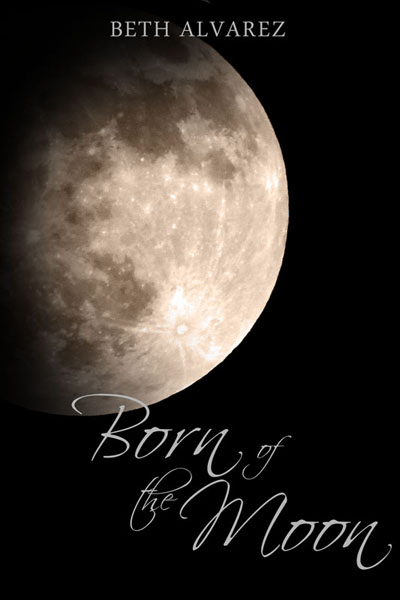
    Some of you have already had a peek at this, but now it’s public and official: the cover for Born of the Moon, the sequel to Death of the Sun and the second installment in the After Undeath series!

    I fleetingly mentioned this project while talking about taking pictures of the full moon through a telescope a few years back, and I’m glad to have had the opportunity to do it! I enjoy making my own book covers, though I tend to lean toward sleek and simple.

    Anyway, the word series might have caught your eye up above, so I’ll expand on that a bit. I never intended for Death of the Sun to spawn a series, but it became evident pretty quick after I put the book out that there was a little more story to tell. This is the only direct sequel to Death of the Sun there’s going to be, but there are going to be more stories–short stories, maybe a novella or two–that will be considered part of the series. When they’ll come out, though, I can’t say right now. Some may pop up here as part of my collection of short stories, or might end up posted as a novelette, similar to what I did with Gale’s Gift.

    Ready to see what’s coming? Read on.


    born-of-the-moon-sm.jpg

    Life after death isn’t all it’s cracked up to be.

    It’s been six years since Blaine Moreau returned to the world of the living, keeping only his fangs as a souvenir. Though he didn’t expect the transition to be easy, a heartbeat comes with health problems, a sea of red tape, and the shine of new silver developing at his temples. Dealing with insurance claims and explaining away a shady employment history is enough without the added grief of being unable to satisfy his wife’s dreams of having a family.

    Never mind old problems coming back to haunt him.

    Without their vampire god to lead them, the clan is subject to a slow extinction, one Grace isn’t willing to accept. Clinging to her memories of their time together, she seeks Blaine, the only one who can help her have the life she wants.

    But he’s not so eager to help. With everything else in shambles, the last thing he needs is undead on his doorstep.

    Especially when one has a simple suggestion that could solve all his problems–or destroy everything he’s worked to build.

    Sequel to Death of the Sun and second book in the After Undeath series, Born of the Moon is scheduled to release on December 1st.

    Happy reading!

  • Wind

    Wind

    Some said her affinity was the worst to have; at times like this, Firal was tempted to agree.

    She wasn’t foolish enough to think the task would be easy. If it were easy, it wouldn’t have been part of their tests. But she did feel she had a disadvantage due to the energy source her power was bound to, one perhaps only shared by earth-bound mages. The others faced minimal challenge at best.

    The test was simple: shift the wind just enough to change the direction the leaves on a sapling moved. Most of her classmates achieved it with little obvious effort. The gale Ran created nearly tore the sapling’s roots from the ground, but everything he did seemed easy—when he actually attended class.

    She tried not to fret while she watched the students ahead of her perform their task. A more experienced mage than she would be able to sense the way they manipulated the energy around them, but she was still too young for that. When she was strong enough to move up to green robes, perhaps she’d be skilled enough to tell. For now, all she could do was watch and wonder, trying to determine just how she was supposed to accomplish the same feat.

    Mages with an air affinity would find it easiest; all they had to do was tell the air to move. Fire and water mages had easy access to air currents, too, relying on heat and humidity to give them power. She didn’t know how earth affinities fit in, but she could always ask a friend later. But the four of them were core elements, stronger, more power available at their fingertips. Firal’s Gift was healing, tying her to the power of life. It sounded good on her written studies, but when she stood alongside her classmates, she couldn’t help but notice how much weaker she was.

    Life force was everywhere, but to sap strength from other living creatures struck her as wrong. It meant working with a handicap, leaving her with only her own strength to rely on. Demonstrations left her tired. Sometimes they were beyond her skill completely. More than once she’d wished it possible to change her affinity. She would have liked to be a mage tied to water or wind, able to shift the weather to suit her moods. But it wasn’t a choice, so she’d settled for the next best thing; making friends with other healer mages, hoping to learn from their expertise.

    “Firal?” the Master mage beside the sapling called, beckoning her with a finger.

    Swallowing hard, Firal strode forward. She looked up at the sapling, convinced it had grown taller and stouter while she walked.

    “Move even the smallest branch successfully, and you will pass.” The white-haired Master smiled, inclining her head before stepping back and gesturing toward the tree.

    Firal stared, watching the bright leaves fluttering on their narrow stems. The breeze was steady, stronger than she first thought, and would be difficult to turn. Licking her lips and worrying her yellow training robes in her hands, she extended her sense of self to her surroundings. As always, life sprung before her senses with the most strength, flowing from the people around her, the grass underfoot, even the tree itself. Life was the most difficult element to use; despite all their studies, the how and why of what gave things life was a mystery to even the most knowledgeable Masters. They could tap it, manipulate it, even end it, but that was all they knew.

    And life had nothing to do with wind.

    Nibbling her lower lip, she tried to focus on the feeling of the air against her skin, watching the way it made the leaves dance. She tried to feel the strength within it, searching for some way to anchor herself to it. With water, earth and even fire, touching it was enough to let her find purchase. With air, she felt nothing.

    Nothing at all.

    “Mageling Firal?” the Master prompted.

    She tried harder, her senses finding nothing.

    “All you have to do is move a branch,” the woman in white said.

    Firal gritted her teeth. Couldn’t the woman see she was trying? She squeezed her eyes closed.

    A long moment of silence drew by before the Master mage sighed. “Just shift it with air and you’ll be done, mageling.”

    Firal’s amber eyes flashed open and it was all she could do to keep from glaring. “Just shift it with air?”

    The Master nodded.

    Clenching her fists at her sides, Firal marched to the base of the tree, sucking in a deep breath, her cheeks ballooning as she blew.

    The lowest branch swayed and rustled, pushing against the breeze.

    The students stared, even the Master gaping. Then, somewhere to the side of the crowd, Ran burst out laughing.

    “Will that do for you, Master?” Firal glanced at the woman from the corner of her eye.

    For a moment, the white-robed Master sputtered. Then her face darkened and she thrust a finger toward the low building that housed the classrooms. “Not in the least, young lady! You are to go see Master Nondar and tell him of your insolence immediately!

    Tossing her unruly black hair over her shoulder, Firal lifted her chin and spun on her heel, marching toward the classrooms.

    It wouldn’t be the first time she’d been sent to Nondar for discipline, but she was sure the old man would side with her today.

    After all, her teacher never said the wind had to be magic.

  • To market, to market

    Though it’s common for me to write blog posts ahead of time, I typically post them manually when blog day rolls around. I usually have them scheduled, just in case something happens, like my power going out or something like that. But I like hitting ‘publish’ on each new post, and I like being able to share the posts with friends and family as soon as they go up. And this week, I didn’t have anything written up ahead of time, so for the first time in a few years, I didn’t have a Tuesday blog update.

    Normally when I travel, I have my laptop and phone with me, so I can post an update if I really need to. But the trip this past week was a bit busier than normal, since on top of traveling to see my family, I was taking craft supplies and handmade things with me to attend the picker’s market where they live.

    It’s a pretty neat thing, running from spring to fall and closing up during winter months. The second Sunday of each month, the historic main street closes and vendors set up shop. It’s mostly vintage and antique stuff, but this month they allowed handmade crafts, too. I’ve been selling my handmade goods online for a while, mostly selling through Etsy, but I’d done two craft shows before. Neither one was very successful, and honestly, this one wasn’t either.

    It’s a vetted show, so the first step is getting accepted. I ended up being the only jewelry vendor, oddly enough, and we got in without any problems, but booth spaces were assigned, not chosen. Instead of closing the main street for one more block, they opted to put a number of vendors into a parking lot behind the main street buildings, where nobody could see them. Guess where our booth ended up?

    Naturally, that meant we didn’t get much foot traffic, while the vendors on the main street were surrounded by several thousand shoppers! The parking lot would have been a great setup for the food vendors, but it is what it is. If they offer crafting booths again in the future, they might have a better setup next time. Not that I’d be there–it was an interesting event, with live music and lots of things to look at, but it’s too far to travel. Especially when my poor car ended up sustaining damage on the trip up, and the money I did make won’t even cover cost of repairs.

    The time spent at the house with some of my siblings was lovely though, and Dad and I squeezed in some bonding time while we puzzled over how we’d fix the paint on the roof of my car. Mom enjoyed lots of time with her grand-baby, and little bit enjoyed lots of time with her aunts and uncles.

    Of course, I didn’t get a single bit of work done the whole week, but once I’m finished unpacking and things start to settle, I’ll have something to talk about: Born of the Moon.

  • Just like a clock

    Just like a clock

    Kifel didn’t hear the door open, oblivious to his stewardess standing at the entrance to his office until she cleared her throat. He paused with his pen poised above paper, glancing up. She never interrupted him unless it was important; that his son stood beside her indicated a problem.

    The boy’s head was down, his expression sullen, dirt smudged on his face. He held Medreal’s hand, as he was expected to, but he stared at the floor.

    Frowning, Kifel put his pen aside. “What has he done?”

    “I found him in the garden, Majesty,” Medreal said, sparing the child a sidewise glance. She had a sour twist to the corners of her mouth, which didn’t bode well for the news of his behavior. “He had just bloodied the nose of the Captain’s boy, tussling in the dirt. He broke the chain to the necklace you had made for his birthday, I’ve already sent it to be repaired.”

    “Thank you, Medreal. You may leave him here.”

    The old woman nodded, dipping in a curtsy before sliding back into the hallway, drawing the door shut behind her.

    The boy winced when the latch clicked.

    Kifel rested his elbows on his desk and laced his fingers together. “Come here, Ran.”

    Hesitating, perhaps trying to decide if he had other options, the boy padded across the room to stand in front of the heavy desk.

    “How badly was he hurt?” Kifel asked.

    “He started it,” Ran grumbled, staring at the carpeted floor.

    “That’s not what I asked.” Careful to keep his tone patient but stern, Kifel sat a little straighter. “How badly did you hurt him?”

    Ran clasped his hands behind his back, bowing his head a little more. “Not bad.”

    “And he saw you as you are?”

    “Yes, sir.”

    A problem, but not a large one. Captain Tanrys was a reasonable man; if he weren’t, he wouldn’t be Captain. A short meeting would take care of any concerns that came from Ennil’s boy scuffling with royalty. Kifel rearranged duties in his head to make room for it that afternoon. “Did you apologize?”

    Snorting, Ran kicked the carpet. “He’s just a peasant boy.”

    Kifel’s lips pressed thin. Slowly, he stood, turning toward the large fireplace against the far wall. It was decorative more than anything, but it was occasionally useful for destroying papers. “Come here. I want you to see something.”

    His son padded along behind him, watching as he pulled the clock down from the mantel and wiped dust from the glass over its face. Kifel knelt, holding it out. “What do you see?”

    Ran studied it for a moment, finally lifting his somber violet eyes to meet his father’s gaze. “It’s your clock.”

    Nodding, Kifel tapped a finger at the center, where the two hands converged. “This represents us. We are the hands of the clock. We are what people see. We tell people when they are to do things. As rulers, that’s our duty. We are the face, the forefront of a kingdom. And the kingdom is a clock.”

    Peering at the shifting minute hand, Ran frowned. “How do you mean?”

    Kifel held up a finger, turning the clock face down into his palm, unfastening the back. He removed it carefully, mindful of the ticking and whirring gears that moved inside. “Here’s what you don’t see. The workings are very delicate. What do you suppose would happen if I removed one of these gears?”

    “It would stop working,” Ran murmured, leaning close.

    “And a kingdom is just like a clock. You see, a kingdom is composed of thousands of parts, each one vital. You might not see them right at first. All you see is the rulers, the face. But behind him is an elaborate scheme of gears and wheels, all of them turning, all of them working together. It doesn’t matter how large or small a gear is. If one is removed, everything ceases to turn.” Kifel stuck a fingernail between the cogwheels, tilting the clock to show how all the workings ceased.

    “These are the peasants, Ran. The fishermen and the harbormasters, the farmers, shepherds, maids, servants and soldiers. The rulers may be the clock hands, but the peasants are the gears.” He pulled his finger back, letting the workings resume. “Do you understand?”

    The boy nodded. “They’re all important, aren’t they?”

    “Precisely. Remember that.”

    Sighing, Ran gave him a sheepish look. “Does that mean I have to apologize?”

    “As a matter of fact, it does.” Kifel closed the back of the clock, putting it back on the mantel. Then he smiled, reaching out and tousling his son’s dark hair. “Because no matter how big or how small the job, every job is just as important as yours. Just like what’s inside a clock.”

  • Persimmon Tree Tea’s Rooibos Vanilla Chai

    Persimmon Tree Tea’s Rooibos Vanilla Chai

    Yes, tea again this week! I’ve been so busy the past few weeks that I’ve had little else to write about.

    Until now, my knowledge of chai tea was limited to knowing it was on the menu at most cafes.

    Well, that’s not entirely true; I had a vague idea of what it would taste like, based on the ingredients it contained.

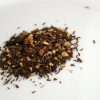
    IMG_2667

    Based on that limited knowledge, I predicted that the slightly cinnamon-like flavor of rooibos would be well-suited to a chai tea, and I’m proud to say that even as a tea novice, I was right.

    The package boasts of traditional masala chai spices, but it has a few extras, too. A hint of vanilla adds a bit of sweetness to the aroma, though it’s hard to detect in the tea itself. It also has bits of orange peel, which add a little tang. I thought the inclusion of orange peel was odd, since chai is traditionally served with milk, but I was brave and tested it. While it adds a little flavor, it doesn’t add enough citrus to curdle the milk. And milk definitely helps this tea be all it can be!

    The flavor is very bold when it’s straight, but most of what you taste is cinnamon and anise. I’m not very fond of anise, but that flavor fortunately is mellowed when milk is added. With milk in the cup, what I tasted was mostly cinnamon, a hint of vanilla, and a note of something almost minty.

    I shamelessly added sugar, too, since it’s common for chai to be sweetened. Just a hint was plenty to make it taste great, a pleasant blend of warmth that would be great to sip on a wintery morning. The warm flavor makes me less likely to want this in the summer, but I’m sorry I won’t be able to add this one to my shelf.

  • A small mound of stones

    A small mound of stones

    They were all shapes and sizes, all different colors. Some were semiprecious, glittering crystals with their markings etched in. Others were plain stone in drab hues, sometimes with the markings only painted on the surface. But they were special, just the same. Each one a treasure, a symbol—to him, at least—of a life being rebuilt.

    Rune hadn’t won many, but he had enough. Most people he played with had full sets made just for them, game pieces in uniform sizes and uniform materials. He could have had his own set made, but he liked what he had. A small mound of mismatched stones, no two alike, but each one important. He rolled them in the palm of his hand, studying the way the light glinted off some and made others appear to glow. He had more fine stones than plain, now that he looked at them, but it had more to do with who he played against than anything else.

    “Playing to how many points?” his opponent asked, arranging his set of matching stones along his side of the board.

    “Three.” Rune spared the man’s choices barely a glance before digging through his own stones, turning them over one at a time, selecting seven stones and laying them on the checkered tiles of the board. Were they playing to a higher score, they would have each had fourteen. But fourteen stones would have made the game too short, and they did want to enjoy it at least a little.

    He still preferred chess to runestones, but chess wasn’t so common. The councilor across the table from him had a chessboard, but everyone from farmers to soldiers to the king himself played runestones. Chess pieces took up more space and couldn’t be made by peasants with a ready supply of smooth river rocks and a rainy evening at home. The grid for runestones was one square smaller, seven by seven, and the rules were more difficult to remember since each of the thirty-seven pieces had their own unique movements and uses. Sometimes he thought the people he played against took advantage of the fact he was still learning. More than once, the councilor had to correct him on his understanding of a piece. Sometimes he also thought the councilor was too honest to hold his position in politics.

    Putting the rest of his stones away, Rune paused to study the last one left in his hand when the rest poured off into their bag. It was the first stone he’d gotten, a gift from Redoram, the councilor across from him now. He carried it with him, even when he didn’t carry his bag of stones. It was the marking he wore on the back of his hand, the scar that had given his name. He dumped it in with the rest and pulled the drawstrings closed. “Who chose the marks for the runestones, anyway?”

    Redoram raised one thick white brow, lifting his eyes from perusal of his opponent’s pieces. “Who can say? There used to be forty-six, but there were so many redundancies and markings that looked alike that nine fell out of use. They could pare it down more, I’m sure. There are still quite a few stones that do essentially the same thing.” He slid a stone across the board with a fingertip, clearing his throat. “Not all of them have meanings, either.”

    “Not meanings you know of,” Rune muttered, fitting a talon-tip to the grooved shape in the top of a stone to move it. He preferred etched stones for that reason. The smooth ones were sometimes hard for him to pick up.

    Chuckling, Redoram nodded. “True enough. Some are letters from ancient languages I’ve studied, but some are symbols I’ve never encountered. I suppose each culture adds a bit of themselves to the game.” His counter-move took the first piece off the board.

    Rune frowned. “Maybe that’s why I’m no good at it. There’s no part of my culture in this game. We don’t have it.”

    “Don’t you?” Redoram’s gaze shifted to the scar in the back of his scaly hand.

    Irritated, Rune turned it so he couldn’t see. “No.”

    “Well then, I suppose you’ll have to insert a bit of yourself into how you play. Games like this are meant to evolve, after all.” The councilor paused, glancing to the board.

    Rune’s eyes narrowed. “What?”

    Redoram waved a hand. “Well, go ahead, my friend. After all, it’s your move.”

    ******

    This week’s prompt was “A small mound of stones.” This was one I kept coming back to, since it was hard for me to think of something to use for it, but it ended up  being one I really enjoyed. You can see what the lovely Megan Cutler has done with this prompt here, and what her awesome writing partner put together here.

  • Persimmon Tree Tea’s Ruby Orange

    Persimmon Tree Tea’s Ruby Orange

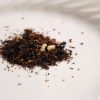
    ruby-orange

    I was surprised and disappointed earlier this month to discover Persimmon Tree Tea’s website had no stock. All their pages indicate an indefinite hiatus, which ruffles my feathers since they’re the producers of my favorite Earl Grey and Green Pomegranate tea blends.

    When I made this discovery, I was unsure if I should continue posting reviews of their teas, since people who like the sound of them won’t be able to get them. But I decided I would, obviously, since I’m posting this. I still feel like the information is important, if only because documenting information about the teas here will help as a point of reference for similar alternatives later down the road. Good tea is very valuable, after all; to the Vikings, it was worth its weight in gold.

    I still have five teas of theirs to review out of my batch of samples, so here’s one of the five: Ruby Orange.

    Ruby Orange is a delightful rooibos blend, sweet and fruity on its own without a need for sugar. Pieces of orange peel give it a wonderfully tangy aroma, while the tea brews without the normal bitterness the peel often leaves behind. It has a mellow herbal taste, the addition of hibiscus petals adding a pleasant earthy floral note while enriching the natural red color of the rooibos. As rooibos always seems to for me, it has a very faint taste of cinnamon, but it’s just enough to keep the flavor warm without being overwhelming.

    Overall, I’d say I definitely liked this tea, and if it was currently available, I’d probably consider adding a few ounces to my tea shelf. With luck, I’ll be able to find a comparable tea in the future.