Beth Alvarez - Author of Epic Fantasy
  • Mage colors

    Over the weekend, I shared a video about customizing a Nendoroid doll into Zaide, the main character from Spectrum Legacy. While most of my commentary surrounding the character was related to how his appearance was influenced by our dog, who just passed, I also spent a little time discussing the mages in Snakesblood Saga, and why their use of the white and blue color scheme made me hesitant to use the same for Zaide. Likewise, most of the discussion about the project was condolences for the loss of our very sweet pet (thank you, she is missed!) there was one message I received via social media that expressed curiosity about my reasons for the mechanic when it comes to the mages in Snakesblood.

    If you’ve read the books, you know that all the mages eventually end up with white hair and blue eyes. If you haven’t, then here’s the gist. In the Snakesblood universe (and the world of Ithilear) the changing color of hair and eyes is a sign of mastery over their craft.

    They’re also a simultaneous indication of the mage’s victory over power, and their failure to successfully wield true power. To be recognized as a Master mage, evidence of the two changes must be shown, but they don’t necessarily appear in the same order.

    Whitening of the hair usually happens first. When a mage pushes themselves too far, they run the risk of having their power literally unmake them. But that boundary lies in a different place for every mage, and learning where it is means setting one foot across it and then successfully coming back from the brink of death. Master mages must learn to skirt that line, access as much power as possible and refuse to let it take them. Such an experience results in extreme physical trauma, and that trauma–especially when repeated–eventually results in white hair. Truthfully, it’s just premature graying, a result of the perpetual stress on their minds and bodies that comes with the trials of magecraft. That hardly sounds glamorous, though, and nature of the mages themselves means the whitening of hair is enshrined as a rite of passage and a mark of incredible strength and prestige. However, that doesn’t stop some mages from making an effort to hide their new grays. Especially those who may be a little more vain.

    The changing color of a mage’s eyes is a little different. It’s not so much that the eyes change color, as that they lose color. Magic is an energy that manifests itself in a number of ways, and one of those manifestations is light. Free mages are those who can touch pure power, unfettered, and it reacts to them accordingly. Funneling such power and letting it blaze freely as part of one’s spirit is reflected in one’s eyes. But those born without a natural resistance to such power find themselves drained by it, rather than enriched, and it results in the eyes–the window to the soul–having color stripped away as magic beyond what they can handle slowly chews at their spirit. For some mages, this is a deeply emotional experience, as they may feel the loss of color robs them of part of their identity, but it’s considered a necessary sacrifice in the name of power.

    In some ways, that’s what makes it fun to use the same colors for Zaide in Spectrum Legacy. It stands the expectation on its head, and instead of being a powerful mage, Zaide has no power at all.

  • Next year, I’m taking summer off

    Of course, I guess it could be said I’m taking this summer off, too. The difference is, I didn’t plan for it, so dealing with it is a whole lot harder. I have things I need to do. Contracts I need to complete. Deadlines I’d still like to meet. But this summer has been the most demanding I’ve ever had to deal with. The odds of getting those things done?

    I’m starting to think they’re pretty slim.

    In fact, in the past 6 weeks, I’ve gotten almost nothing done. I accomplished a tiny bit of writing in June, and that’s the extent of my achievements.
    Worst of all, I should have seen it coming.

    Oh well–it’s too late to do anything to salvage productivity now. There are only a few weeks left before school’s back in and we have to create a new routine. But there are lessons to be learned here:

    1. Having a few goals set is ideal to keep from drifting aimlessly, but under-planning is better than the alternative.

    2. I really need to start looking at the amount of time I anticipate having, then cut that in half and plan for that amount of work time instead.

    3. It’s better to delay deadlines than produce inferior work trying to meet them.

    That last one’s been a real chore this year, as I try to balance replacing my camera/filming setup with still getting content out. There’s the saying that anything worth doing is doing badly, and to an extent I agree in some areas: It’s better to do something to the best of your current ability than not at all, but if you have the power to stretch farther and produce something better, it’s always better to do so. I’ve kept my video schedule sparse as I try to overcome the current struggles and issues, but I do hope to return to weekly things before the end of the year. We’ll see if that works out–I’m establishing plans for August now, and trying to keep that “half of anticipated work time” thing in mind.

    It’ll be rough, especially since I have a lot of catching up to do.

  • Artisan Magic

    Artisan Magic

    Each time I start a project that takes place in a new world, there’s the task of determining how the magic works. Magic has appeared in every fantasy story I’ve written, even if it hasn’t been in the forefront where it’s easily seen. In stories like Of Blood and Rain, the magic is quite mysterious, clearly influencing the world, but escaping the grasp or understanding of the main characters. In things like the Snakesblood books, it’s front and center and deeply developed, while the magic in Spectrum Legacy is a little more ambiguous, but touched on enough to provide a clear understanding of what magic can and cannot do.

    Image via Ann Milovidova, Pixabay

    For my latest standalone project, which is being written alongside the end of Paragon of Water, I decided to root the story in yet another world, which lets me explore a new type of power: Artisan magic.

    Artisan magic is one of the focal points of the story. For a good while, the working title of the book has been Threadmancer. That won’t likely be the name the book is published under, but it might function as a series title if I eventually write more. Then again, Artisan Magic wouldn’t be a bad series name either. Hmm.

    For Threadmancer, the lead character is a seamstress (something I know a little bit about, myself) with the power to sew magic into the garments she creates. And that’s an important rule for the artisan magic in this world, because magic can only inhabit things physically crafted by people with the right set of skills. Mages weave power into their creations, be they threadmancers (like our heroine) or metalmancers, who might forge a weapon or armor that bears special powers. But the mages themselves can wield no power, only what they’re able to create.

    On the other side of the coin, there are the ravelers, who have the ability to strip magic from imbued objects. They’re considerably more rare, but their power has the potential to be used for wicked or for great good, as they’re the only ones who have the skill necessary to unravel dangerous curses from items made with ill intent.

    Anyway, I’ve been poking along with the book for a bit now, so I thought you might enjoy a little peek into one of the building blocks for this new fantasy story. I hope to have it done by this fall, but a lot can change between now and then, so we’ll see what happens. I’ll have more to share before long.

  • Spectrum Sketches

    Spectrum Sketches

    As I tidied up my desk this week, I found myself flipping through the pages of my 8.5×5.5 sketchbook. It’s the one that contains a lot of cover sketches, concepts, and character chibis I’ve drawn for the Snakesblood Saga. But it also contains a lot of the rough concepts for Spectrum Legacy, some of which are things I later developed into more finished art. I’ve shared a portion of it here before, but not in sketch format, so I thought it might be fun to have a peek inside and talk a little about each piece.

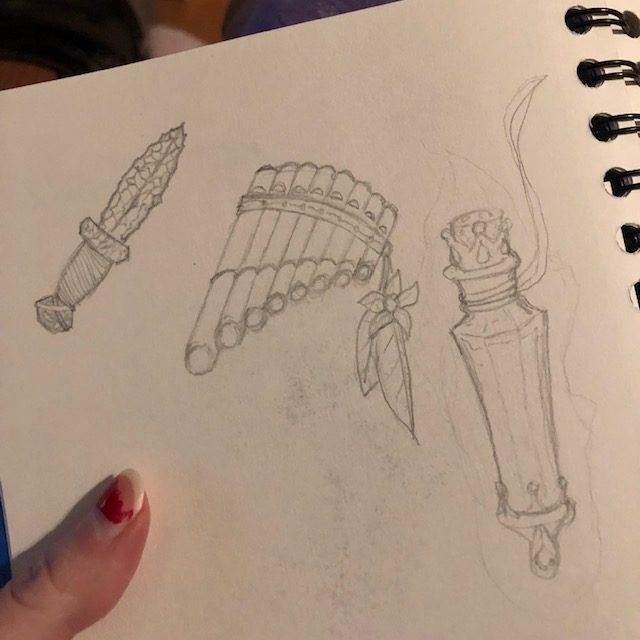
    Let’s get started with the first Spectrum-related sketch in the book: The artifacts.

    I don’t usually get ideas right the first time, but these changed very little between the sketch and what I ultimately traced onto watercolor paper and painted. The finished versions were a lot larger than these tiny little sketches. Back when I painted these, I actually recorded it, and also spoke about each one on my blog. For your convenience, I’ll link to them, so you can see the painting if you desire. From left to right, they’re the Molten Dagger, the Vale Hymnflute, and the Captured Spring.

    These were one of my first forays into working with watercolor (well, using gouache as watercolor with wet-on-wet techniques) and were super fun, but they were also one of the earliest parts of concept development for the series. I knew I wanted there to be two things: Magic artifacts, and magic abilities represented by color. It’s the reason the main artifact is the Spectrum Blade. Its power is a small portion of each other element, each color of magic. But that’s obviously explained more in-depth in the books.

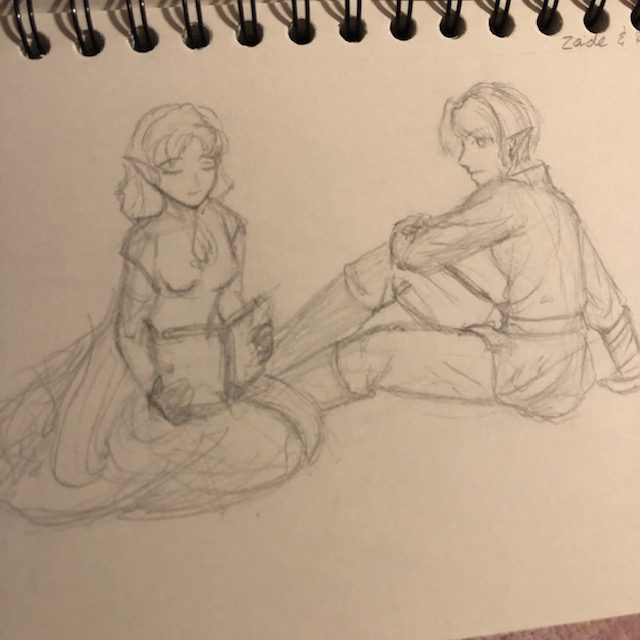
    On the very next page was this early sketch of Zaide and Resia.

    I have no idea why I was in a more anime mood when I did the Spectrum sketches. Maybe because I’d been working on art for Snakesblood for so long that I was burned out on realistic painting and wanted to do something a little softer? Dunno.

    This was another one I transferred to nicer paper, though I used colored pencil on it instead of paint. It’s also unfortunately one of those pieces where I liked the sketch a lot better than the finished illustration. It happens, sometimes.

    One interesting tidbit about this sketch here though is Zaide’s ear. In the books, his left ear is truncated, having had the pointed tip cut off in some accident he doesn’t recall. This sketch was done before I’d decided to take that path in the story, which is amusing to me because it ends up being an important piece of symbolism later on!

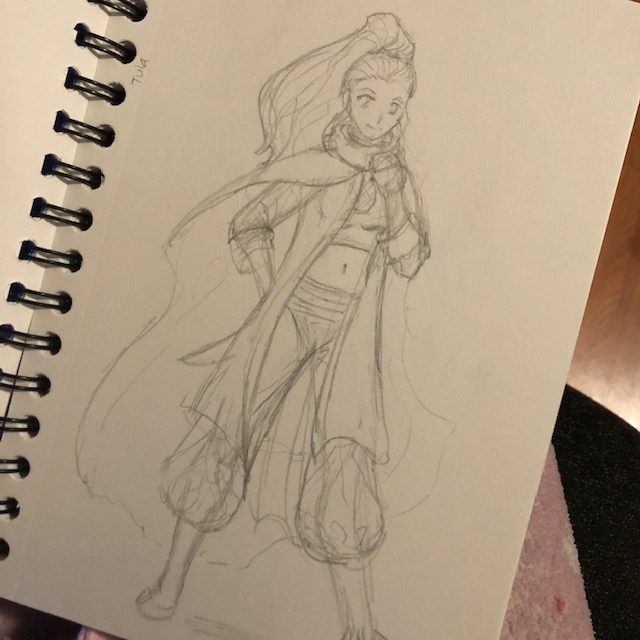
    A few pages later, we find the first concept for Tula.

    Like everything else so far, I filmed the process of finishing this as a painting. Looking at it now, I can hardly believe how much this character’s direction changed! Aside from her garb and some of the colors, the Tula on the cover of Paragon of Fire seems totally different… but she’s still smiling, so I think that counts for something. She’s a peppy character, innocent and also not at all, and having her smiling on the cover of book 2 meant a lot to me. Of course, I think Michelle did a much better job portraying her than I did, but hey. I’m not the professional artist, here. I just do these for fun!

    Now we’re getting into the stuff I haven’t shared in any form before, and that’s pretty neat.

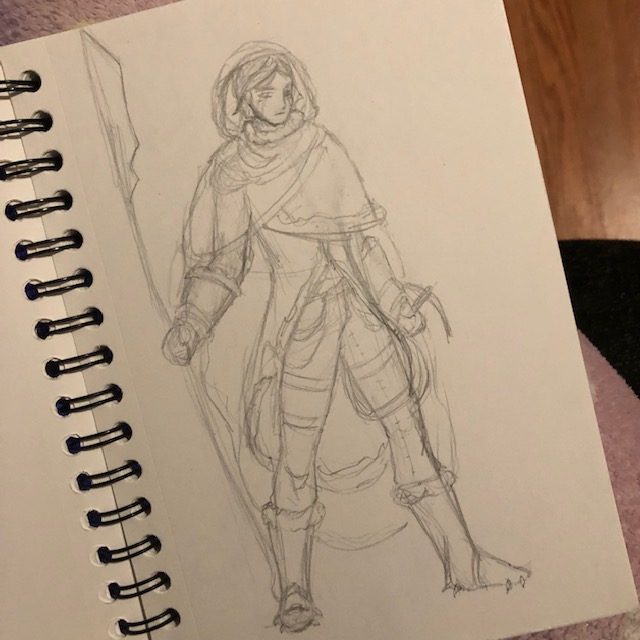
    If you’ve already read Spectrum Blade, you might have a guess as to who this very roughly sketched fellow might be. As you can see, having Andriun swathed in fur-lined garments has always been important, just like his spear. There are a couple elements here I still really like, such as having his coat split all the way to the hip so he has a lot of mobility in his legs, having claws on his boots to help him walk on the ice, and of course, you can see he’s holding an ice pick. Andriun will be on the cover of book 3, and I really look forward to seeing how he comes together for it.

    And of course, there’s Lark, the last of the main 5.

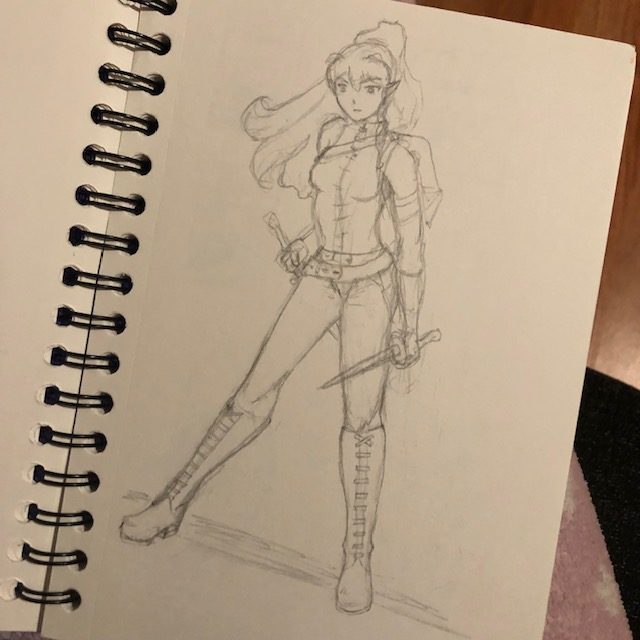
    Perhaps to be expected, but Lark ultimately has been the hardest to nail down as far as appearance and design goes. I gave her a high-collared but sleeveless shirt, which I planned to use to show a bit of muscle definition in her arms and make it clear she was someone who could hold her own, despite her regal and refined–and somewhat aloof–personality. Originally, I had some concerns that her physical appearance would be too similar to that of Tula, since they both have high ponytails. In color, they’re easy to tell apart, but I think Lark is a little more fine-featured than Tula is, so I think it’s easy enough to distinguish them in the black and white sketches. This one might be fun to paint at some point. Maybe I’ll finish it someday, but I don’t know.

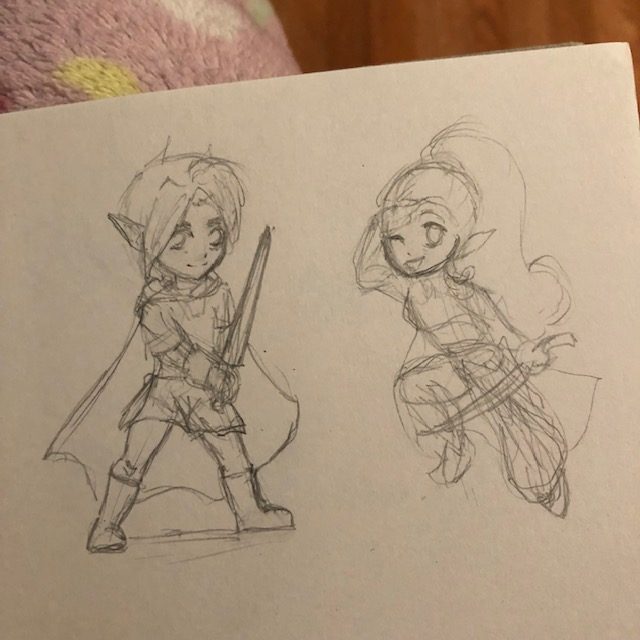
    Lastly, there were some attempts at chibis.

    And man, they are not as graceful as the ones I did for the Snakesblood characters. I was able to save Zaide back in January, when I turned this sketch into a sticker to go with his book. I don’t think there’s any saving that rough idea for Tula, though, no matter how much I like the idea of her shading her eyes but also making a winky face because… Tula. She’s something else, I tell you.

    That’s all that was in the sketchbook, though. At least, for this series. Maybe I should spend a little more time doodling?

  • Library dreams

    Library dreams

    You know the ones. The Pinterest libraries with the white shelves, the fairy lights, all the books.

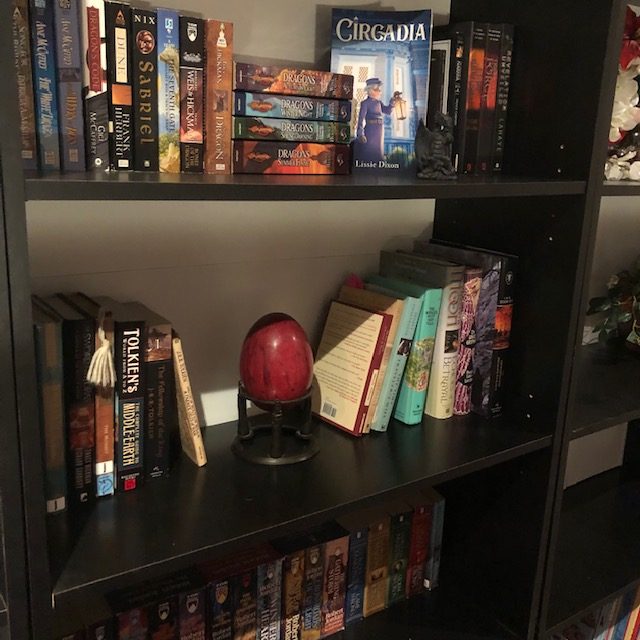
    Most of my books were a casualty of moving. They’re big and heavy, take a ton of space, and anything I didn’t love or anticipate reading (or reading again) was given away. So right away, I was going to start at a disadvantage. And while our new house came with a furnished library space, the bookshelves they’d left behind were black, and the loft was very gloomy.

    How, then, is a bookworm to get an attractive library space? Without several hundred dollars to drop on new shelving?

    Contact paper, I guess.

    Three rolls was enough to change the backing color of all eight shelves, though I wish someone had warned me that Contact paper shrinks after application. That certainly wasn’t mentioned in any of the homey upcycling blogs where I saw people doing this. So there are visible seams between every piece, but hey, at least it’s brighter, and you can actually see the books now.

    Someday, I’ll have a chance to redo it properly, but at least it’s a little more airy without a massive wall of black. And I don’t have any more books than these, unless we could my own stock that goes in the my shop of signed books, but someday I’ll fill these shelves up… or else replace them with something smaller and better-suited to the size of my literary collection.

    How would you decorate a space like this? a 20-foot-long wall that hosts eight bookshelves and has no outlets?

  • The greatest thing I ever KonMari’d was the method

    Everybody wants a house that stays clean and runs smoothly. My mom read Marie Kondo’s book and told me about it before it was popular, but it wasn’t until all my friends were on board the train that I decided I might take the time to give it a look.

    Like a lot of people stuck at home in 2020, I spent a lot of time making plans for better home organization, tidying things up, culling stuff from the house. Mostly using my own methods, but I tried the KonMari way for a couple things, too. Folding my clothes that way seemed nice in my tiny drawers, and having less of anything to clean up was nice, too.

    But over time, it became its own kind of frustration. It required me to fold clothes differently than what I’d been doing for more than 20 years, so it was slow and ineffective. Some things didn’t fold nicely. And as a tall person who rarely finds jeans long enough, the whole concept of having a wardrobe–or anything in my house–solely because it “sparks joy” instead of being tolerated because it meets my bare minimum needs and “better” is outside my budget soon left me with a distinct feeling of lack instead of some newfound freedom from commercialism or whatever it was supposed to be.

    A sense that the basic things I found that I had to settle for weren’t good enough.
    That to be efficient, I paradoxically had to give up efficiency.
    And a frustration that nothing I tried seemed to make things better.

    Earlier this year, I reflected on this while I folded five baskets full of laundry.  As I did so, I found myself considering how the method could be applied to many more things beyond, well, things. That led me to think about the practice itself, and as I folded a shirt the KonMari way, I decided to follow it with one folded the way I’d always done. It took more space. It wasn’t pretty in the drawer. But it took half the time, and it worked fine. I put them side by side on my bed and thought, does this spark joy?

    And so all my laundry went into the drawers folded the old way.

    Now I’m looking at other things in my life with the same critical eye. Obligations I signed up for, jobs I took on, social media platforms everyone swore I should try. Am I doing it because it actually helps, or is it just the popular thing? I guess it’s just like writing advice, and what so many resources tell you to do with it.

    Keep what serves you. Discard all the rest.

    Joy need not apply to laundry.

  • Burnout blues

    I’d hoped this one would be a post where I told you Paragon of Water was done, and that I was starting the next project, excited to get it underway.

    Needless to say, that didn’t happen. April was a great month for writing, but a lot of surprises came in May. Unfortunately, when you’re already juggling things, adding one more means dropping the ball. I thought I’d be able to put everything down and regroup fairly quickly, but then the little one got sick and ended up being home from school a lot, and that sort of brought the month to an end. The best laid plans, right?

    So things are moving a little slower than anticipated. I’m outlining the project that’ll come after Paragon of Water, making plans for a fun smaller project I might try to slip in after Paragon of Light, and that’s enough to keep me feeling creative, though not quite enough to get words on the page.

    The good news is, shifting my schedule this year gives me enough space that taking time off won’t affect the number of books I get done this year; I still expect two more, and Paragon of Water is tentatively scheduled for the last weekend of October, now. It might be a week sooner, but we’ll have to see how the calendar dates line up. I write slower over the summer, but will be back in full swing in August, so the book will be wrapped up by then no matter what.

    Inspiration can be capricious, so I’m not sure which project is going to hit completion first, but we’ll find out.  No matter what, I’ll have some more about one of these upcoming books for you soon, so I’ll keep you updated on how this break goes.

  • The clarion call of side projects

    Shortly after I started the long process of writing of writing Paragon of Water, a few snags arose. Cover art needed to come slower. Plot ambiguity stalled the writing. And all the while, some new concepts for something short, easy, and stand-alone kept brewing in the back of my mind, making it that much harder to keep going.

    Of course, burnout hit shortly after that, so then there was no writing happening at all (still working on getting back into the swing of it…) but through it all, I found myself craving work on that side project instead.

    Why do we do that, anyway? I guess it has something to do with what I typically write. That’s how Westkings Heist came along, too. In between the Snakesblood books, which were twisty and complicated with lots of characters to keep straight, I felt so fried that I needed something short and sweet to finish between them. So I wrote those heist novellas. Although the last one is considered a full novel at 50k words, it was still substantially easier than the 100k+ word books I’d been juggling, and having just a single point-of-view character and a single plot thread for each story was refreshingly simple. Since I was doing the work on Westkings Heist between and around bigger books, they were still slow to get done, but they felt so easy, and they helped refresh my brain when I got stuck on the bigger projects.

    So maybe I should have learned from that. I had several big releases in a row: Serpent’s Crown followed by Serpent’s Blood, finishing the Snakesblood Saga. Then immediately after, Spectrum Blade–which is the longest book I’ve ever published–and Paragon of Fire. Four epic fantasies in a row was possibly my max… or maybe even too much. Maybe that was why I found myself wanting something else, coming up with a dozen ideas for new stories, things I could jot down and add to my ever-growing list of books to write. I think we’re at 14 right now. If I keep up the current apparent pace of two to three books a year, it’ll be seven years before I finish the stuff I already have planned, and that’s rough.

    Don’t get me wrong, being busy for that long is great. Having a long-term plan and a goal set in the future is great. But when I look at the length of time it takes me to complete things, it isn’t motivating to dangle the carrot of what I really want to be working on at the end of that pipeline. Instead, it becomes crushing. Seven years is too long to wait, and that, in turn, creates a negativity spiral. If only I could write faster.  Maybe if I gave up doing x, y, or z, I’d be able to have more time to write.  If I learned how to write using this method, or that method, or outlined better, or…

    It goes on and on, and as I sit and reflect on it while having my morning tea, I wonder if maybe it’s a sign I should be leaning more into the fluidity of scheduling that comes with being my own boss. I try to focus on one project at a time, because I feel like that gets things done faster. But maybe having something on the side, something short and easy, like Westkings Heist was, would be beneficial. Something to bounce to when I’m stuck. Because it’s not just a distraction if it becomes a reward and is something that gets pushed out sooner, rather than later, right? Or am I deluding myself?

    I don’t know. I guess no matter what, writing is a continually evolving process. Even as I work on my 21st book, I’m still learning new things about my process, and that process never seems to stay the same for long.

  • Letters Home

    Letters Home

    Last month, I wrote a scene in Paragon of Water (the upcoming third book in Spectrum Legacy) where Zaide penned a letter to his foster parents. This started a small writing exercise for me. What might be in that letter? How many letters would a homesick character write? I decided to jot down some ideas of what his letters might entail, and that soon expanded into writing some letters from other characters, too. It’s something small, but fun, to help me stay deep in a character’s point of view while I’m working on chapters from their perspective… or experiencing a lull between their chapters, where I feel a little disconnected from their mindset.

    Photo by Debbie Hudson on Unsplash

    I sent the first of these letters home as part of last month’s newsletter, but it was fun to write, so I figured I’d make it a practice. Not all the characters are the letter writing sort, so there will probably be some journal entries and things along the way, but it’s a chance to get a glimpse into the thought processes of the characters in the stories… and maybe pick up a few extra tidbits you might not learn about their families otherwise.

    The second set of letters–from two different characters, this time!–will be going out with my monthly newsletter update this weekend. I don’t plan to post these on my website, since they’re bound to be rife with spoilers for the people who haven’t started the series. So if you want to read, the newsletter will be the only way to get them. And if you haven’t read it yet, you’ll get a digital copy of The Choosing when you sign up. It’s a short story about Zaide’s Choosing and one of the background events that set things up for Spectrum Blade.

    You can hop over to my newsletter page to sign up now. And if you want the one you missed, let me know. If there’s enough interest, I might set up an archive exclusive for newsletter subscribers, so that past letters can be perused at your convenience.

    Now, wish me luck. I’ve got to finish Paragon of Water this week, before summer break begins.

  • Five minutes at a time

    Five minutes at a time

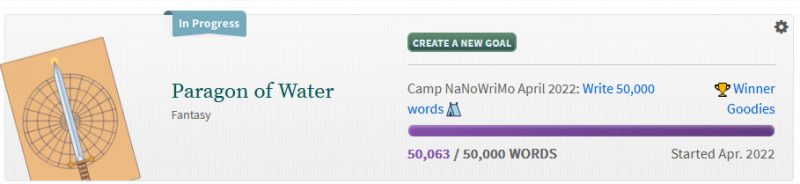
    Last month, I decided to do Camp NaNoWriMo. Spoiler alert: I set a goal of 50,000 words, and ultimately, I hit it. I wrote only Monday through Friday and took a few days off, too. That means I averaged 3,000 words a day on each writing day. I aim to do the same thing this month, while I wrap up writing Paragon of Water. At a minimum of 3,000 words a day, it’ll take me about 16 days to finish the rest of this fantasy book.

    There was a time in my life where I thought it was impossible to write that much. Now, it still feels like too little, but as we creep closer to summer break, I try to remind myself that it’s a perfectly reasonable amount of writing for someone in my current life situation… and that I’ll probably get less done across the summer months.

    When you’re raising kids, finding the time to write can be one of life’s biggest challenges. One of the biggest things I’ve done to make it more achievable has been learning to work in bits and pieces. This has been a long process for me, and training myself to be able to work this way has been rough. But my books are getting done, five minutes at a time.

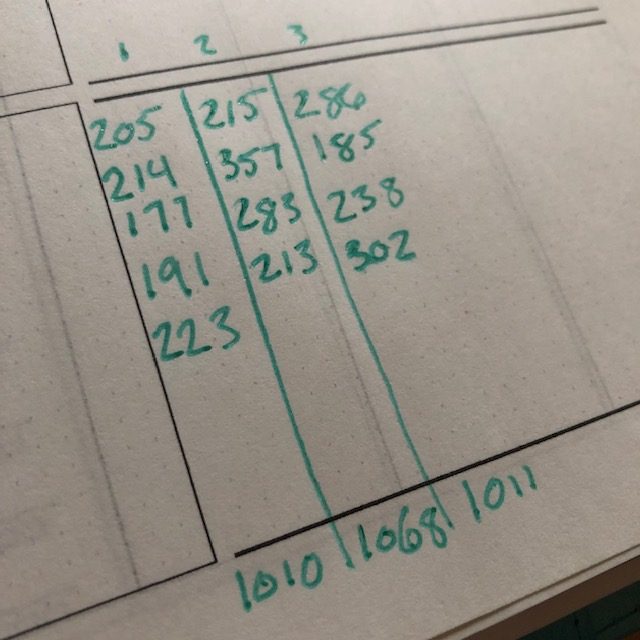
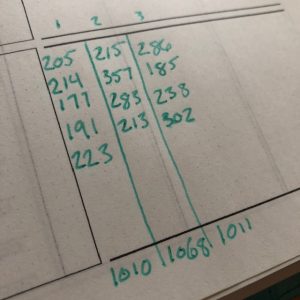
    One of the ways I keep myself going with writing is using a day planner. At the bottom of each daily page for the days I intend to write, I put a section to track my writing, split into 3 columns. Right now, each represents a session, and most of those sessions happen in the morning, during school hours. But across the summer, they’ll represent morning, afternoon, and evening.

    Each number on the grid represents five minutes where I sat down with my laptop, opened my book document, and set a timer. That’s it. Five minutes at a time, in between chores and the rest of everything life has to throw at me. When my time’s up, I write down how many words I wrote in that 5 minute period, then move on with my day.

    If I can claim just 5 minutes for myself out of every hour through the day, I can consistently hit my 3k daily word goal. And if I can only get 5 minutes every other hour, that’s still 1,500 a day and nothing to sneeze at.

    There are a few things I did to make this easier. One, I became a solid outliner. Not only do I have an overarching outline for each book, but lately, I do mini outlines for each chapter using index cards. I break each important part of a chapter down into bullet points on my cards, but I only make up two or three in advance, so I can change things as needed if I find something on my outline isn’t working well. Each bullet point on a card is followed by how many words I estimate will be necessary to achieve that piece of the story, so I know how many 5-minute sessions it’ll take. And then I carry my index card in my pocket or stuff it behind the case on my phone, so even if I can’t get to my laptop, I have my immediate outline handy so I can tap out some words in my phone’s notes app. I’m an iPhone/Mac user, so it’ll sync automatically and I can easily copy/paste my work to my book document later.

    Having a whole hour to think over what happens next means when I sit down, the words tend to come more easily, and sometimes it gives me extra witty one-liners because I’ve had all day to think them up, so it seems to be working well. I wrote Paragon of Fire this way, too, and that’s the first book I’ve ever written that succeeded in making my husband laugh out loud.

    All this means I have to spend a little time on the weekends figuring out what’ll go on my next few index cards, as well as checking my main outline document to make sure I’m heading where I need to go, but it’s made a big difference in how fast I can finish books.

    Just five minutes at a time.