Beth Alvarez - Author of Epic Fantasy
  • Going full time

    Going full time

    A couple weeks ago, I shared a photo on my personal Facebook page. Everyone liked it, but I didn’t say a whole lot about it, other than that I was trying to treat what I do more like a business than a hobby.

    My business card

    But it was also part of getting ready for a big change.

    For the past five years, I’ve been a stay-at-home mom, and that’s been my biggest job. I left my employer because my daughter needed me. But now she’s officially started school, and it meant it was time for me to go back to work.

    My husband and I talked about it. We made plans. Going back to a normal job was the first option on the table, and honestly, it would pay better. But it’s not what I’m passionate about, and things have changed in the past five years. At the time we discussed it, we were in a position where his income could support us; there was no longer a need for my income to pay bills. That meant I was finally faced with a pretty amazing opportunity: I could work, or I could work for myself.

    It wasn’t a difficult decision, but things happen. I made the decision immediately. I was going to stay home and write.

    Then I started having health problems, and the insurance company did not pay. It’s funny how fast one bill can change plans, and we still don’t know what’s wrong with me. Almost as soon as I made the decision to pursue my writing, it seemed Life had decided to prevent it from happening.

    I spent a lot of time thinking. A lot of time working, too–usually thinking while I worked. I started scraping together money to put toward the bills, thinking all the while about what I’d have to give up in order to pay it off.

    Then one evening, while working and thinking and listening to podcasts about creative work, I recalled when my sweet friend Megan encouraged me to read The Alchemist, citing the core message of the book.

    Sometimes the universe doesn’t put obstacles in your way to prevent you from reaching your goals. Sometimes the obstacles are put in your way to see how badly you want to reach said goals.

    I’m still going to work hard. I’m going to pursue my passions and try to build something of it while I can. And for now, when it comes to the bills and the stress and my desperate need to have something to contribute to my household… well, I’ll put that in God’s hands.

    For now, I’ll stick to the original plan and say it:

    I am now a full-time author.

    For how long, I don’t know. But I hope and pray that something comes of it, so I can push past these monstrous obstacles and reach that shining goal at the end.

    I’ll still be doing YouTube stuff, probably at the same pace, but my main focus will be writing. Right now, my goal is to arrange all my work so that my evenings no longer have to be split between work and family. I’ll aim to finish work before my daughter gets home from school and have my evenings free to be with my loved ones. And hopefully, so long as I don’t wear myself out, I’ll be completing one book every two or three months and will allow myself weekends off.

    That’s the plan, anyway. We’ll see how long it sticks.

    For now, I have some writing to do.

  • Naming the cities

    Naming the cities

    I’ve been working on my world a little at a time. One of the most annoyingly difficult things to do was name all the important cities. Though I turned to my favorite name generator for some assistance when I got stuck, there were a few things I wanted to accomplish in naming the different cities scattered across Amroch.

    For one, I wanted to ensure no two cities bore names that began with the same letter. Having too many names to keep track of is a common complaint in readers, and it’s one of the reasons it’s usually suggested that authors try to avoid having characters that share beginning letters. I have to admit that even I had trouble when reading the Wheel of Time–I can’t remember how many books it took me to stop confusing Caemlyn and Cairhien.

    With casts as big as mine, it’s usually not feasible to do it, but I’m making a concentrated effort to conquer the problem in Spectrum Blade. It was surprisingly difficult, especially when another thing I wanted to do was establish naming conventions that would help each region stand apart. After all, Amroch was originally a number of smaller kingdoms that eventually allied and then merged. I wanted the cities to retain the flavor of their original version.

    Some of the naming conventions came out fairly obvious, while others are a little more subtle. But I came up with as many names as I could and then tweaked them until they worked.

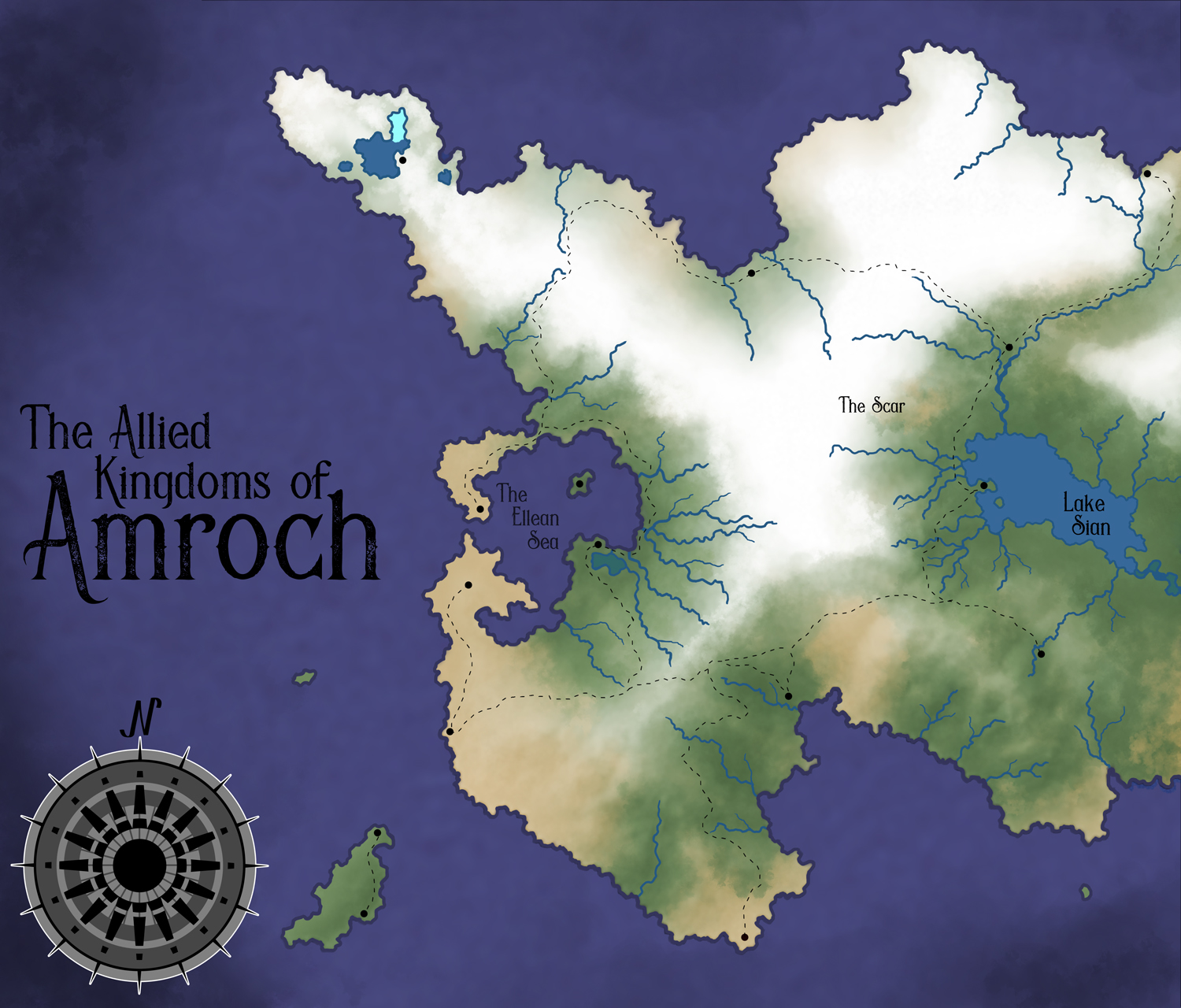
    The most difficult name was Amrochan, the capital. I’ve already done the city-named-after-a-ruler thing in another series (*cough*Snakesblood Saga*cough*) so I didn’t want to default to it, but no matter what I tried, Amrochan just seemed to work. So it stayed, and the names all went on the map:

    Map of Amroch from Spectrum Blade

    I intend to revise the map a little to make the labels more legible, then I need to do the print-friendly version of the map, but I’m rather fond of this color layout and think it’s what I’ll use most online.

    The more I get done, the more excited I am about finishing my current work-in-progress so I can get started on Spectrum Blade. But there’s still so much to do, both in world building and character development. Right now, I’m aiming to have Her Midnight Hunter completed by the end of September, but you can hear all about my weekly word counts and the progress I’m making on that project on my Facebook page.

  • Finishing the set

    Finishing the set

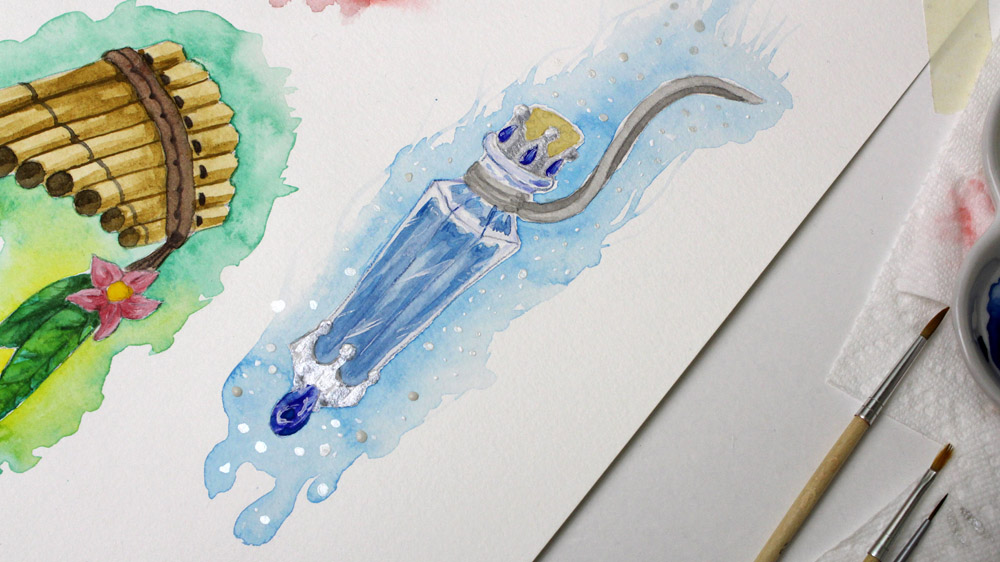
    Last of the three items being painted is the Captured Spring. This one was interesting to do and I think it turned out decently, despite my inexperience in drawing glass objects–never mind glass objects with a new medium.

    The Captured Spring from Spectrum Blade

    Overall, I think it worked well for completing the set, and I like the contrast between the three colors. I thought I ruined it with the metallic paints, though; they didn’t work like I expected, more opaque than translucent wash. I tried to pull it back together, but I’m not going to fret over the problems. It was a really fun project that inspired me to do more of this kind of work for my stories in the future. Later this month, I’ll set up the gallery and start putting these art pieces into it. It’s nice to see the set all together.

    Spectrum Blade magic items

    I may paint Zaide’s sword soon, as it’s the fourth important magical item that comes into play in the first book, but I don’t know yet. I’d actually like to make a physical version of the sword, but haven’t been able to find the right blade to modify just yet. Back before my daughter was born, there used to be a vendor at the local flea market who sold a wide variety of swords and knives. He doesn’t seem to go anymore, though, and I prefer not to shop online if I can avoid it.

    But that’s a project for another day. Next week, it’s back to world building.

    The video can be seen here:

    Now for that world building…

  • More magic items

    More magic items

    Okay, so I don’t actually have a lot of world building to add this week. Probably not next week, either, since at this point we’re getting Little Bit ready for school. But after last week’s post on developing magic items, I really wanted to keep sharing the artwork for them as I get it done! Hopefully I’ll  have the third item painted in time for next week–though you can see the pencil lines for it now.

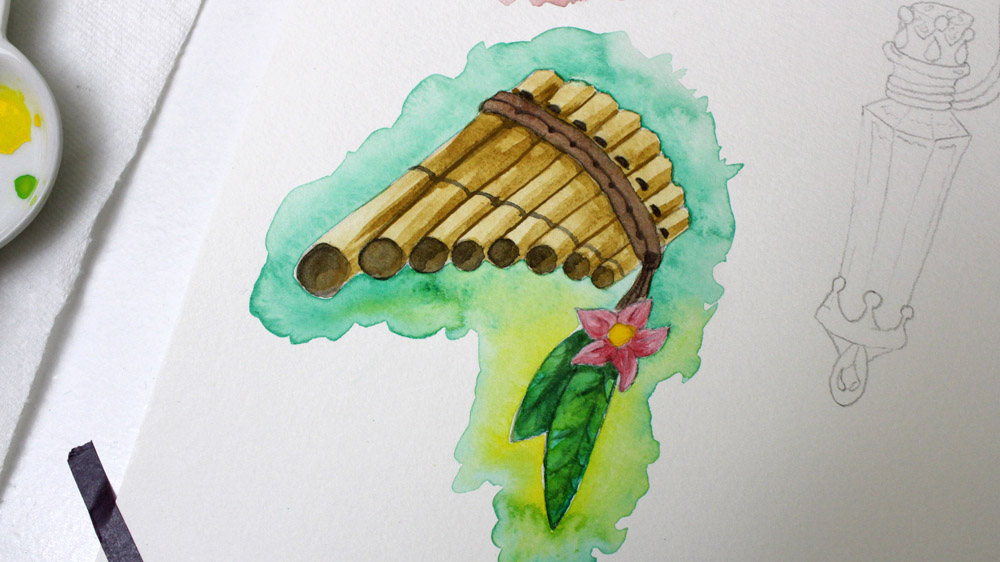
    This one needed watercolor pencil to do some of what I wanted. Probably because of my inability with gouache, being a total novice. But I have a great set of Prismacolor watercolor pencils gifted to me by my wonderful friend Alisha, so I got those out to use on it.

    The Vale Hymnflute from Spectrum Blade

    This one is the Vale Hymnflute, and if you haven’t figured it out yet, each of the items correlates to the regions I mentioned as important when I was working on making my world map. There’s an item for the desert, the forest, and the frozen wastes. You can see the third item there, just waiting to be painted.

    Magic items from Spectrum Blade

    Overall, I’m pretty happy with how it came together.

    You can watch me paint the Hymnflute in this video:

    That means there’s two down and one to go. And at some point… I guess I’ll  have to paint the blade, huh?

  • Magic items (Building a fantasy series, part four)

    Magic items (Building a fantasy series, part four)

    Magic items tend to be staples in most fantasy, and weirdly, they never played that big of a part in stories I’ve written before. There are a few important ones, but no epic quests that involve picking them up along the way, which means Spectrum Blade will be a little different for me. There will actually be a small number of important magical items and legendary artifacts the heroes will encounter, and since they’re interesting to me, I decided to draw them, too.

    I didn’t want to throw in magic items just for the sake of having them, though. So instead, as I developed the outline for Spectrum Blade, I highlighted parts where it seemed a magic item would make a good addition, then I worked out a role for each in the overarching story. Once that seemed solid, I wove them into one of the main themes: Color as a representation of magic. I’ll have a separate post about developing a magic system, but you can probably see a couple things starting to come together for the idea now.

    At the end of the plan, I double-checked to make sure each item met a few simple requirements:

    1. Is it a pointless MacGuffin or will it actually help shape the story?
    2. Does its existence help enrich the story world?
    3. Will any of these end up being viewed as a Deus ex Machina?
    4. Are any of them wildly overpowered?
    5. Are they necessary to tell the story I want to tell?

    A few passed the test. A few did not. Ultimately, I think there will be six such magical items through the course of the series, but most of them come into play in the first book, and then help shape the rest.

    For now, back to the “drawing items” part. My parents gave me a beautiful set of Holbein gouache paints for my birthday and though I’d used them for a doll, this was my first time using them to paint. I’d also never done watercolor painting, so there’s a definite learning curve, but it was lots of fun.

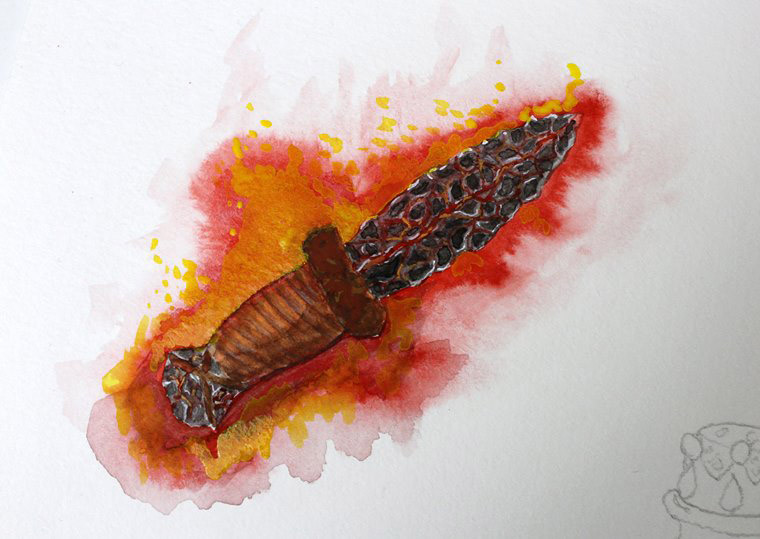
    The Molten Dagger from Spectrum Blade

    The first item I painted is the Molten Dagger, who gets its name for reasons that should be pretty obvious when you look at it. It’s a pretty useful weapon, and I think it’ll be a fun inclusion in the story. I’m pretty happy with the outline for the first book at this point, so I’m working on fleshing out ideas for the later parts of the series while I put together bits and pieces like this to enrich the first one. Although I’d love to include illustrations in the paperback editions of the books, I feel the images would lose a lot in black and white, so I’ll keep them as something special to see when you visit my website, I suppose. I’ll be putting together an image gallery for Spectrum Blade (Like I have for the Snakesblood Saga) pretty soon.

    I’ve filmed the process of painting the two items I’ve done so far, just for fun. Here it is, if you want to take a look:

    Next week, I’ll share the other item I created.

  • Creating your book heroes (Building a fantasy series, part three)

    Creating your book heroes (Building a fantasy series, part three)

    The characters for Spectrum Blade were actually one of the first things I came up with. I spent a long time stewing over rough concepts for each of the heroes that would join the party, in addition to rounding out some villains. But while the characters themselves came together pretty easily, the backgrounds for them haven’t.

    Instead of trying to put everything together before I start, I decided it may be best to start with general concepts that can grow organically as I write the story. There will need to be some basics, but those are pretty easy to come by.

    I knew there would be two lead characters, one male and one female, and then a handful of secondary characters who play very important parts, but won’t always be in the fray. The hero is Zaide, a young elf with snowy hair and one cut ear. And one of the secondary characters is Resia, Zaide’s childhood best friend.

    While Zaide is a foster child, raised in the care of the region’s Elder–a common practice among houses that wish to broaden their child’s horizons–Resia is a native of the forest city they call home. If you saw the world map I shared last week, their home city is the marker directly south of Lake Sian. So far, the name I’m planning for the forest region is Kolmar–making Resia one of the Kolmari.

    Most of the Kolmari can be compared to wood elves, with darker complexions, brown eyes, and brown or black hair. That makes Zaide and the other foster children oddballs, with each of them bearing the coloration common in their home region.

    Since the goal of being fostered is acquiring the practices of the region they’re fostered in, Zaide spends his days training with the Kolmari soldiers. While Resia would be welcome among them, her interests are more scholarly. She spends most of her time studying history and linguistics, and while she tries to pass her knowledge of Amroch’s languages on to Zaide, who knows whether or not he’s really listening.

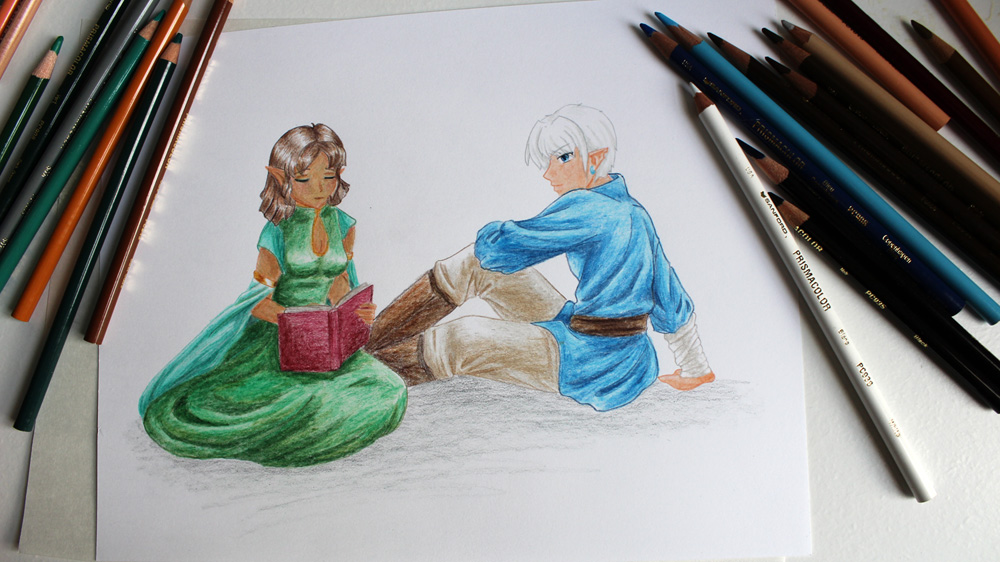
    As I developed these characters, I decided to do artwork for each of them. With their friendship in mind, it made sense to draw Zaide and Resia together, perhaps during one of her lessons.

    Zaide and Resia

    And just for fun, you can see the coloring process, too.

    Gosh, it had been years since I used Prismacolor pencils. I hit my stride later in the video, but those early experiments were rough. I also decided to do something anime-styled for some reason; heaven knows why, I haven’t done that since I was a teen. Oh well. It was fun! I may use gouache for the next character portrait, but we’ll see. I’d like to do illustrations for everyone.

  • How long should epic fantasy be?

    As part of outlining a novel, I always have to plan how long it needs to be. Sometimes they make it. Sometimes they fall well short. One thing I don’t do is try to pad up my word count with unnecessary scenes. Sometimes a book needs fleshed out a little more, which is fine, but I don’t add words just to add them. If it doesn’t add value, it’s not added at all.

    As I get better at weaving things together and creating nuance and layers in my stories, I find I need fewer words to get there. But epic fantasy is a weird genre, where more words seem to be prized, even when they’re useless. So how long does this new series actually need to be?

    I’ve already determined that for the best story flow, the series needs to be six books, all of which now have titles. The middle four books will have a naming convention that doesn’t quite make sense when compared to the first book, but the sixth book crowning the series helps make sense of that.  There’s certainly enough story for that many books, but how long of books?

    While most of the books I think of when I think epic fantasy are huge books that make great paperweights and excellent doorstops, I don’t really think that’s necessary. I always wanted to write big books, so I wrote a big fantasy series without a lot of filler. It never went anywhere (I’m sorry, Snakesblood Saga. You’re still my favorite, don’t worry) and one consistent piece of advice I got back from agents was make it shorter. Kind of counter-intuitive when all the fantasy books I see are massive, and at 182k, the first book in the series was comparable in length to The Fellowship of the Ring. But I heard the same thing from a lot of them: Most fantasy novels that get published are closer to 95,000 words.

    I found that hard to believe, so I took it upon myself to do some more research. How long is the average fantasy book? And how long would Spectrum Blade be?

    There’s a great thread on the subject of word counts in the Fantasy Faction forums. It shows a definite trend of very fat epic fantasies, but my eyes kept going to the top of the list, where Tolkien’s word counts seemed oddly small. Considering the trilogy was originally six books, the total word count divided by six gives an average length of 78,000 words. And yet those words are enough to create a massive world that has enchanted readers for the better part of a century.

    A second search took me to an interesting comparison by Thoughts on Fantasy. Part of what made the list intriguing to me was that it expanded the horizons of fantasy a bit to include the Dragonriders of Pern books, which are typically categorized as science fiction, but definitely lend themselves to the fantasy genre as well. It also brought my attention to the YA list, which was something I hadn’t previously considered. While I don’t think of Spectrum Blade as YA (it’s more in line with the conventions of typical adult-oriented epic high fantasy) it may be taken that way by some, since it has a young protagonist. YA books tend to have voracious readerships, yet they’re more consistent in length, hovering closer to the word counts I was quoted by the agents I queried.

    Even still, there are a few odd outliers. Earthsea began as a story only 56,000 words long; ten years ago, I barely would have considered that a novel instead of a novella.

    But I had to expand to other considerations, too. For example, the longer the book, the less likely a paperback will survive multiple readings. I want my stories to last, especially if I end up taking Spectrum Blade on a self-published path. That seems pretty likely, considering I want to write a story that embodies everything I loved about fantasy books in my youth, which means relying on a lot of worn story themes that traditional publishers have come to despise. But traditional publishing also helps shape genre expectations, and it’s important to note the submission lengths encouraged by the publishers of most epic fantasy. While you have your outlier Brandon Sandersons, most publishers seem to prefer exactly what agents told me: Books between 95,000 words and 150,000 words, with most only specifying the lower number.

    That said, I don’t know if the books that come after Spectrum Blade will be that long. I tend to run long in the first book, and then the subsequent titles are a bit shorter, since the initial world building is already done.

    So for now, I’m setting that as my guideline: Ideally, Spectrum Blade will be 95,000 words long. We’ll see how close to that number I land in the end, but if it ends up being longer or shorter, so be it. I’d rather have shorter stories that are fast-paced and fluff-free than a bulky word count full of frivolity. For that reason, I’m planning the rest to be a bit shorter. Spectrum Blade might end up around 95k, but for books 2 through 6 (which have names I’ll be sharing soonish) I’ll aim for 85k-90k each.

  • Resources for BJD book props

    Resources for BJD book props

    I puzzled over the best way to share these resources to go with my new video for a while, then decided the best option was probably making them available in a post on my site. I don’t post about doll things here too often, but it’s still the best way to collect information in one spot, and it’s also useful for things like contest entries. So here we go.

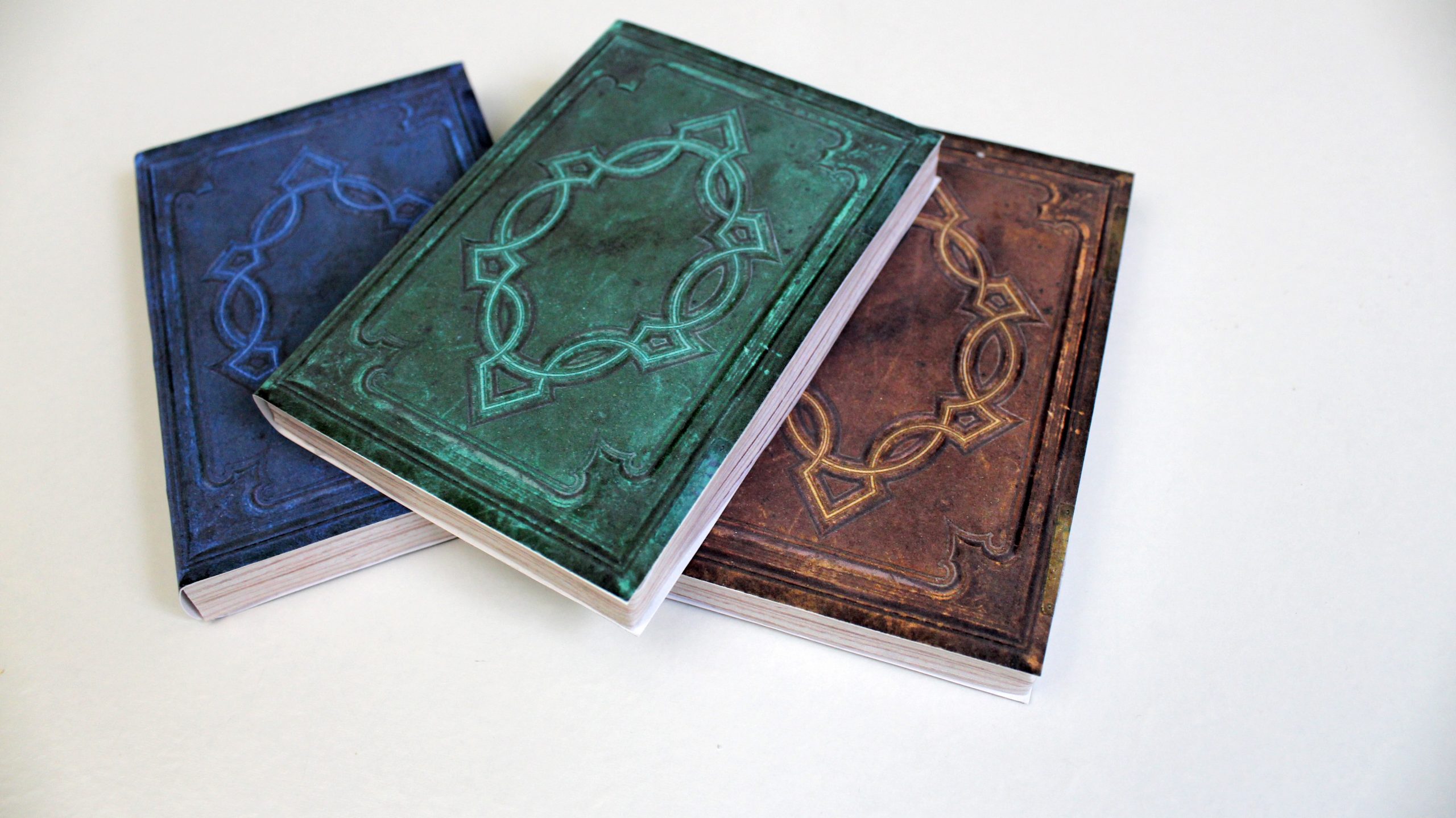
    As part of a diorama for my dolls, I decided one thing I had to have was books. But making real books takes forever, so I figured filling in with faux books would be a good idea.

    The hardest part was finding book covers I thought I could use, so here’s a small assortment of options.

    The video features books made with this image. I changed the hue and saturation for more varieties:
    Historical book cover image

    Another great resource I found was a collection of beautiful book bindings from the 1800s and early 1900s. As these are all over 100 years old, these designs have fallen into the public domain. However, I decided to skip them since they all bore names and titles and I don’t have time to Photoshop them out to make my pretend books.

    You can see them here:
    Publishers’ bookbindings 1830-1910

    After you pick your covers, you’ll want to print textures for the pages, which adds a little extra realism to the books. I created these myself and they are intended for personal use only; no commercial usage, please. There are two versions. One solid sheet that can be cut to any width, and a sheet of 9mm strips that fits perfectly on the edge of two 3/16″ foam board pieces put together.

    You can download the solid sheet page texture here:
    Solid sheet page texture

    And the strips here:
    Page texture strips

    And for convenience, here’s the video.

    Happy crafting!

  • Making a fantasy world map (Building a fantasy series, part two)

    Making a fantasy world map (Building a fantasy series, part two)

    I’ve been fascinated by fantasy world maps since I was a kid. I always told myself that when I eventually published my own fantasy books, I’d make sure they had maps. Preferably ones I drew myself, since I’m a control freak like that.

    Having done map making the “right” way before, starting with tectonic plates for my fictional planet and building landmasses appropriately on top of them, planning weather patterns, determining watersheds and river placement based on geography… well, I knew it took a ton of time. My map for Ithilear to go with my Snakesblood Saga books still isn’t done, several years after its beginning. I figured there had to be a faster way.

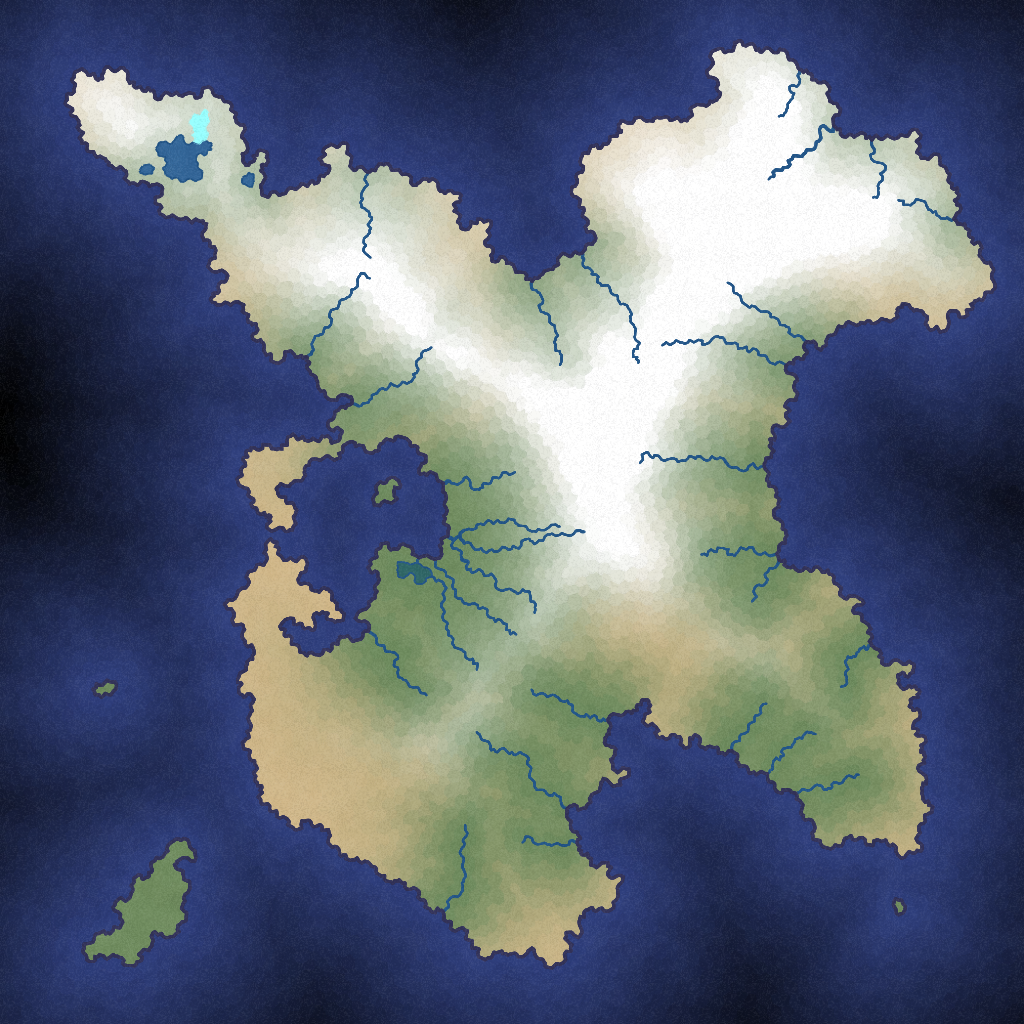
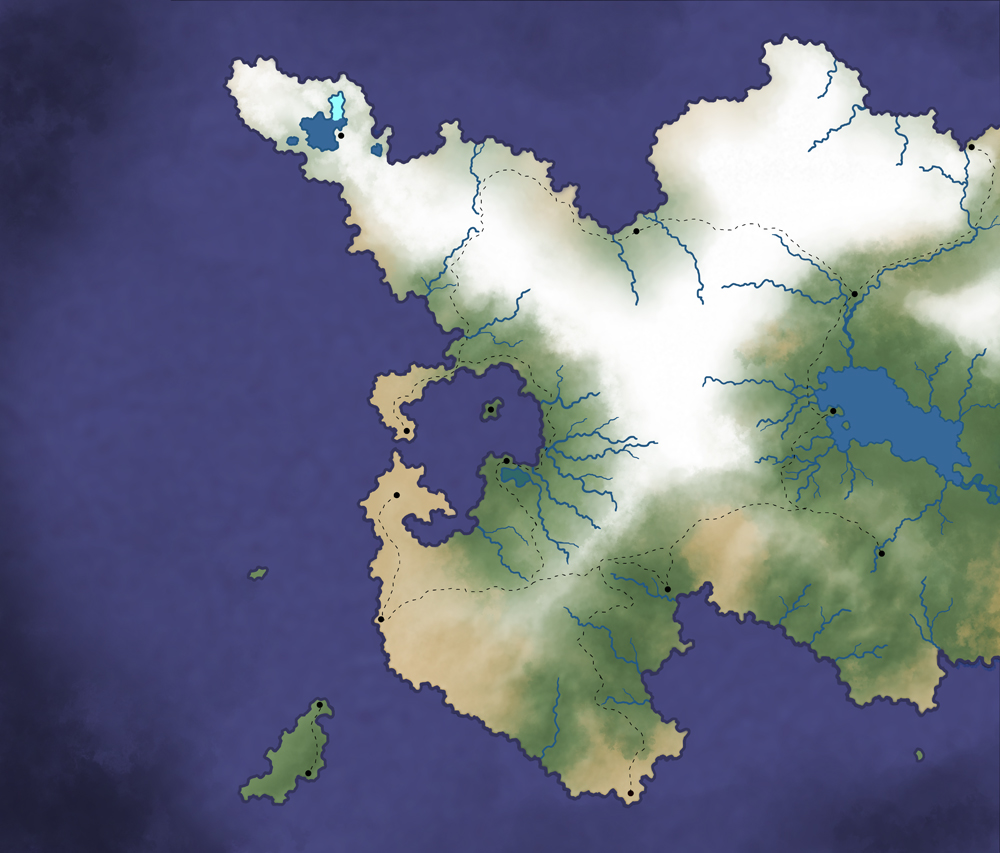
    The method I came up with relied on the map generator created by Amit Patel and available over at RedBlob Games. It’s offered as open source and is incredibly useful as a starting point. The generator creates an island with a central mountain. I knew I wanted the country to be something of a peninsula, jutting out into the ocean so Amroch would have water on three sides and a nebulous “rest of the world” off the right side of the map, so that meant I’d need to do a little work to finish one side of the thing… but that’s easier than drawing something from scratch.

    I knew a few specifics I wanted out of the layout, though. I wanted a forested area in the southeast and a desert in the west, and snowy wastes to the north. Obviously, this means Amroch will be quite large, but you do get a little leeway in fantasy worlds, so a harsher climate isn’t too far fetched. I punched in dozens of random seed numbers for maps, stopping when I found one I felt would work.

    First generated map of Amroch

    With the biomes visible, I had a good place for a forested region in the southeast, a desert to the southwest, some harsh, cold terrain to the north, and a couple cool islands as a bonus. The mountains cutting off the northern region from the rest of the world worked well for my story plans, too. I turned off the biome visibility and saved the generated map to draw over and turn into my main map image.

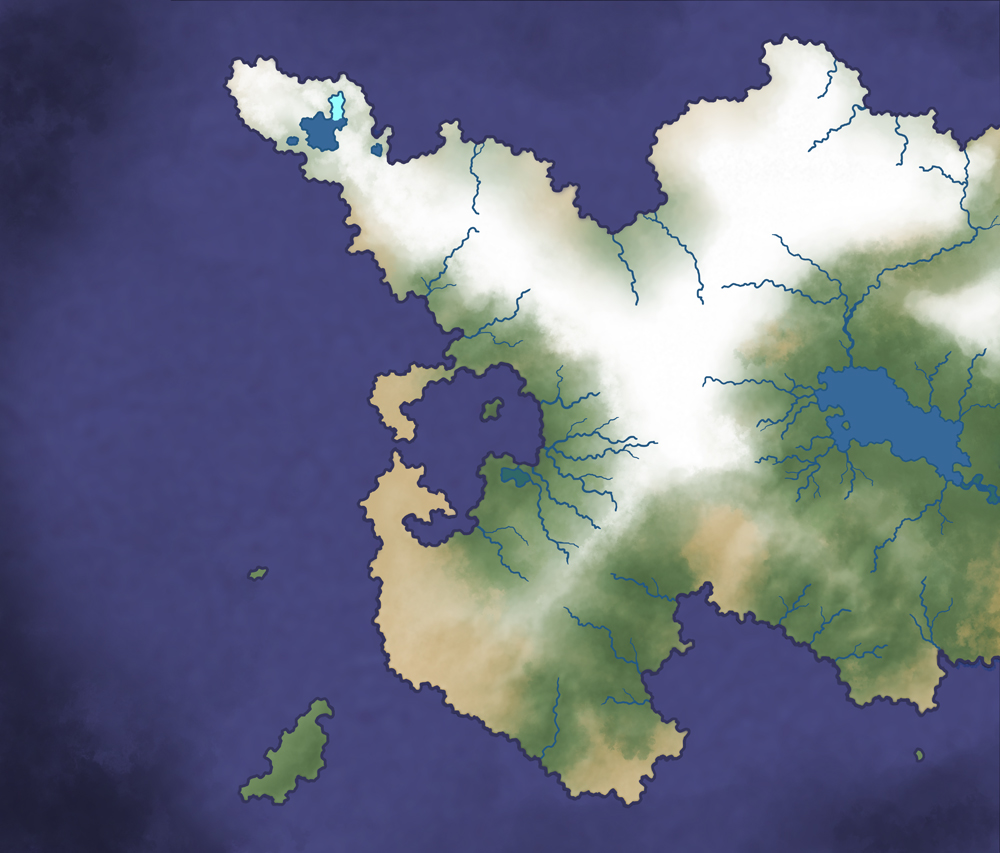
    Amroch map part 2

    The first portion of map work was pretty boring, just tracing the coastline and expanding the land mass to the edge of the map on the right side, then redrawing the rivers and water bodies, as well as sampling the colors I liked and repainting the land features with textured brushes.

    With the way the land mass created a crescent on the right side, I figured all that runoff would result in a massive lake, which worked well for my plans of having that region be a heavily forested agricultural area. I turned part of the coastline into a path for a wide river feeding into the ocean from the giant lake. I decided Amroch would be sheltered by mountains on the east, even if they’re not visible on the map, so I added a jutting mountain range above the lake. I also took the liberty of making the northern region look a little frostier, and added some tributaries to a few of the big rivers.

    Completed land mass for Amroch

    Then it was time to plan cities.  I tried to be logical about it, and work with what I already had in mind for the different peoples that would inhabit the world. The marshy area near the sea would be a great place for agriculture, probably with a focus on growing things like rice. The islands would be ideal places for a thriving fishing community. There would need to be a few major rest stops along the coasts for resupply of ships, and the kingdom’s heart would need to be set somewhere with an abundant supply of food and fresh water, as well as someplace more easily defensible, meaning the small peninsula on the lake–sheltered by rivers around it–would be the perfect place for the capital. There were two other factions that needed attention, so the isolated northern tribes got a settlement near a body of freshwater in the north, away from everything else, and the defense-minded desert people would have a fortress on the hill in the middle of the desert peninsula, where they could not only hold out against invaders, but would be sheltered by the lack of resources readily available in the desert.

    Adding regional location markers

    While there would be a great deal more small settlements, I opted to mark only the largest and most important, keeping the map less cluttered. So last of all came trade routes. These would help determine where the rest of the settlements would be when it came time to write, and also let me know where my characters would be traveling. Until we had the idea for highways where we bulldozed the land to make room for our roadways, roads tended to take the path of least resistance. So a few major roads went in alongside rivers and the coasts, where supplies would be abundant and the route would be difficult to lose–just follow the water to the next settlement. A couple harsh mountain passes would be a necessity, but the main travel routes would run a circuit around most of the country. I’m sure there would be smaller routes that would make travel easier and more direct between two points, but again, not worth marking.

    Adding trade routes

    My favorite result of adding trade routes was the triangle formed by roadways in the center south. I figure there will be a city at each intersection, and as my super-cool friend Michelle pointed out, it would make a perfect gathering place for seasonal festivals and markets, and I’m totally going to incorporate that idea into the book once I actually start writing.

    At that point, it was time to start labeling the darn thing. I named the lake and the sea, and marked an important region of land, but I don’t have any ideas for city names just yet. But considering I only spent two weeks working on the map when I had a few minutes left at the end of some days, I think it’s working out pretty well. I guess the next step will be naming places, but that will probably tie in to creating all the characters and their cultures.

    There are a few other things to do, like creating a black-and-white version of the map that will look all right in print, but for the most part, the map for the front pages of Spectrum Blade is ready.

    Labeling the map

  • Building a fantasy series, part one: Creating the world

    Building a fantasy series, part one: Creating the world

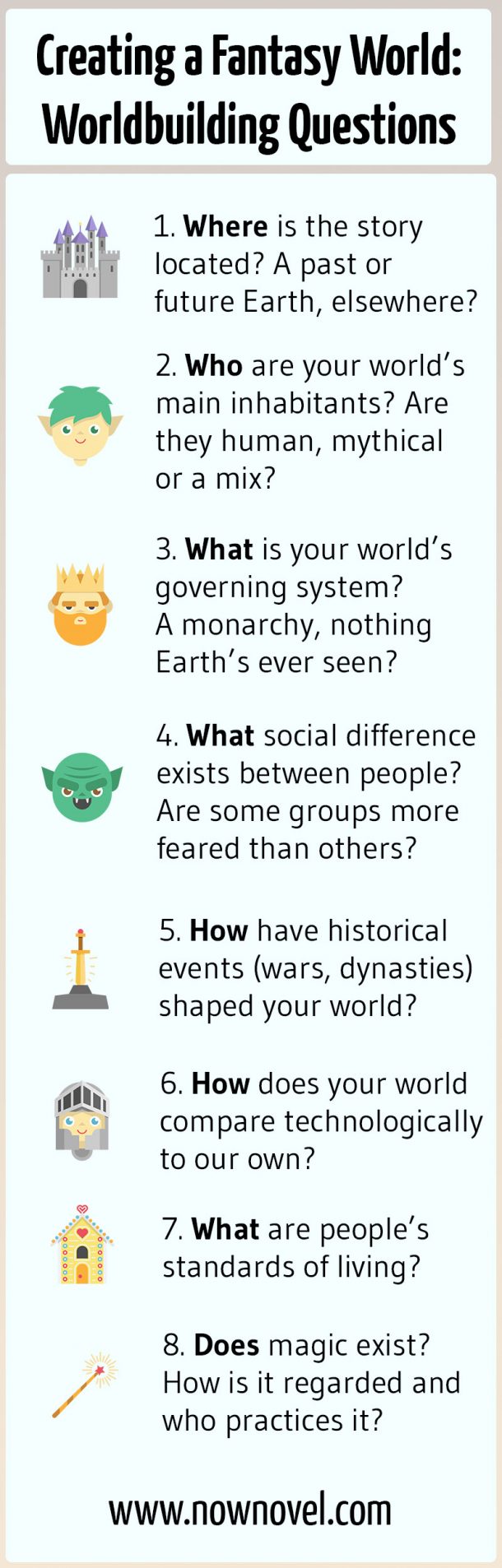
    I ran across a great article from NowNovel that came with an infographic laying out some things to address when creating a fantasy world. For convenience, I’ve included it here. To get things started, I’ll share a quick breakdown of the answers for a few of these, as well as which ones I’ll be bundling together at a later date because of how the story will work.

    The first question on the list was a pretty simple one: Where is the story located? I immediately knew it was going to be a non-earth high fantasy novel, set in its own world. But that meant creating a world for it to happen in… and that meant creating a home for the characters in the story.

    One of my favorite features in fantasy books is the maps. I’ve tinkered with drawing maps before, but the world always came first. This time, I decided I’d use the map as a key part of creating a world that sort of makes sense.

    I’ll share more on the map creation next week, since it kind of evolved into a huge thing of its own. But it gave rise to one important thing: The name of the place the story happens in.

    The Allied Kingdoms of Amroch.

    That helped me answer a few more questions. I already knew the answer to #2, who lives in the world and what sort of fantasy races we’ll be dealing with, but I hadn’t touched on #3 yet–the world’s governing system.

    Amroch is composed of a handful of smaller kingdoms that eventually banded together and submitted beneath the king whose forces had the best chance of survival against their foe. While the map I’m working on leaves a few mysteries, all of Amroch will be pictured–and the whole story will take place on the map.

    As of yet, I’m unsure if I’ll be naming the world. Naming the kingdom alone is probably enough; the events are such that it doesn’t need to be much bigger than that.

    Question #4, about the social differences in people, I’ll answer when I start introducing the characters. I’ve been working on artwork for them, as well.

    Question #5, how the history has shaped the world, is kind of the basis of the whole plot, so I’ll get to that in another post as well.

    Question #6, touching on the world’s technological level, is another easy one; it’s medieval-type fantasy. Bite me, it’s what I like. There will be some basic mechanics going on, but I picture it as slightly less advanced than my Snakesblood Saga, which brushes up against steam power (without becoming even remotely steampunk anything.)

    Question #7, the standards of living, varies greatly from people to people. Since Amroch is made up of a bunch of different groups, the different regions of the large country have different standards, so that will also be explored as characters are introduced.

    And question #8, about whether or not there’s magic… Of course there is. Magic will be a central part of the story, but I’ll probably devote an entire post to that when I get to the subject.

    That’s it for today, but next week, a first look at the map of Amroch.

    Oh, right. There is one last thing.

    The series and books within the series have been named. I’ve been told it sounds more sci-fi at first shake than expected, but as I start explaining the world I’ve put together, I think it’ll make more sense. For now, we’ll be venturing onward into the beginning of the new series with book one: Spectrum Blade.

    See you next week!