Beth Alvarez - Author of Epic Fantasy
  • Building a series from the ground up

    Building a series from the ground up

    Before I even started the book, I decided I was going to put paranormal stories aside after I finished Her Midnight Hunter. Right now, I’m hoping to be done with it in August, so that I can tackle a new project in the fall.

    My first instinct when returning to fantasy stories is to pick up Rune’s series–my Snakesblood Saga–and work on it more. Then I remember the whole series has been drafted, and the series needs to be put away for a while after a round of unsuccessful queries and revisions. It’s clear it must still have problems, or else it would have gone somewhere. I’m still sure I can fix it, but sometimes what’s needed most in situations like those is more experience.

    I considered picking up another shelved project to work on it, but it’s a standalone novel and what I really need is more experience writing an epic series. Writing and fixing a standalone novel won’t help me solve problems in a series. So instead, I sat down for a brainstorming session and came up with something totally new. I’ll be building a new fantasy series from the ground up, going back to relying heavily on the things that originally inspired me most, and hopefully learning what I need to fix Rune’s books along the way.

    I started with a framework idea for an overarching story line, then started developing characters. While I’m trying to commit everything to paper, I’ll be committing everything to my blog, too, sharing the process of bringing a whole new fantasy world (and its inhabitants) to life.

    I’m doing sketches for concept art, as well, so I’ll be sharing that as I go along, and I’ll come back and update this post as a master list of subjects I cover.

    In no particular order, here are a few subjects I know I’m going to go over:

    • The main characters, their countries, and development
    • Creating a new, non-Earth world, and what’s important to plan for fantasy
    • Creating a world map
    • Developing a magic system
    • Developing magic items
    • Planning a full series and number of books
    • Developing an overall theme

    I’m sure some other things will come to mind, but that’s all I can think of off the top of my head.

    I’ve spent a bit looking at various lists of world building questions and I’ll probably answer a few here and there. One of the biggest lists comes from SFWA, but by all means, if anyone thinks of any questions or subjects you’d like me to specifically address as I go along, please leave a comment and let me know!

    What do you want to see most as the series develops?

  • Audience of one

    Audience of one

    Trying to become a full-time author is fraught with bad advice. Over time, you get better at absorbing the good advice and abandoning what doesn’t work for you. After all, no two people will ever use the same methods, no matter how similar their work may be. Despite this, there’s one consistent piece of one-size-fits-all advice given to authors who want to take the next step and push from hobby to career. That suggestion?

    Write to market.

    It’s pretty simple in concept. Pick a niche–preferably one that doesn’t have a whole lot of books available in it–and research thoroughly to learn the genre expectations. Study the clichés (er, I’m sorry, tropes) present in the most popular books, work out the successful formula, then write until your fingers bleed. The idea is that if it’s already out there and you’re fitting yourself perfectly to the mold of expectation, your books will be a hit.

    For some people, supposedly, this is the magic bullet. It’ll launch your career like nothing else, bringing you enough royalties to write full-time and gathering masses of passionate fans. Like a lot of writing advice I come across, I tried it. It wrecked my physical and emotional health, and almost killed my love of writing.

    See, while I’m sure it has worked for a few people–since it wouldn’t be touted as a cure-all if it hadn’t–it’s not good advice for most people who have a passion for writing for a few reasons.

    For one, it requires you to write fast. This isn’t a problem for everyone. Some people are able to jump in and write 2,000 words a day or more from the get go, but most people have obligations that keep them from doing that. Work, school, family… any number of things can dig into that writing time, and if you need more than an hour or two to plan and write, you’d better not count on completing a book a month. Actually, that’s not even considered the optimal speed anymore for writing to market; most modern plans suggest publishing books written to suit market no further than 18 days apart. Ask yourself, and answer honestly: Can you write a good book in 18 days?

    One solution offered in response to that problem is waiting until you have a bunch of books ready to release all at once. But there’s another problem that comes out of that situation. How do you know your books are going to sell? How do you know they’re going to be liked? How do you know you aren’t writing six books in a series and just throwing money away, buying professional covers and paying for editing on something that will never be read? Yeah, exactly.

    You don’t.

    A secondary problem is that books written to market are rarely picked up by traditional publishers, outside of romance novels, where the genre is already given to high amounts of churn. Your heroine and her steamy harem of werebear lumberjacks might be successful if you work fast and pop it on the indie market while that subgenre is hot, but if you need six months to write six books for the series, don’t count on the genre still being hot when your series is complete. And if it’s hot now, traditional publishers probably won’t want to touch it with a ten foot pole. After all, it’s not unusual for a book signed today to hit the market two years from now. If you don’t know it’s going to be successful in six months, what makes you think it’s going to be the bees knees in a few years?

    Then there’s the biggest issue I encountered, the one that almost did me in.

    Writing to market is a soul-sucking experience because at the end of the day, I’m not part of that market. I don’t typically like what’s hot and trendy, so trying to write it is soul-crushing and discouraging. I find a lot of popular books trite and cliché, sometimes even painful to read.  Sure, fitting the mold might be a shortcut to success, but it’s also a path that runs contrary to the reason I started in the first place. And of all places, the harsh wake-up call came from an episode of My Little Pony. My friend Megan blogged about the same episode recently, if you want to read her thoughts, but for me, it pretty much boils down to one thing.

    I write because of a piece of much older advice, which I think suits most people better: Write what you want to read.

    I started writing because the books I liked had fallen out of popularity, and I found everything coming out of publishing houses when I was a teenager to be sorely lacking and highly uninspiring. And that’s the core of the conflict between writing to market and writing what I really love. Writing to market means finding a big audience, learning exactly what they want, and then giving it to them.

    Writing what you love means writing to an audience of one.

    Writing what I love is obviously better for me. Writing it at my own pace is better, too. The difficult part is that, contrary to what they show you in My Little Pony, the chances of what you want to read being what a large market wants to read are pretty slim. But it’s a richer experience, more fulfilling, and it results in what I think are better books.

    Unfortunately, not everyone shares that opinion.

    I wrote Her Midnight Cowboy because I wasn’t a fan of the super explicit paranormal romance. I found a few authors I enjoyed and wrote what (I felt) was the best thing I’d ever done. It was story-rich, just a little spicy instead of smutty, and completely lacked a snarky weapon-wielding heroine in leather pants, like what’s most popular in paranormal romance.

    It totally bombed, and yet I still feel like it’s one of the best things I’ve written, because it was what I wanted to read. A sweet, fun and funny story with an immersive world and a gritty, violent paranormal adventure, rolled together under a charming country coat of paint.

    But because it bombed, I was bombarded with the same message again: Write to market. Write to market, or you’ll fail again.

    I guess that means it’s time to reevaluate success, because if writing to market means writing to someone else’s expectations, I’d rather not do it. I’m writing for me. An audience of one. And as far as I’m concerned, these stories are pretty fantastic.

    Maybe my books won’t ever be successful because I’ll never give people who enjoy a mainstream market what they want out of a book. But maybe, just maybe, someone will eventually find my books and love them.

    I mean… I could probably write for an audience of two.

  • A week of 2k a day: Afterthoughts

    A week of 2k a day: Afterthoughts

    Last week was my challenge week. The goal: Write 2,000 words every day, Monday through Friday. The plan was to end the week with 10,000 words of new material written for Her Midnight Hunter, the next book in my current paranormal trilogy. HMH needs to be done before I move on to something else, but it had been a while since I wrote, so I needed to get back into the swing of it.

    On an average day, when I’m writing on a daily basis, I get about 500 words written. In an average month, I log a total of around 20,000 words,  doing a little extra on weekends and in stolen time. By that standard, 10k would be half a month’s work, packed into 5 days. I wrote a little about how I was feeling after every session, which I’ve pasted below. Here’s how it went…

    Monday

    That was exhausting.

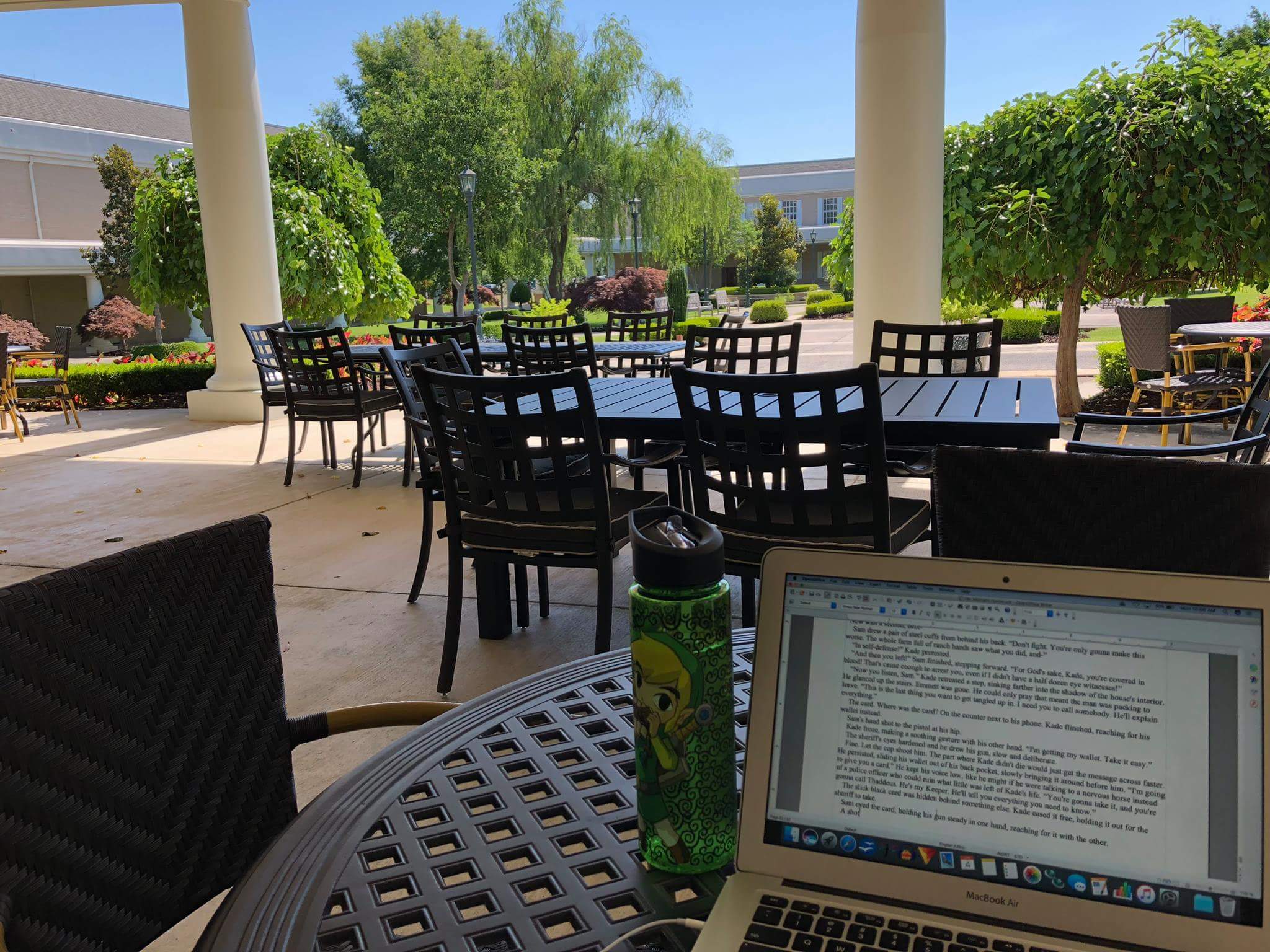
    I dropped Eevee off and headed out to the garden right after. I picked a spot and took a couple pictures to share with the people who knew I was doing this today, then sat down and got out my stuff.

    Before I could do anything, I needed to reread everything I’d written so far. I haven’t touched this story in a few months, so I need the refresher. I got caught up editing a little along the way, but it didn’t take too long, as I was just shy of 12,000 words into the story. After I was done reading and knew where I was starting from, I copied my outline paragraph for that chapter over to the story document and started work at around 10. I brought headphones to shut out the sound of the sports the hundreds of kids here were doing, so I was in my quiet little bubble on the other side of the garden. It’s beautiful, so it’s hard not to be inspired there.
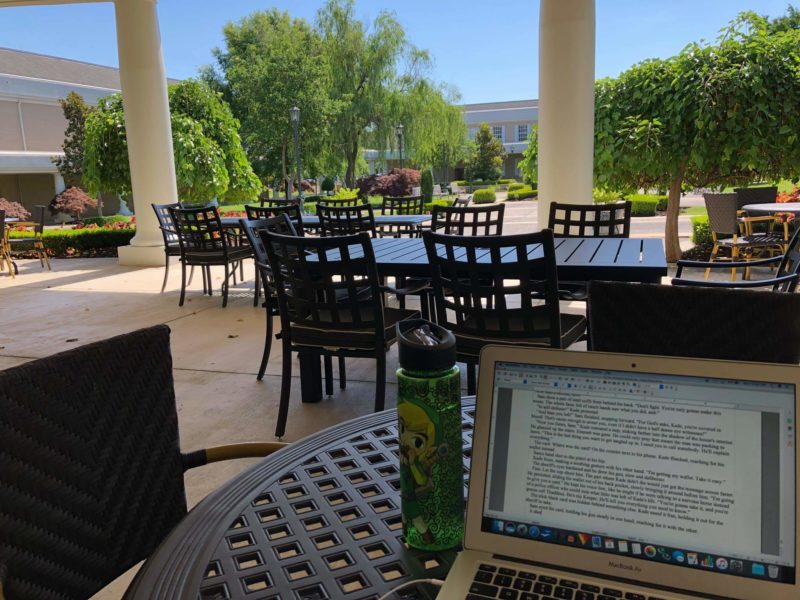
    I thought it would be easier to just pick up and go, but I was picking up at an action scene, which is one of the harder things for me to write. I really struggled through the beginning. Well, I guess I really struggled through the whole thing. I haven’t written in so long that I really had to buckle down and when it hit 11 AM and I only had 700 words, I wasn’t sure I was going to make my goal.

    But it did get easier as I went. I stopped at 11:55 with 2,206 words. I can’t say how happy I am with those words, but it’s the better part of a chapter, and at least it moves things forward. The first half of the week is supposed to be beautiful weather, so hopefully I can keep this up.

    Monday’s word count: 2,206

    Tuesday

    I started earlier today, finding a shortcut into the garden. I started writing at 9:15. The first hour was the most productive this time, starting a fresh chapter and refining my outline and plans as I went. But after an hour some other people came out to enjoy the weather and it got pretty loud. It was hard to concentrate after that, so even though I got over a thousand in my first 45 minutes, it took me another hour to reach my 2k goal. I stopped at 2,142.

    I think I’ll be able to do 2k comfortably each day after Eevee starts school, but working at home will probably be easier then. One issue is that I can only go that hard for about two hours, then I’m exhausted. I took a break at 11 and explored the library and enjoyed the weather until 12, then sat down to write a bit more. But I was tired, so I didn’t get much farther. Rough.

    Overcoming that mental fatigue will be the hardest part and I think it’s a big challenge for this week, too. How much can I do in one week with consistency? Will I burn out and wear out before I reach the end of the week? Today was okay, but maybe tomorrow I’ll sit in a different place with fewer tables and see if I can keep things quieter for more of my work time. It would be pretty cool to break 3k one day, but I won’t push it. I made 2k and got extra. That’s progress, so I’m satisfied with that.

    Tuesday’s word count: 2,464

    Wednesday

    I didn’t charge my laptop last night, so I sat down with under 30% battery. Whoops. Still, that got me almost two hours of work time. I wrote from 9:15 to 11, though I worked faster in the last 45 minutes. Funny contrast, compared to yesterday. I overslept this morning and ended up in a mad scramble to get ready and make it to the church, so I was still groggy when I got to the garden. I imagine that’s why. I wrote until I got a low battery warning and just barely squeaked by 2k.

    I’m all right with averaging a thousand words an hour. It’s not great, but I’m trying to strive for quality as I work, so you sacrifice speed when doing that. It makes editing way easier later on down the road and I’d rather have easy editing than a document full of horrid word vomit to sort out later.

    As of today, the document is about 250 words shy of the 20,000 word mark, which means it has almost doubled in length in the span of 3 days. If I can write this way full-time in August when Eevee starts school, I will be content. Working in the morning may be better for me, instead of putting off writing until the evening. I am not sure how I’ll fare with writing before I do any housework, though—having dirty dishes and undone laundry tends to distract me. That’s one nice thing about coming and writing in the garden. It’s impossible to do anything but focus on my work while I’m here.

    I suppose one possibility is coming to the garden to write even when Eevee is in school. I’ve been sitting in a beautiful portico (I went back to the same spot, since there wasn’t anyone else here this morning) so I could come even on rainy days, as long as it’s not too hot or too cold. At 2k a day, I could finish a 90k word book in 6 weeks. Leaving room for editing, that means I’ll be able to put out about 4 books a year. My fantasy stories will probably average around that, so that would be great. But if I can get up to 3k a day (including weekends) and do that consistently, I’d be able to complete a 90k word book every month, which would put me great strides forward in my author career.

    I can’t be greedy, though. Maybe tomorrow I can try for 3k. Since I stopped at 11 today and my laptop’s battery is depleted, today is not the day. But tomorrow, if I stop for a short break in the middle to stretch and clear my head, I might be able to do it.

    Wednesday’s word count: 2,089

    Thursday

    I can’t seem to push any higher. I’m wiped out. Exhausted after days of early mornings and late nights, because I still have to go home and tend Eevee’s needs and get my normal amount of work done on other projects. I felt like this morning was going okay at first, but then everywhere got crowded. Dozens of people outside in the portico, hundreds in the lobbies. I tried to find a different place to sit. Noise and people everywhere. I can work around noise okay, but I can’t work around people. People are distracting. So while I did make it to 2k, I couldn’t seem to push much past that, and it took from 9:20 to 11:50 to get that far. At that point, I was too worn out to keep going, so I decided to call it good enough.

    I dream of someday doubling that word count, but I have to keep reminding myself that this is good enough for now. Especially knowing I normally only accomplish 500 words in a day, a fact I try to remind myself every time I feel frustrated about the progress I’m making now. This is good! This is better than I’ve been doing! It’s huge strides forward. I know I can keep up this pace when Little Bit starts school, and if I want to boost my productivity then, it’ll be easier to do—I can write two hours in the morning and land around 2k words, then work on other things until lunch. I can do another hour or two after I eat, then go pick up the munchkin. That should be able to put me in the neighborhood of 3,000-4,000 words a day for week days, and I’m sure I can carve out at least an hour—roughly 1,000 words—a day on weekends.

    And the more I do it, the faster I get. So why does it still feel like hitting that ceiling is a disappointment, even when I know I’m doing better than most? I guess that’s an inner struggle I need to work on.

    Either way, I’m ending today with close to 22,000 words in my novel’s document, which means by the end of tomorrow, I should have the book close to a third of the way done.

    That should be inspiring, right?

    Thursday’s word count: 2,197

    Friday

    Today’s writing session totally derailed my book outline!

    That’s not unusual for me. I usually derail twice, but I end up getting back to the end point eventually. I started writing at 9:20 and this time, I decided to allow myself a couple short breaks to stretch and refill my water bottle. Kind of important, since it’s 90 out today and I’m still outside to do my writing.

    I stopped at 12:05. At that point, I felt like I needed to stop and reevaluate my outline to figure out what came next. That’s an important part of my process these days, so I didn’t want to fight it. I figured it’d be better to take a few minutes to revisit my plans and then I would be starting with fresh notes next time I sit down to write.

    If I hadn’t hit that obstacle, I probably could have reached 3,000 words today, which felt like finally getting close enough to clear that hurdle. Hopefully that’s one I’ll clear when I do this again in August, after Eevee starts school.

    Of course, I hope I won’t be working on this book at that point. HMH is now 24,356 words long, which is right around a third of its total projected length. For some reason, I thought I had more of the book written before I started this project. But I’m nowhere near the midpoint. Either way, it was still a pretty substantial week of work for me. I briefly considered trying to write a little more tonight, but I think I’ll give myself the weekend off. This whole ordeal was pretty mentally taxing, so a break might do me some good.

    Okay, maybe I’ll give myself tonight off…

    Friday’s word count: 2,490

    Total word count for the week: 11,446

    All in all, not too shabby.

    Now to figure out how to do this every week.
  • 2,000 words a day

    This week’s a special one. The munchkin is attending VBS for the first time, and while part of me feels like I probably should have volunteered as a program assistant, the week has an important purpose for me: teaching me what it’ll be like to be alone during the day.

    I’ve been a stay-at-home mom for five and a half years now. Time to myself just doesn’t happen. But Eevee starts school in the fall, and I’ll have to know what to do with myself when that time comes.

    No more morning snuggles. No more late breakfasts and impromptu park trips. And moving on from that is kinda hard.

    But VBS is only half the day. From 9:30 to 12:30, so it’s a good opportunity to ease into things. And part of what I decided to ease into was hitting my writing a little harder, working with the intent to get my books written a little faster and polished a little sooner. I’ve Her Midnight Hunter languishing on the back burner since November, so it’s a perfect time to pick that up and try to make something happen. By the time this goes up, it’ll already be Day 2, so I won’t be doing a daily check-in. Instead, I’ll journal my thoughts about the process at the end of each day through the week, then compile them all into one post to go up on the 12th.

    My goal is 2,000 words per day, which would knock out 10k of story and push me fairly close to the midway point in the first draft. From that point–hopefully–things should be downhill. I definitely won’t be able to keep up a 2k/day pace once VBS ends, but I’ll poke at things slowly, and hopefully this will give me the jump start I need. When I was a teenager, I could hammer out 2k words in an hour fairly easily. As I’ve gotten older and more skilled, it’s paradoxically gotten harder and harder to reach those kind of numbers.

    To try to bolster my productivity, I am hoping I can spend most of the week out of the house, just me and my laptop and notebooks, away from terrible distractions like the internet. Weather permitting, I’d like to sit in the cloisters overlooking the gardens and write there. There’s a lovely sitting area with ceiling fans and comfortable patio furniture, and hopefully, that will be enough to combat the high temperatures that are supposed to happen later in the week. There’s also the added convenience of restrooms and water fountains nearby. I’d love to be able to hole up in a cafe and write with a frappuccino (or equivalent) close at hand, but I’m on tray 20 of my Invisalign plan and I’ve gone this long without breaking the “no food and water only” rule, so I’d rather not break that streak.

    So, if you’re reading this, wish me luck–I’ll report back on my successes and failures on the 12th.

  • Story afterthoughts

    I’ve had a bit of time to simmer on things now, shortly after finishing the five-chapter mini-adventure I decided to write just for the heck of it. I planned for it to do a few things, and when I thought about it, I figured it was worth taking a second to document what it actually did for me. So here’s a short rundown.

    Goal 1: I wanted it to motivate me.
    I deliberately picked characters I know and love, who I also hadn’t been able to write anything for in a while, since I finished the first draft of the last book in their series a while back. After a while, characters become kind of like friends, and when you complete their story and leave them behind, you miss them. You miss their adventures. You want more. So I decided to do something that fit in between books, part of an adventure that’s hinted at but never addressed openly in the series. I may do more with that idea in the future, but I don’t really plan on writing a book 3.5 (or 4.5, depending on how I end up splitting the series) and didn’t want to get bogged down in that. So it was a single shot adventure, revisiting people I thought would be easy to write.

    Therein lies Problem 1: It wasn’t easy.
    When I sat down to write the story, I didn’t have a plan. One of the most frequent pieces of advice I get when I get stuck is to just write something different. Just sit down and write. Just do something. And if that works for you, then hey, that’s great–but it doesn’t work for me, and I really ought to know that by now. I need structure to keep me focused and inspired. I need to know where I’m going, or I never go anywhere. My story stalled out fast and I spent a lot of time spinning my wheels. I don’t feel like the end result was very good, and a large part of that is because it wasn’t focused. Without that focus, I couldn’t really get in deep with the characters, even though I love them. And I couldn’t stay on target very well, ending up with a story that was probably a lot longer than it really needed to be. So that’s one hard lesson learned, I guess. I work best with an outline, always have, always will, and I’m going to refrain from trying to survive without one from now on.

    Goal 2: I wanted it to get me back in practice.
    I haven’t really written since my great uncle passed away in November. I never expected his passing would hit me so hard. It completely sapped my inspiration. I was already feeling pretty burned out after writing and publishing more books in 2017 than was healthy for me, so the end result was me not writing at all.
    I needed to do something to get back in practice, but nothing sounded appealing. Part of that is for reasons I’ll explain another time in another post, but mostly I figured I just needed to get back to something I knew I could do.

    Problem 2: Getting back in practice is hard when your plate is already full.
    I never had a lot of time to write. I get about an hour in the evenings where I can do it, but I have to share that time with other projects, too. So I wasn’t able to get back into what I consider “full time” writing, writing every day–and I felt like my writing quality suffered for it. Coupled with not really knowing where I was going with the story,  it was incredibly hard to get anything done. I didn’t write every day, and I didn’t get back into that practice, either. Getting back on the horse is hard, especially when it never quit bucking.

    Goal 3: I wanted it to teach me something.
    About writing, about myself… whatever. Something. I wanted to walk away with more experience. This is the only place I felt the project actually succeeded, too. I decided to try to exaggerate one piece of writing advice I’ve frequently read: start a scene late, leave it early.

    The “leave it early” is what I decided to focus on. While I generally write until a chapter feels like it has relayed enough information, I started this project while re-reading The Chronicles of Narnia. I was reading them to my daughter for the first time, and you notice a lot of things when you’re reading out loud that never draw your attention otherwise. One thing that really stood out with a little person on my lap was Lewis’s method of leaving a scene early–his chapters are not their own little stories within the story, like they are in many books. His chapters often end right smack in the middle of something big happening. Sometimes it’s when a dire question is being asked, and the answer is in the next chapter. Sometimes it’s when someone is faced with life and death, and you don’t know if they’ve been killed until you turn the page. But that’s the important part of this piece of advice: you turn the page. If the goal is to get the reader to keep reading, then learning to end every chapter with a cliffhanger, instead of a resolution, is one sure-fire way to make sure they keep pushing on. Getting to use it in practice is totally different from knowing about it, though, and it means that if I want to utilize this in the future, I’ll need to learn how to incorporate it into my outlines.

    For all that the project was a struggle for me, though, there were a few fun things that came from it.

    I developed the idea for the city by building it with Lego bricks. My daughter helped. It was crazy fun.

    I got to spend some time doodling things for some of the chapters, which reminded me how much I miss drawing.

    I had ideas along the way for other stories I plan to write, too.

    But I’ll talk about those another time.

    In the meantime, I’m considering compiling the five chapter story into eBook format. It’s a whopping 12,541 words long once all is said and done, which makes it a novelette on its own, and it might make a nice addition to my collection of eBooks available, even if it’s only a small bonus download available here.

    What do you think? Worth the effort, or no?

  • Think you can’t afford a BJD? Read this.

    I apologize for the interruption in story time, but with everything going on in my favorite hobby right now, I figured this was a good thing to share because not a lot of people are talking about this aspect of the hobby at the moment. See, one of the most frequent comments I receive on YouTube is… “I wish I could afford a BJD.”

    I don’t blame anyone who sees the price tag of these dolls and feels discouraged. That was exactly how I felt back in 2004-2005 when I first came across Volks and fell in love with the Super Dollfie line. I thought I would NEVER be able to afford my own doll, and I was so sad!  But if we fast forward to now… I own EIGHT dolls, and all of them are from expensive companies–Iplehouse, Fairyland, and LatiDoll. And before you start with the “Yeah, but…” let me tell you something: I only purchased one doll while I had a job. Every other BJD I have was purchased during periods of being unemployed and having no regular or guaranteed income. Despite that, I still managed to acquire seven of these eight dolls new from legitimate companies, and the last, Rhyllyn, a doll who has been discontinued for years, as a second-hand legitimate purchase complete with COA.

    It’s not easy to save money, especially when you’re not working. But the unpleasant truth of the matter is that if you’re going to make it through life, you have to learn how to properly manage money. Many people starting with BJDs are young, in their teens and early twenties. It’s a perfect time to start learning how to scrape money together and keep it put aside. I had my savings shattered by emergencies plenty of times–cars breaking down, family issues that required me to travel halfway across the country, computers quitting–and two of those things happened while I was saving for Rune, my very first BJD. It’s hard. So to try and help encourage you, I’m going to tell you how I was able to afford my first BJD, even despite unemployment and problems that drained my savings multiple times. Here we go.

    First, a few tips for saving:

    • Try to put a portion of something away every time you have money that isn’t immediately spoken for. If it’s even a dollar a week, you might be able to get your first BJD at the end of a year. I’m serious! I’ll tell you more about that later.
    • DON’T try to funnel every penny you get into doll savings. This works for some people, but not for me. Dolls can be very expensive, and saving every penny means you aren’t putting anything aside for a crisis and you will spend months starving yourself of special treats, which makes saving feel like a punishment.
    • Treat yourself sometimes. This is related to the previous point. It’s a good idea to take a small amount of money now and then to give yourself something special. A new book, a favorite dessert, a cool notebook… okay, those are the kind of splurges I like. Just try to keep it small. Even a one dollar dessert once a month can help you feel like you still love yourself, even though you’re saving.
    • Split your savings, if possible. There are two reasons for this. One, it lets you keep money aside specifically for emergencies. It slows down your saving overall, but it means you’re less likely to need to pull from your doll savings. Two, it makes it easier to justify spending the money on a doll at the end if you have extra savings somewhere else!
    • Don’t be upset if emergencies happen and wipe out your savings. While I was saving for Rune, I had to empty my savings once to fly from the very coast of North Carolina to St. Louis. Then I had to empty my savings again to replace my computer when my 10-year-old machine stopped working. But There’s this crazy thing about money–even when you’re absolutely destitute, you have the entire rest of your life to earn more money, and near infinite ways to do it. I’ve been so poor I had nothing left after bills–and that was when I lived in a rent-controlled apartment that only cost $220/month. You can move up and onward no matter how tight things are. See what worked before and see if you can build on it.

    Now for a bit about how I earned money for my first doll.

    After cost of shipping, Rune was $735. He is a very expensive doll from a very expensive company. He was my first doll and I still have him and love him most. When I started saving for my first doll, I was newly married. We had one car, which my husband needed all the time, so a job wasn’t possible. I had a computer and an internet connection, so it was time to get creative.

    • I started with $22 in my wallet, which my parents had given me for my birthday. A dollar for each year of my life.
    • My first bit of income came from selling used books on Amazon. I started with my college text books from the prior semester. Then I sold any valuable books I didn’t think I’d read again.
    • I sold other things on Amazon, too! It was a better guarantee than eBay and had lower fees in some categories. I sold old electronics I didn’t use anymore, then hunted for bargains at the local antique/junk shop that I thought I could flip for a profit. Sometimes the profit was only a few dollars, but it made a difference.
    • I broke out my craft supplies and determined things I could make. I had supplies for basic jewelry from when I was a teenager. I opened an Etsy shop and sold inexpensive jewelry.
    • I found websites that offered paid surveys. Sometimes they paid no more than a quarter, but they added up. Just be careful to research them well before you start—make sure they’re legitimate.
    • I took commissions. Not just for art, but for hand-sewn plushies. Making plushies required me to invest in a little fabric with the money from my savings I’d scraped together, but the first plushie sold covered the expense and it was profit from there.
    • I babysat. Probably the most difficult thing on the list, if I’m being honest!

    Rinse and repeat through unexpected needs, and it took me 16 months to save up enough money for my first doll. But considering I was unemployed the whole time, and had to shell out hundreds of dollars for a flight once and a computer another time, that’s not that bad. Contrary to what is a popular belief in the doll hobby—that most women who don’t work get their doll money from their husbands—my husband did not give me one cent toward the cost of my doll, because he thought they were stupid and an enormous waste of money. Fortunately, he has changed his opinion after seeing how much joy my collection brings me.

    So what about my other dolls? I’ll list them all—including those I no longer have.

    • My second doll, a ResinSoul Bei, was purchased with proceeds from my Etsy shop.
      • Vahn (SID Claude), my third doll, was purchased while I was working.
      • Firal (F65 Chloe), my fourth, was purchased with money earned from publishing my first book and from selling my ResinSoul Bei.
      • Lillibelle (PukiPuki Ante), my fifth, was initially paid for by my dad—I paid him back with money earned by making doll clothing that was sold in a brick-and-mortar store.
      • Lumia (Littlefee Chloe), my sixth, was purchased with money from selling doll clothing and the event head that came with Firal.
      • Wren and Lark (SleepingElf Bracken and Moona), my seventh and eighth, were purchased with my birthday money. More on that in a second.
      • Arrios and Laele (SID Omar and nYID Aria), my ninth and tenth, were purchased with money from book royalties, commissions, selling doll clothing, and selling Wren and Lark.
      • Sophie (Mystic Kids Lillian), my eleventh, was purchased with money from Etsy.
      • Rhyllyn (LatiDoll Rei Cristopher), my twelfth, was purchased with the money I got from selling Sophie.

    All of these were original, legitimate dolls, either purchased second-hand from reputable collectors or directly from the doll company.

    My most expensive doll is Arrios, who was over $900. My least expensive doll is a tie between my SleepingElf Bracken and Moona, who I purchased at a local doll show from a collector doing some hardcore downsizing. She wasn’t worried about money and sold them to me for $40 each.

    Rune, Vahn, Firal, Lillibelle, Lumia, Arrios, and Laele were all purchased new from their respective companies. My RS Bei, Wren, Lark, Sophie, and Rhyllyn were purchased second-hand.

    Purchasing legitimate dolls second-hand is a great way for people to get started in the hobby.

    My ResinSoul Bei was $75, but came with extra wigs and eyes. Since they weren’t a style I wanted for that doll, I sold them, recouping $40 of what I spent. So at the end of the day, all I had invested in Bei herself was $35.

    A lot of people claim that buying dolls second-hand doesn’t do anything to aid the original artists, but I don’t think that’s the case. I purchased my Bei second-hand, but it introduced me to the overall quality of ResinSoul’s dolls. While they aren’t perfect for everyone, it showed me that the company met my needs and expectations despite the lower price point. Just this month I ordered custom parts from ResinSoul because of this great experience, and I look forward to their arrival.

    Many other companies, such as Iplehouse, might have a lot of dolls for sale second-hand, but they offer a lot of optional parts like hands in alternate poses, which can be very appealing to someone who already got a bargain on a preowned doll. Their dolls also have very unique bodies, which typically only fit in clothing made by Iplehouse. This means they stand to gain business even from second-hand purchases.

    There’s also the fact that someone bought that doll directly from the artist in the first place, so they’ve been fairly compensated for their work for that specific doll they brought into existence. Many doll makers will also allow purchase of replacement parts for second-hand dolls, so long as the owner has a certificate of authenticity to prove it was an original, legitimate doll. If the artists themselves frowned on second-hand sale, they would offer no such thing.

    If that’s the case, why didn’t I buy all my dolls second-hand?

    I wanted specific dolls in specific resin colors, none of which were available second-hand when I was looking for them. And while I did see an Iplehouse Aria second-hand while I was shopping for Laele, she was on the SID body, and I wanted the nYID body. That’s the price you pay for being picky!

    But if you’re patient, any doll will eventually come up on the market, even those that were extremely limited or discontinued long ago. Rhyllyn, my LatiDoll Blue Rei Cristopher, had been discontinued for the better part of a decade. I’d been watching for a couple years, but never saw him. Then one afternoon, a friend sent me a text message, letting me know one had just come up in a Facebook doll sales group. He arrived at my doorstep a week later.

    I’m an artist. I support doll artists, too.

    That’s why, despite the massive price tag on some of them, I only buy legitimate dolls new from the company, whenever they are available. As much as I love my dolls, they are a luxury item and if I can’t get the exact doll I want because it’s no longer available… well, those are the breaks. I want a 1969 Shelby fastback, too, but I can live without it. I can’t live without food or creating art, which is a vital piece of who I am—and neither can the artists I choose to support as they turn their passion into a career. A doll I buy from one of these small studios puts food on their tables, and it lets me feel good about having what some people consider a frivolous hobby.

    And because I normally write about books, let me tell you a short true story.

    Two or so years ago, a friend of mine discovered that one of her books had been stolen. While her book was only available on Amazon, someone had published it to iTunes without her consent, and it was selling at a steady pace. She’d spent years laboring over this book and was excited to finally reap the rewards. Except now some stranger had stolen that effort and put it up for sale, reaping hundreds of dollars that should have rightfully been hers.

    The book was taken down after she reported it to iTunes, but the damage was already done. Hundreds of dollars had been paid out to someone who never lifted a finger in the creation process, stealing her effort and selling her work under her name without her consent—at a cheaper price than she offered it on Amazon, too, which meant many customers spent their money on the cheaper version available from iTunes instead of her version on Amazon.

    I’m pretty sure everyone can agree that this situation is outrageous. Nobody deserves to have their work stolen. If you’ve ever created anything, it will probably, unfortunately, happen to you. I’ve had photos and drawings stolen. I’ve had people try to steal characters I’ve created, too. I’ve had my books pirated, robbing me of money I needed to pay my bills and crushing my hopes of ever supporting my family with my work.

    But this situation isn’t unique to books, is it?

    Just some food for thought.

    Where to buy dolls like mine:
    Iplehouse
    Fairyland
    Denver Doll Emporium
    LatiDoll
    Den of Angels
    BJD Addicts Sales Group
    BJD Saviors: Damaged doll sales group

  • Making maps

    Making maps

    Unsurprisingly, as a fan of fantasy, I love world maps. I’ve always wanted maps in books I read, and have seen some beautiful maps in the past.

    When I started writing my own fantasy stories, I knew I wanted to make my own maps. I’ve tried a variety of options, such as Inkarnate, Dundjinni, Campaign Cartographer, and countless others. I’ve drawn my own maps my hand, drawn maps in Photoshop, and used a number of fractal generators. But recently, a new idea sprang to mind.

    A couple years ago, the ‘macaroni method’ for map making went viral on the internet, but it was just a pasta-fied version of the old D&D drop map, where spilling dice across a piece of paper gives you an idea of the lay of the land. Tracing the spilled dice (or macaroni) defines the shape of the landmass, then you fill it in as desired.

    But if your artistic skill is limited, that’s where the line is drawn. Some people opt for color coded fields and hills, but what if you want an illustrated map? I’ll admit, my maps sometimes end up looking like childish scrawls instead of graceful cartography. I seem to be able to draw all the elements individually, but putting them all together presents a challenge, and I tend to get bored long before I’m done drawing in all the clusters of trees and rolling foothills.

    Then one day I looked across my desk and saw the box of sticker paper that’s been sitting there since I decided to get myself a Silhouette Cameo 3. As I sat there staring at it, I had the most delightful idea. Why not combine the drop map method with my love of stickers? Why not make myself a map-making kit? Any time I want a map, all I have to do is pull out my sticker box and pop mountains, forests, and castles anywhere I want on the paper. No more need to redraw the symbols over and over again. No more getting bored. And it would involve stickers, and who doesn’t love stickers?

    Okay, so it requires me to draw some elements before I get started, but there are other options for those who are less artistically inclined. For one great resource, I ran across Nicu’s clipart collection, which provides scalable vectors of icons for RPG maps. They’re all released for totally free use, and they look great, as you can see:

    But even though they’re an awesome starting point, I think I’ll still draw most of my own resources just so they’re my own aesthetic.

    I don’t know when I’ll get around to it, but once I start, I’ll make sure to share the sticker creation… and the finished maps, too.

  • Don’t Wait

    Don’t Wait

    Late in January, my husband ran across a comic with a title remarkably similar to the title he’d chosen for his own. It’s not an uncommon issue; similar titles get used in stuff all the time. Heck, even identical titles crop up now and then. We discussed it a bit, laughed about it, and he mentioned in passing that the person who was promoting the comic didn’t seem to be the artist. On a whim, I looked it up. I was curious to see what kind of marketing team the artist had, since studying other types of marketing is always useful for any author. It only took a few clicks to learn the person heading up the project was the artist’s wife. But where was the artist?

    He passed away before his series was complete.

    This is a sadly familiar plight in fiction. Every time Game of Thrones comes up, people discuss the completely reasonable fear George R. R. Martin will pass away before the series is finished. Robert Jordan never saw the end of the Wheel of Time, and while Anne McCaffrey passed use of the Pern name on to her son, the series as we knew it died with her. One still living. One who lived a long, full life. One who died too soon, but knew the end was near. It’s different from the comic artist, who died suddenly, only a few years older than I am now.

    As a creative, it’s crossed my mind many times. More, now that I’m an adult and a parent and balancing that with a want to create. Overwhelmingly, as I pursue my stories, I see one message emerging from every aspect of life: Don’t wait.

    After spending more than half my life refining a story, I can’t say if it’s any better or worse than the first time I put it together, back when I was 14. Instead of fine-tuning over and over again, maybe my time would have been better spent pushing forward, finishing the subsequent books in the series, then moving on to other books. If I’d managed even a book a year, I could have 17 books published now instead of a small handful. If I’d worked up to my current level of productivity, I could have 40 or more.

    Instead, I spent entirely too much time waiting.
    Waiting for inspiration to strike.
    Waiting to be a better writer.
    Waiting for answers to query letters.
    Waiting, and waiting, and drowning in a sea of wasted time, leaving me looking at my work and wondering when it would see the light of day.
    Waiting for an answer nobody could give me.
    Waiting for things that may never come.

    Waiting, when I really needed to move.

    Even now, I find myself waiting, even when I know better, when I want nothing more than to push forward.

    Waiting for feedback that never seems to come.
    Waiting for the funds to do things the right way.
    Waiting for the time to get everything done.
    But if I don’t move forward, everything I’ve spent the better part of two decades building may never emerge.

    I read an article by an author who said he reached the level he’s at now by always saying yes. Any time he got an offer for publication, the answer was yes. There was no time to wait for something better, for the perfect fit, for the dream deal he’d always hoped for. There was only now, and hopefully, tomorrow would bring more stories.
    Don’t wait.

    Traditionally published books take so long to reach market that if I were to sign a contract for my series today, it could be ten years before the final book is published. I suffer anxiety, and sometimes I rub my fingers over my aching chest and wonder which time it’ll actually mean I’m dying, instead of simply being stressed. And then I wonder if I’d be so stressed if I wasn’t waiting.

    Death is a morbid motivator, but it’s good at pushing us beyond our comfort zones. When I finally got to see my favorite band live, I wanted nothing more than to ask the lead singer for a selfie together. Instead I spent a couple hours on the edge of a panic attack, letting the opportunity slip by time and time again. My husband kept urging me to go ask. But I waited. And waited. Eventually, I saw what I was doing and challenged myself.
    If I died on the trip home, would I regret in my final moments that I hadn’t been brave enough to ask?

    I got up and pushed my way over. I didn’t even have to ask. All I did was hold up my phone and he grinned and said, “Yeah!”
    I clicked a couple pictures and went back to my seat, but I felt better. For just a moment, I could die without regrets.

    If I went now, my biggest regret would be never sharing the stories I have written that I desperately want to release. So that should be my biggest goal for the year. Getting it done. Getting it out there. Knowing that after it’s done, that for just a moment, I could die without regrets.

    No more excuses.
    Don’t wait.

  • Revision Eight

    Revision Eight

    Eight.

    Just typing that headline makes me cringe.

    It’s not uncommon for books to go through a lot of different drafts, but this is a little bit different. After a serious reevaluation, a split and a renaming, the first book in my epic fantasy series is now in its eighth full rewrite. That’s eight times I’ve started at the beginning with a book full of notes and a pile of index cards, tearing the story apart and putting it back together. And in some ways, this one–the eighth rewrite–is the hardest rewrite I’ve ever done.

    Splitting the first book in two does a lot of things, one of which is messing up the pacing. Though there wasn’t really any fluff in the first rendition, it was long simply because the book had a great deal of territory to cover. But in the end, this ended up working against it. I reached a point where I had to go back and ruthlessly chop out pieces of the story for brevity’s sake. Prior to splitting, the book was 182,000 words, which isn’t bad for an epic fantasy story. But I encountered two problems.

    One, agents kept telling me it was too long for publication (For epic fantasy? Really?) and encouraged me to reduce the word count by half.

    Two, the first version of the book would have been closer to 240,000 words. Ultimately, paring out so many side stories reduced the epic scale of the whole thing and didn’t do it any favors.

    So if 182k was too long, 240 was way too long.
    But with a little care, maybe splitting could work out better in the long run.

    I split the book exactly at the midpoint and started with an endingless manuscript just under 95,000 words long–the count agents kept telling me to shoot for. There were exciting things happening at that part of the book, and it was right around the time when the first character arc ended, meaning it told a full story on its own. I roughed out an ending when I did the seventh revision.

    But it didn’t feel right, so the eighth revision began, and some of the cut content has started filtering its way back into the story. One third of the way into the eighth revision, the first book is just under 98,000 words long. I don’t think it will end up anywhere near the 120k it would have been the first time I wrote the story, if only because I’m better at writing now and can say more in fewer words. But I expect it will creep over the 100k word line, and the second half–which will become the second book–will probably be a shade longer than that, as it lost the most content in early revisions.

    What comes after this, I don’t know. I don’t feel like the next book in the series lends itself to splitting, but it’s also the shortest of the original three, at 160k words. I actually think it’s the best book in the series, but there are a lot of logistics to consider and what path I take to publication will play a large part in the decisions to be made. Right now I’m just trying to finish book one.

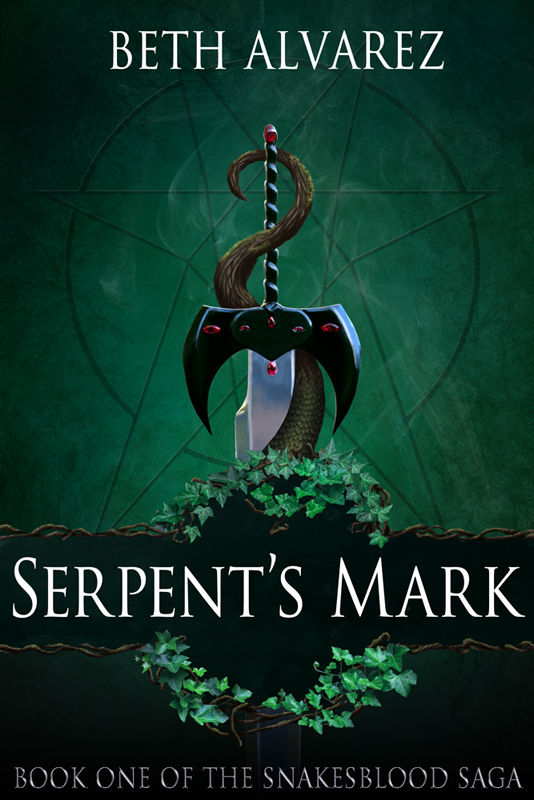
    I war with myself a lot on the decision to break it up. It’s easier to present to traditional publishers, and easier to turn into a readable paperback if I take an independent publication path. But it’s hard to stop thinking of the book as three books instead of six, because it’s been three in my head for half my life. I even had visions of covers in my head. The first book was to be green, the second blue, and the third red. I made a cover mock-up for the first, featuring Rune’s sword with a vine coiled around it, the bark turning to scales. I kept it to myself for several years, using it as something to encourage myself with as I slogged through each draft of the book.

    Serpent's Mark cover mockupBut no matter how the book ends up reaching readers, it won’t be the cover used. If I go with a traditional publisher, I won’t have any say in the cover, and if I go independent, I know now that “iconic” covers rarely perform well and I’m better off having one of the characters front and center. Might as well share the rough mock-up. I even changed the text on the front to try to sell myself on the title change that went along with splitting the first book.

    While I’m feeling better about the choice to break it in half these days, I’m still mired in revising (or re-re-re-re-re-re-re-revising, as it happens) and publication is a long way off. But learning what I have about the publishing industry, its current practices, and the way they treat their authors, I’m less confident than ever about traditional publishing and strongly feel like independent is the better option for me. I never would have signed a contract that required me to surrender my rights to the world and characters I’ve created, and my aggressive desire to have say in things like the covers and how the print books look means I’m probably better off doing things on my own, anyway. It will still be a quality book, with pretty pictures, beautiful formatting, and a whole team of skilled editors. I just want to take my time and make sure everything is done right, no matter which way it reaches the market.

    Yet I also don’t want to sit forever, waiting for a contract offer that probably wouldn’t meet my desires, anyway. Were I to sign a contract for this book today, it would not hit shelves for around two years. I don’t want to wait that long, but I guess I may if that’s what’s necessary. I just have to accept that I can’t have it both ways.

  • Her Midnight Wedding now available in paperback

    I won’t lie–I’m a paper book lover. Not only do I like paper books, I like attractive paper books. Bad spacing and too-tiny-to-read fonts drive me crazy. I like hyphenation and pretty chapter headers. And because I’m a control freak, that means fine-tuning the book over the course of many weeks to get it the way I like it.

    As a result, Her Midnight Wedding is only just now available as a paperback, two months after the digital book’s release. The digital edition has been freshened up, too, and it’s ready for new readers.

    Ready to get your copy of Her Midnight Wedding in print? You can grab it over here on Amazon in eBook or print. The print edition will be available through other retailers, such as Barnes and Noble, soon.

    Want an early look? Here’s a video unboxing of the first print proof of Her Midnight Wedding! Just ignore the obvious errors… it’s a proof copy for a reason.